
AI poses ‘biggest challenge’ to young people’s mental health, expert warns
Subscribe to Independent Premium to bookmark this article
Want to bookmark your favourite articles and stories to read or reference later? Start your Independent Premium subscription today.
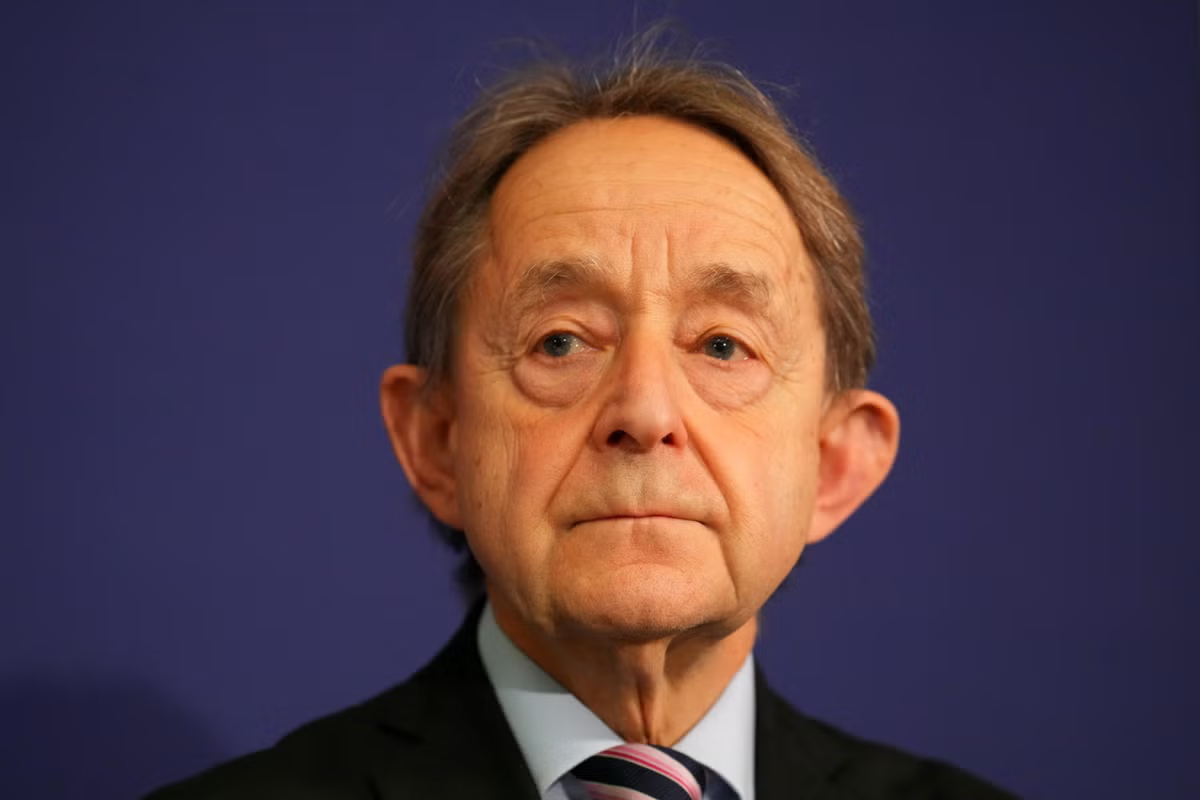
The educational promise of artificial intelligence is currently being "squandered", while the technology poses the "biggest challenge" to young people’s mental health, a leading historian has warned.
Sir Anthony Seldon, a former private school headteacher and co-founder of the group AI in Education, warned that the potential for harm is "immeasurably greater than from pre-AI social media".
Writing in The Times, he stated that the technology also presents serious risks "to intellectual rigour and to the integrity of assessment".
Sir Anthony directed sharp criticism at the official response to the issue: "You might expect strong and decisive leadership from the government on AI in education. You’d be surprised," he wrote.
"Britain ranks close to the bottom internationally on AI in schools. Too little, too miniaturist and too late characterises the response.
"School leaders, governors, teachers, parents and pupils are bewildered and are crying out for guidance."
His remarks follow a publication co-authored with tech entrepreneur Tim Bunting, calling on the Department for Education (DfE) to set up a "rapid response team" to "revolutionise" its approach to the sector.
"The biggest risk of AI is not that it pulls the plug on humanity but that, without rapid government intervention, it will choke and not liberate the minds of our young people," Sir Anthony said.
The advisory organisation AI in Education offers guidance to schools on which technological developments are likely to prove beneficial and which may cause damage.
Sir Anthony has previously suggested that artificial intelligence could swiftly reshape modern classrooms, while cautioning that institutions must ensure tools do not "dehumanise" students by restricting face-to-face interaction.
In 2025, he told the Press Association: "It will be such a different world because the heavy lifting and a lot of the learning can be done on the screen, sometimes in a lesson where you’ve got all the kids on a screen, sometimes in smaller spaces."
His comments coincide with findings from the Organisation for Economic Co-operation and Development (OECD)’s Programme for International Student Assessment (Pisa), which examined teenage AI adoption globally.
"Overall, you can say the more AI is present, the worse the country performs," Andreas Schleicher, OECD education and skills director, stated earlier this month.
However, he noted that outcomes depend heavily on how pupils use the technology, explaining: "You do not get fit by watching sports," he said.
"In the same way, you do not learn by consuming content. Learning is always about effort, that’s the only way you build your brain cells, by investing energy, by investing by cognitive struggle.
"Where AI enhances that cognitive struggle is great. Where AI undercuts that cognitive struggle by making things easier for you, task performance increases but results do not, learning does not."
Responding to the concerns, a DfE spokesperson said: "Our guidance is clear that AI must be used safely, responsibly and effectively in education – any technology should enhance, not replace, the deep thinking, creativity and critical engagement that underpins effective learning.
"Equally, part of keeping children safe means ensuring that all young people develop the digital knowledge they need to use these technologies responsibly."
The department added that it is investing £23 million to determine which digital tools deliver the "greatest impact in schools", alongside broader plans to reform the national curriculum and assessment framework.
Related Stories
 AI News
Global biotechnology company Amgen is using artificial intelligence (AI) in the entire process of de..
24 seconds ago
 AI News
Deakin University GIFT City Campus Launches Master of Applied Artificial Intelligence (Professional) for Indian students
40 seconds ago
 AI News
Anthropic, OpenAI, Microsoft and other AI companies scared of their own AI models get blunt advice from W
1 hour ago
 AI News
US and China Hail Talks as Positive Ahead of Trump
1 hour ago
 AI News
Wall Street Journal Hires Max Zeff to Cover Artificial Intelligence
1 hour ago
 AI News
US and China discuss AI safety plan ahead of Trump
1 hour ago
 AI News
Kakao Consortium, which has developed "Everyone's Artificial Intelligence (AI)" service, presented a..
2 hours ago
 AI News
Revelion, an artificial intelligence (AI) semiconductor company, announced on the 21st that its neur..
2 hours ago