
AI and the Risk of Synchronized Blindness
AI and the Risk of Synchronized Blindness
What happens when AI teaches us all to think the same way?
Updated June 12, 2026 | Reviewed by Tyler Woods
I've spent considerable time focusing on what AI does to individual thinking. From the student who stops struggling to the professional who stops trusting their own judgment, it's been eye-opening. And while these are real concerns, there may be something bigger going on.
Here's the key question. What happens when millions of individuals make the same "cognitive trade" simultaneously? It's not a failure of any single mind, but one that manifests in the aggregate.
Generally speaking, complex systems don't self-correct through consensus. They self-correct through the productive friction of people who see things differently. And when that happens, they arrive at different conclusions for reasons they sometimes may not be able to fully articulate.
Markets are an excellent example. A financial market isn't, at its core, a calculation. It is a mechanism for aggregating divergent human judgment. The buyer and seller in any transaction disagree about value. That disagreement isn't a flaw in the system, it is the system. Remove the friction and you don't get a smarter market. You get a more fragile one.
Science, medicine, and markets all depend on the same hidden and very human asset. They are full of people who look at the same evidence and arrive at different conclusions. And that may be valuable beyond measure.
A calculator extended our ability to compute. A search engine expanded our access to information. Neither reached into the architecture of how people form judgment.
AI does. And once it does, a spiral begins. When the same models, trained on the same data, processing the same inputs, inform the risk assessments of investors, the diagnostic reasoning of physicians, and the editorial judgment of writers, something structural shifts. The individuals remain. The diversity leaves. And as it leaves, the work those people produce becomes more similar. And that feeds the next generation of models, which narrows the range further.
I've written about cognitive surrender—the way individuals hand over judgment to AI not because it's hard but because it's easy. I've written about model collapse, what happens when AI trains recursively on AI-generated data and originality is averaged away. Synchronized blindness is both of those things happening simultaneously, at the population level. Not one person surrendering, but everyone converging.
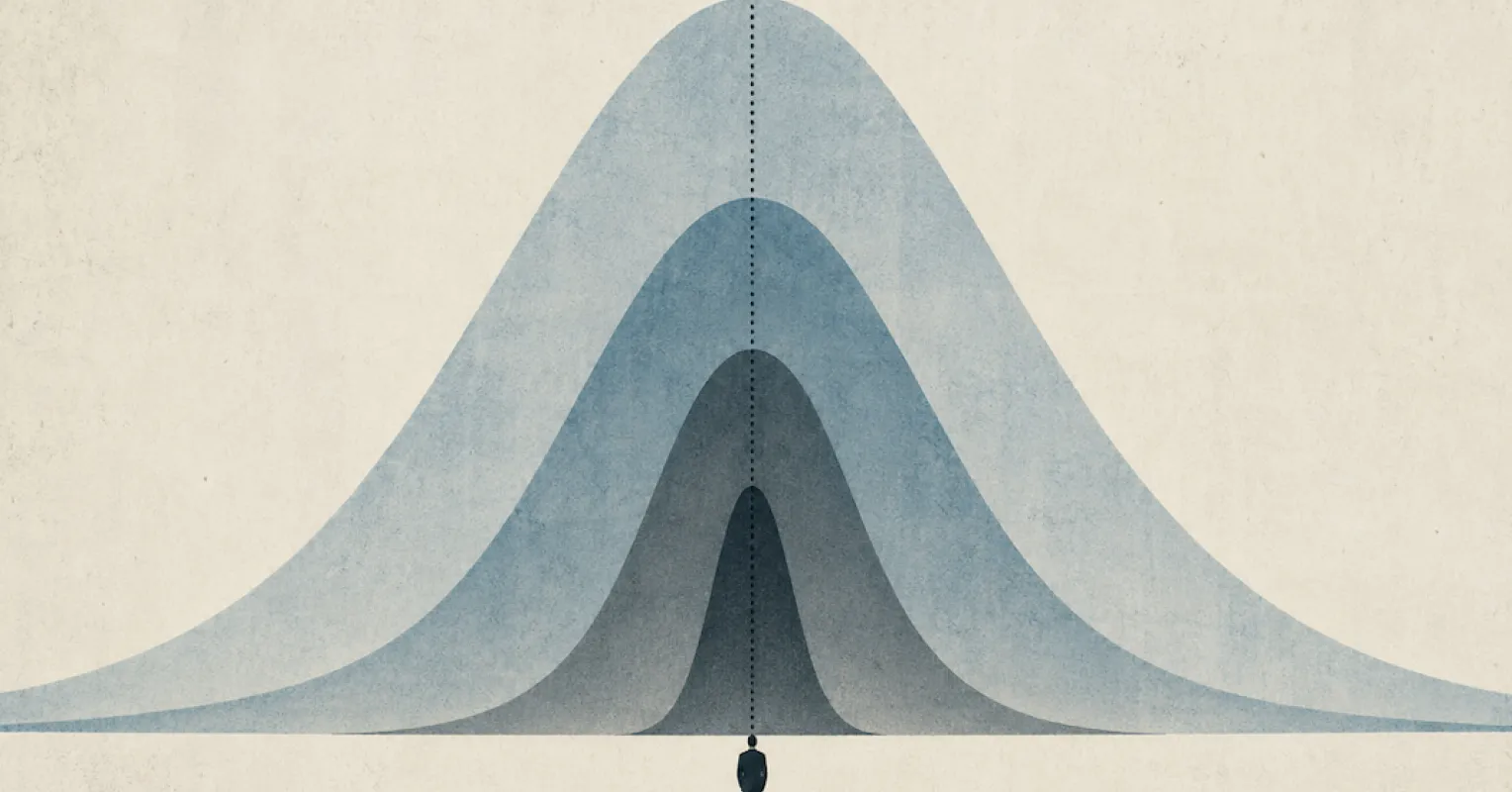
My point here is that the statistical tails matter. Financial bubbles, intelligence failures, medical assumptions that persisted long after the evidence contradicted them. These weren't failures of information. They were failures of perception. Enough people looking at the same facts and missing the same thing at the same time. In markets, the experienced investor who senses something wrong before the data confirms it is operating from pattern recognition built through the memory of what a bad position actually costs. That knowledge lives somewhere models don't reach. It can't be extracted and encoded. It has to be earned.
When that kind of perception disappears from a population of participants, the system loses its early warning capacity. The anomalies that a sufficiently diverse field of human judgment might have caught become lost. And it's not because they aren't there, it's that the apparatus that could sense them has converged around the mean. No tail, no tell.
The Systemic Risk We're Not Measuring
We have frameworks and clinical instruments for measuring individual cognitive decline. We have very few for measuring this narrowing of collective perception. This is a hidden problem because the risk that synchronized blindness poses isn't visible at the individual level. Each person, using their convenient and brilliant AI tools, may be performing better than before. The aggregate, simultaneously, may be seeing less.
AI doesn't just change how individuals think, it changes what we can perceive. And when that perception narrows collectively, the risk isn't that AI fails us. It's that we all start missing what matters, at the same time, without knowing it.
Related Stories
 AI News
World's first patient to undergo live AI
1 hour ago
 AI News
Nvidia discussed buying AI startup Hugging Face: report
1 hour ago
 AI News
Nvidia CEO Says AI Is Already Productive, Not Just Promising
1 hour ago
 AI News
Bill Gates says world unprepared for 'turbulent AI era'
1 hour ago
 AI News
Meta’s plans to replace workers with AI fell flat, report says
1 hour ago
 AI News
Unexpected chat between OpenAI bots led to Hugging Face hack
2 hours ago
 AI News
Bill Gates diagnoses problems with AI, but an expert questions his prescription
2 hours ago
 AI News
Top WSJ Editor Approves AI
3 hours ago