
Abandoned housing camp from Tuktoyaktuk's oil boom era torn down
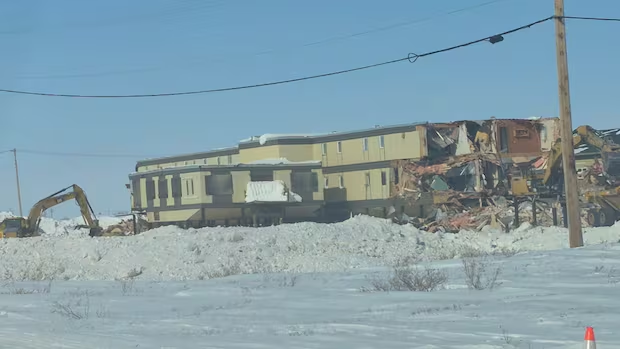
Abandoned housing camp from Tuktoyaktuk's oil boom era torn down
'An eyesore, a fire hazard and dangerous to kids,' CEO of E. Gruben’s Transport said of the building
A derelict housing camp that stood along the road into town as a reminder of Tuktoyaktuk’s oil boom era has been demolished.
Contractor E. Gruben’s Transport, which owns the site where the camp was located, began taking it down in the spring and completed operations this month, depositing debris in the local landfill.
Gruben’s CEO Russell Newmark told CBC News the derelict building was “an eyesore, a fire hazard and dangerous to kids.” He said the usual steps were taken to safely remove hazardous waste, including asbestos and mercury-based industrial lighting, before it was taken down.
Constructed in the 1970s and 1980s by Dome Petroleum as part of a larger site that still remains, including warehouses and storage tanks, the camp was used as office space and housing for the company’s employees.
Dome Petroleum, a Calgary-based energy company, was there with financial backing from the Canadian government to carry out exploration and oil drilling operations in the Beaufort Sea and the Mackenzie Delta.
Able to withstand harsh weather and shifting permafrost on the edge of the Arctic Ocean, it included an industrial kitchen, a darkroom for developing photos, a billiards room and a small theatre.
Doug Matthews, now an energy analyst, was working for the territory in economic development in 1979. He spent five years trying to develop locally-owned businesses that would support Dome’s operations.
“It was pretty basic, there was no TV in those days, we dealt with shortwave radio and stuff like that. There was no road, obviously, so there was air traffic back and forth, or the winter road. You were kind of on the edge of the world," Matthews recalled to CBC News.
“At the same time,” he continued, “the technology that was being developed by the oil companies for drilling in the Beaufort really was leading edge technology. It was unique in the world."
However, when the boom times went bust in the late 1980s, Dome’s operations collapsed and the workers left town, leaving the camp largely frozen in time.
A second oil exploration camp known as Tuk Base was built around the same time by Imperial Oil just across Tuktoyaktuk Bay. That site was entirely demolished after Imperial wound down operations and has undergone a years-long remediation and restoration process.
With the opening of the all-weather Inuvik-Tuktoyaktuk Highway in recent years, the Dome Petroleum camp’s broken and boarded up windows became a draw for both vandals and the curious alike. One YouTuber’s video of his walk through of the site posted in 2024 has garnered more than a quarter million views.
Newmark noted that the increased attention was a factor in the decision to tear the building down.
“We have had continual break-ins and vandalism to these buildings for the past several years. Part of why we decided to demolish the buildings is that we were concerned that kids breaking in may get hurt or start a fire.”
Now that the building is gone, Newmark says Gruben’s has no further plans for demolitions at the site, and will continue to use remaining buildings to store its equipment and supplies.
CBC reached out to the territorial Department of Environment and Climate Change (ECC) for comment on the tear down.
In a statement, ECC spokesperson Dana Bowen said they were monitoring the situation and would “take appropriate action if any non-compliance is identified.” The department is responsible for ensuring projects like this are following environmental legislation in relation to waste management, hazardous material handling and contamination.
CBC also reached out for comment from Tuktoyaktuk Mayor Vince Teddy and the Hamlet council but has not received a response.
Niles Niemuth has more than decade of experience in digital journalism, reporting on and editing stories covering politics, public affairs, labour and community issues across Canada and the United States. You can reach him at niles.niemuth@cbc.ca.
Related Stories
 Technology
When Tech Companies Die, What Happens To The Products They Leave Behind?
1 day ago
 Technology
Two Finns supplying Russia with missile tech worth tens of millions
1 day ago
 Technology
Drones with pepper spray, four
1 day ago
 Technology
Micron Technology stock pre-market at EUR 800.50: memory storage - ad
1 day ago
 Technology
TAIEX Ends at 4
1 day ago
 Technology
ZAWYA: Technology, start-ups can double India
2 days ago
 Technology
Czech government to consider CZK 1 billion fund for startups
2 days ago
 Technology
GDIN Supports Eight Startups at CEATEC 2026 in Japan, Opens Door to Local Investor Collaboration
2 days ago