
A Trump adviser's outburst and a new poll suggest Canada’s tariff strategy is landing
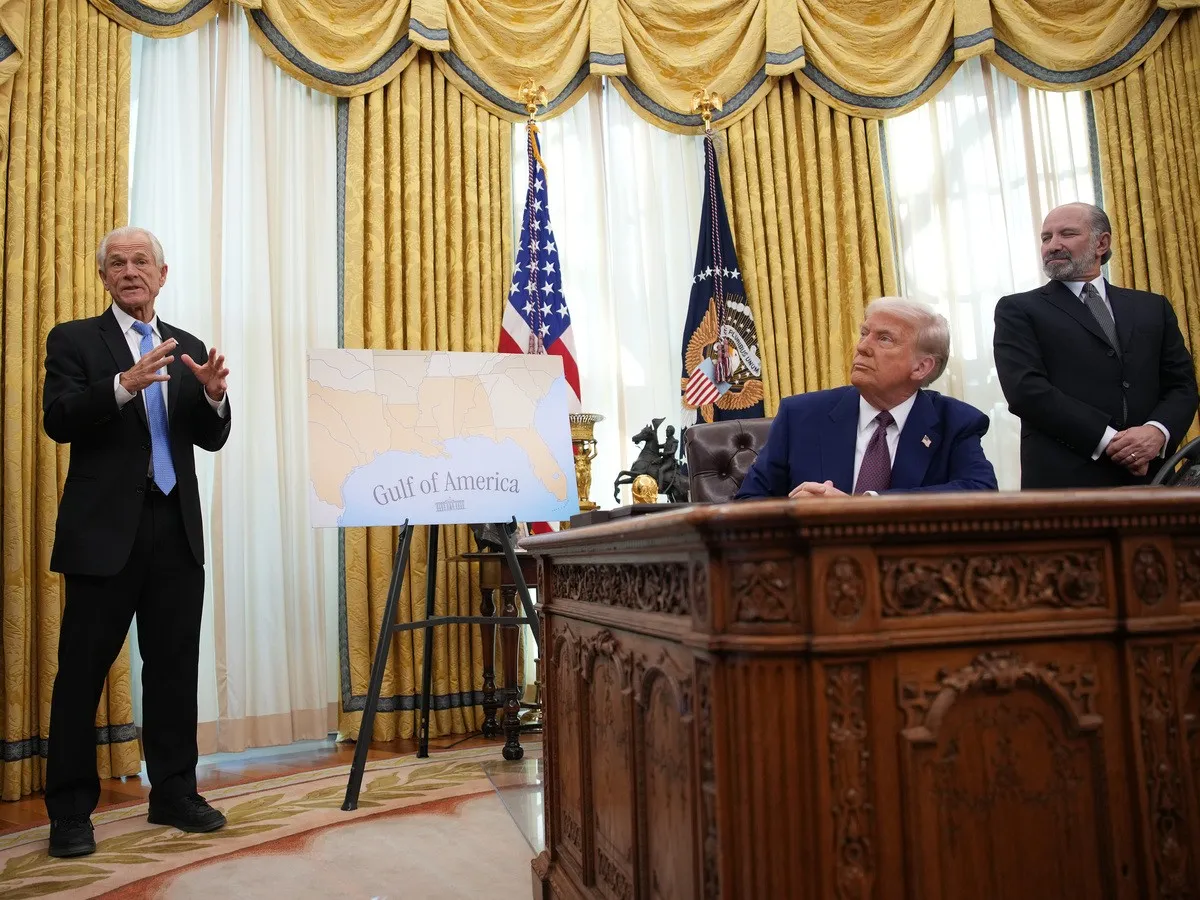
WASHINGTON, D.C. — If Canada is betting that Trump’s tariff fight and Ottawa’s retaliation will exact political costs on U.S. President Donald Trump and Republicans in November’s midterms, it may be onto something: a senior Trump adviser just signalled that the White House sees the Canada-U.S. trade spat as politically sensitive.
Speaking at an economic conference in Washington on Tuesday, Trump’s trade adviser Peter Navarro had a few choice words for Canada. He likened the country to a rowboat and the U.S. to an aircraft carrier before asking whether any Canadians were in the room.
Addressing them, Navarro said: “If you’re on K Street, get the hell out of our country because the problem you have is you lobby this country, and you’ve been successful in the past, and you think you can keep doing that.”
The world gets it now: tariffs bring countries to the table.Everyone lined up to negotiate. Canada? They showed up with lobbyists.Message to them? Get the hell out. pic.twitter.com/JES6qaHZZl
“Memo to Canada: You cannot do that. Okay, the game is up, and if you interfere in our elections in Maine or Michigan, you will pay even more dearly.”
Navarro offered no evidence that Canadian lobbying or retaliatory tariffs amounted to election interference. But by naming the Pine Tree and Great Lake States, both of which have close economic ties to Canada and consequential Senate races, he underscored the administration’s apparent concern about the dispute’s political effects.
The administration may have reason to be concerned. In a newly released survey, the Cato Institute and Morning Consult found that 75 per cent of registered U.S. voters said tariffs, defined in the poll as a U.S. tax imposed on imported products, would be important to their vote.
While few issues draw bipartisan backing these days in the United States, Democrats were not alone in feeling hard done by tariffs. According to Emily Ekins, vice president for policy and society and the director of polling at the Cato Institute, nearly two-thirds of Republicans also said tariffs imposed under Trump had increased prices.
“We were very clear in asking, ‘Are tariffs affecting the prices of things you buy at the store?’” she explained.
“Seventy-four percent of all Americans agree with that, and nearly two-thirds of Republicans did too,” she said (as did 73 per cent of independents and 84 per cent of Democrats).
Andrew Hale, senior fellow at Advancing American Freedom, says the price effect could become especially potent in working-class regions where Trump won former Democratic voters by promising economic relief. Based on recent conversations with Republican campaign staffers, he said voter anger over tariffs is registering.
“The campaign is being won or lost on tariffs, which is seen to be raising prices,” Hale said.
Pollsters, however, are less convinced that tariffs alone will lead to specific voting decisions.
Kyle Kondik, managing editor of Sabato’s Crystal Ball, a nonpartisan election forecasting newsletter, says it has more to do with the economy overall.
“I would just view it as sort of a subset of the larger affordability issue,” said Kondik.
Andrew Smith, director of the UNH Survey Center, agrees.
“Tariffs are, I think, one factor in that, but it’s really just the state of the economy,” he said.
He says tariffs are less of a standalone trade-policy issue than a shorthand for voters’ broader anxiety about the cost of living. He also doubts Americans really understand tariffs.
“I don’t think that people could frankly tell you what a tariff is or what it does,” he said.
But on this, Ekins pushed back, inferring that Trump has been using his favourite word, “tariffs,” a lot over the past two years.
“Ordinarily, trade and tariffs have very little to do with people’s vote. But here’s the difference: Donald Trump has made trade and tariffs his signature economic policy,” she said.
“This year, tariffs are on the ballot because now people think of tariffs as being, ‘You’re raising my prices.’”
While Hale believes some working-class people who were once Democrats and voted for Trump will go back to voting Democrat, the pollsters disagree. They say no matter how frustrated they are by higher prices, most Republicans are about as likely to vote for Democrats as Maple Leafs fans are to start cheering for the Canadiens.
Instead, how Republicans fare will come down to one thing: turnout.
Will Republicans show up on election day? “The hardcore ones will, but the more modestly Republican are the ones that are least likely to show up,” Smith said.
Ekins echoed this. “I don’t expect them all to rush to the Democrats. They’re going to sit at home and not turn out to vote in the midterms.”
Americans still like the idea of using tariffs to support domestic manufacturing, Ekins said, but they are far less enthusiastic about paying higher prices for it.
That reluctance is especially pronounced when the target is Canada. In the Cato/Morning Consult survey, 56 per cent opposed tariffs on Canadian goods — the strongest opposition among the countries tested. Meanwhile, majorities of 57 and 60 per cent, respectively, supported tariffs on China and Russia.
Ekins explained that U.S. voters seemed willing to accept tariffs when the duties are framed as a national-security tool against adversaries, not in trade with close allies.
“Canada is the one country Americans do not want to put tariffs on,” Ekins said, noting that Britain was a close second.
Kondik agrees, noting, “It’s a lot easier to point the pitchfork at China than it is to point the pitchfork at Canada.”
“Most Americans don’t understand why we’re having a trade war with Canada,” Hale pointed out.
He also noted that Navarro’s stark comments amounted to an effort to blame Canada for voter frustration with the administration’s tariff policy, rather than acknowledging the policy’s political cost.
As for election results, pollsters and trade watchers expect the Democrats to win a majority in the House of Representatives, while the Senate remains a closer call. Kondik puts it at 50/50 for now, but Smith expects the Democrats to also win that chamber.
Hale believes the administration is seriously underestimating how severe a midterm defeat Republicans could be facing.
“I think they’re in for a real pasting,” he said, adding, “I don’t think, quite frankly, this administration has tuned into how potentially horrific this could be for them.”
Our website is the place for the latest breaking news, exclusive scoops, longreads and provocative commentary. Please bookmark nationalpost.com and sign up for our newsletters here.
Related Stories
 Canada
A pilot on a FlyDubai flight stabbed another and apparently tried to crash the plane, Netanyahu says
24 minutes ago
 Canada
South Africa summons U.S. ambassador again over ‘undiplomatic conduct,’ official says
24 minutes ago
 Canada
‘Created in Canada’: How a leading cosmetics brand leans into its roots
25 minutes ago
 Canada
Canadians mark sixth annual National Day for Truth and Reconciliation
25 minutes ago
 Canada
GG marks 6th National Day for Truth and Reconciliation with plea for 'understanding the truth'
25 minutes ago
 Canada
‘Time for a new chapter’: Scott Aitchison officially resigns as Conservative MP
25 minutes ago
 Canada
Reports on what Cornell’s Jane Doe initially told investigators prompt fresh questions in newly reopened investigation
1 hour ago
 Canada
Canadian says Meta won't let her talk to a human after killing her accounts
1 hour ago