
99% of people on Earth will get sunlight at the same time this Wednesday
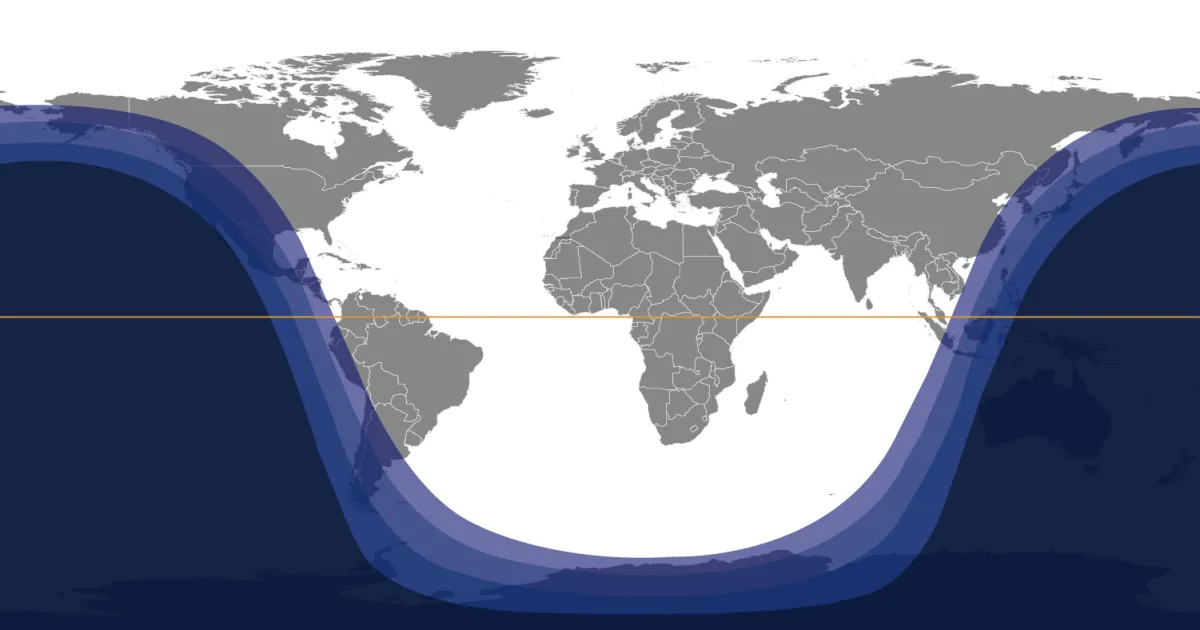
Because of Earth’s tilt and the timing of the Northern Hemisphere’s summer, about 99 percent of the world’s population – some 8.2 billion people – will experience daylight or twilight simultaneously on July 8, at about 11:10 GMT.
For a brief period lasting only about a minute, Earth’s most populated areas will all be under the Sun, with only a small fraction experiencing nighttime.
Daylight will stretch across North America, South America, Europe, Africa and most of Asia, where nearly all of the world’s population lives.
In darkness will be Australia, New Zealand, parts of Southeast Asia and Antarctica, along with the surrounding oceans.
This is not a one-day-only phenomenon. For about 60 days each year, from roughly May 18 to July 17, there is a brief moment each day during which nearly all of humanity experiences either daylight or twilight.
The phenomenon became widely associated with July 8 following a social media post in 2022 claiming it was the only day this occurred, which went viral. A subsequent fact check by Time and Date found that while July 8 is one of the dates when the overlap is greatest, similar conditions occur every day for about two months around the Northern Hemisphere summer.
How many people will experience day, twilight and night?
At the moment when sunlight reaches almost everyone on Earth, about 6.9 billion people (83 percent) will be in full daylight.
Another 581 million (7 percent) will experience “civil twilight”, when the sky remains bright enough for most outdoor activities without artificial lighting.
A further 498 million people (6 percent) will be in nautical twilight, when the horizon is still visible but the sky is much darker, while 249 million (3 percent) will be in astronomical twilight, with only a faint glow left before complete darkness.
Just 83 million people (1 percent) will experience full night, when the Sun is more than 18 degrees below the horizon and the sky is completely dark.
Why does this happen on July 8 rather than the June solstice?
June solstice is the Northern Hemisphere’s longest day, and marks the beginning of summer.
After the June solstice, the Sun begins moving south. This slightly reduces daylight in sparsely populated far northern regions, but extends it further into densely populated areas such as Indonesia and the Philippines.
That small shift brings about 10 million more people into daylight or twilight than on the solstice itself.
Related Stories
 AI News
Tobacco and nicotine
4 minutes ago
 AI News
Liverpool news: Mac Allister's Argentina edge past Salah's Egypt in World Cup epic
4 minutes ago
 AI News
World Cup 2026 quarterfinals: Full schedule and Egypt FIFA dispute
5 minutes ago
 AI News
Nato allies announce £37bn for new missile project
6 minutes ago
 AI News
How Canadian researchers are using 'liquid biopsies' to find traces of tumours left after cancer treatment
6 minutes ago
 AI News
How did people get around Toronto during the World Cup? Here's what the data shows
7 minutes ago
 AI News
They left McKinsey to help businesses fight patent violations. See the pitch deck they used to raise $10 million.
11 minutes ago
 AI News
How EIC-backed startups are turning international exposure into real business
11 minutes ago