
3.8
3.8-magnitude earthquake in northwestern Alberta Thursday startled some residents
AER says no injuries or damage reported from the industry-related quake
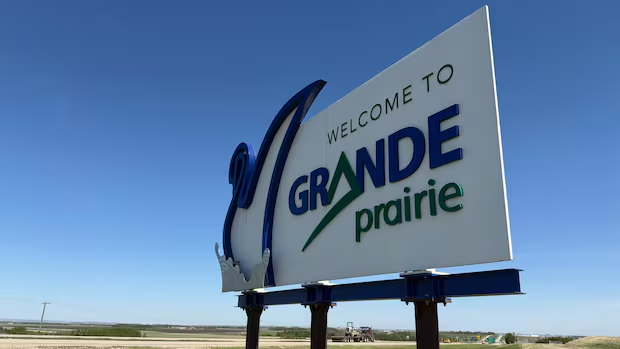
Grande Prairie, Alta., resident Stephanie Brown says it seemed like her whole condo shook Thursday evening.
“From my kitchen area, it sounded like a crack sound in the wall, but there’s no visible damage… and outside, a dog started barking,” Brown said.
According to Earthquakes Canada, a 3.8-magnitude earthquake occurred about 35 kilometres south of Grande Prairie around 6:30 p.m. MT Thursday. It was felt widely throughout the region, with the federal agency receiving more than 30 reports, including a couple from B.C.
“This was, of course, a bit of a large event, but it’s nothing that’s too far out of the ordinary — at least for this region,” said Brindley Smith, a seismic analyst for Natural Resources Canada’s (NRC) Canadian Hazards Information Service.
People may not always notice them, but since 2019, there have been more than 15 events of this magnitude or greater within 50 kilometres of the July 9 epicentre.
For Brown, Thursday marked the second earthquake she has felt in her 13 years living in Grande Prairie, roughly 390 kilometres northwest of Edmonton.
Jason Johnston, a longtime resident of the hamlet of Grovedale, about 20 kilometres south of the city, was closer to the quake site. It startled him.
“I was laying in bed and the whole trailer shook,” Johnston told CBC News.
It sounded like someone stepped onto his deck, he added, but “I look outside and there’s nobody there.”
Johnston didn’t realize an earthquake had actually occurred until he checked Facebook later Thursday evening, he said.
Smith, from NRC, said effects of a roughly 4.0-magnitude earthquake are sometimes felt hundreds of kilometres away.
Earthquakes Canada suspects Thursday’s event to be industry-related. The Alberta Geological Survey, a branch of the Alberta Energy Regulator (AER), has deemed the quake to be “known induced.”
AER Directive 065, which came into effect on March 31, requires companies to engage mitigation protocols when “events” occur, an agency spokesperson told CBC News in an email.
In this case, “the reporting operator has undertaken those mitigation measures,” they said.
Known induced or industry-related earthquakes are common in Alberta, northeastern British Columbia and other oil-and-gas-rich regions, according to Rebecca Swinscoe, a research scientist who works out of NRC’s Geological Survey of Canada.
Fracking and wastewater disposal can induce earthquakes, she said.
“As we inject fluid into those faults and those fractures, the stress inside those zones increases and that causes what's known as slip or failure along those fractures,” Swinscoe said.
Scientists and operators have made “huge technological advances” over the past decade to try to reduce risk of industry-caused earthquakes, but the risk will always persist, she said.
“Yes, it’s not ideal. Yes, it's likely to continue,” Swinscoe said. “But we do have regulations in place that limit the likelihood of those larger magnitude events.”
Eagle Andersen is a reporter for CBC News in Grande Prairie. He previously worked as an associate producer for CBC News in Kamloops, B.C. You can reach him at eagle.andersen@cbc.ca.
Related Stories
 Canada
Canadian seafood industry ’relieved’ with removal of their products from retaliatory tariff list
10 minutes ago
 Canada
Trump downplays subterfuge, risks of Air Force One ruse in Turkiye
1 hour ago
 Canada
Carney says Lake Ontario will not become 'Lake America'
2 hours ago
 Canada
Tornado hit eastern P.E.I. during Wednesday’s storm, Environment Canada says
2 hours ago
 Canada
Five Years of UNMATCHED: Establishing a Foundation of Collaboration and Allyship for Gender Equity in Sports
2 hours ago
 Canada
3 dead after 2 Vancouver Island highway crashes
3 hours ago
 Canada
Canadian firm plans New Brunswick TNT plant to double NATO’s explosives supply
3 hours ago
 Canada
Loblaw is bringing back country of origin labels amid ‘Buy Canadian’ push
4 hours ago