
2 startups failed, house mortgaged, still built Rs 11,000 crore Spinny: How Niraj Singh turned an idea...
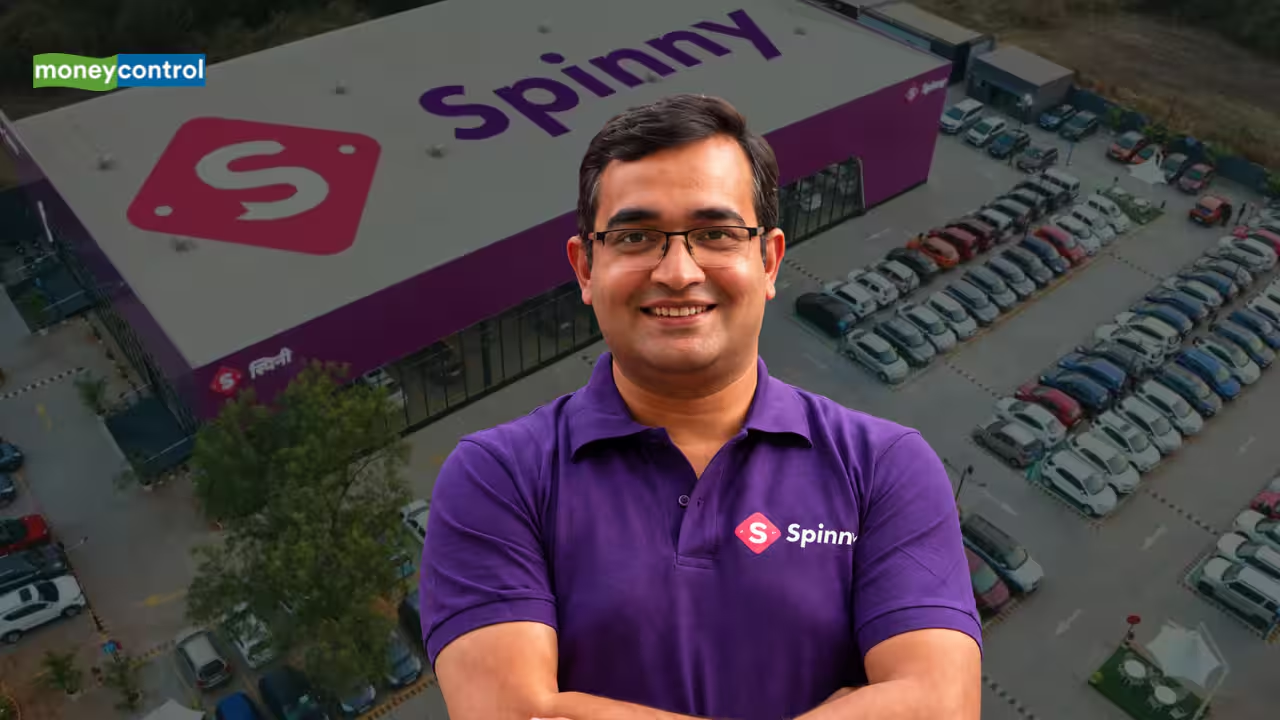
2 startups failed, house mortgaged, still built Rs 11,000 crore Spinny: How Niraj Singh turned an idea investors called 'suicide' into a unicorn
Born and brought up in Daltonganj, Jharkhand, Niraj Singh was a bright student. He consistently topped his class and cleared the IIT entrance examination on his first attempt. He initially joined Roorkee for architectural engineering in 2002, but a year later, he took the engineering entrance examination again and moved to IIT Delhi to study electrical engineering.
His professional journey, however, was very different from his academic record.
His first startup, Locus Education, shut down in February 2011. He later started TechMonkey, a content aggregation and distribution platform, but that venture too closed in December 2014.
"I never had any room for failure," Singh recalled in an interview with Forbes India, reflecting on the contrast between his academic success and his early entrepreneurial setbacks.
Yet, those failures eventually led him to the idea that would become Spinny.
By early 2015, Singh was preparing to start his third venture. His proposed market was used cars, a sector that was already crowded with established players.
The response from investors was blunt.
"Why do you want to commit suicide?" one venture capitalist asked Singh after learning about his plans.
Another warned him against believing that a David-versus-Goliath strategy would work. The market already had companies such as Cars24, CarDekho, Droom and CarTrade competing for customers and inventory.
An angel investor who had backed Singh's second startup also reminded him of his track record: eight years of entrepreneurship, but no successful exit or large-scale business to show for it.
The criticism was not merely coming from investors. He was also taking a significant personal financial risk to keep his entrepreneurial journey going.
There was a phase when he had to mortgage his house and take a personal loan to manage his expenses. He also sold his car to help fund the business. With two startups already shut down, he was effectively putting his own finances on the line for a third attempt.
Yet, he went ahead, and in June 2015, he launched Spinny.
Spinny initially started as a certified consumer-to-consumer marketplace for used cars. But Singh soon realised that simply connecting buyers and sellers would not solve the biggest problem in the market: trust.
In March 2017, Spinny pivoted towards a full-stack business-to-consumer model, buying used cars, refurbishing and certifying them, and selling them directly to consumers.
At the time, many used-car platforms were primarily focused on the supply side. Better prices could attract sellers, but that did little to address a buyer's concerns about a vehicle's quality, documentation, pricing and overall purchase experience.
Spinny instead focused on controlling more parts of the customer journey, from inspection and refurbishment to financing, documentation and delivery.
The strategy eventually attracted major investors. Spinny became a unicorn in November 2021 after raising its Series E round.
The company has since raised about $698 million across multiple funding rounds, with investors including Tiger Global, Accel, Avenir Growth, Elevation Capital, WestBridge, General Catalyst, Fundamentum and cricketer Sachin Tendulkar.
Its valuation, however, has moved sharply over the years. As per Tracxn data, Spinny was valued at around $2 billion following its March 2025 Series F round, before subsequent fundraising rounds reset the valuation lower. Its December 2025 Series G round valued the company at roughly Rs 11,189 crore, or about $1.24 billion.
According to its consolidated financials available on Tracxn, Spinny's parent Valuedrive Technologies reported revenue of Rs 4,746.26 crore in FY25, up from Rs 3,822 crore in FY24. Revenue stood at Rs 3,381 crore in FY23, Rs 180 crore in FY22 and Rs 40 crore in FY21.
However, the company remains loss-making. Its consolidated net loss narrowed to Rs 423.82 crore in FY25 from Rs 590 crore in FY24 and Rs 820 crore in FY23.
Spinny now operates as a used-car retailer combining an online platform with physical hubs. Cars are inspected and refurbished before being offered to customers, while the purchase process includes services such as financing, documentation, home delivery and a return window.
As of February 27, 2026, the company was valued at about Rs 11,623 crore, or roughly $1.28 billion.
From two failed startups and investors questioning his third attempt to building a business with thousands of crores in annual revenue, Niraj Singh's journey with Spinny has been less about avoiding failure and more about building after it.
Discover the latest Business News, Sensex, and Nifty updates. Obtain Personal Finance insights, tax queries, and expert opinions on Moneycontrol or download the Moneycontrol App to stay updated!
Find the best of Al News in one place, specially curated for you every weekend.
Stay on top of the latest tech trends and biggest startup news.
Related Stories
 Technology
Vande Bharatam concludes: MiCoB wins ₹50 lakh, startups secure ₹50 crore in investment offers
8 minutes ago
 Technology
As Software VCs Chase SpaceX Alumni, A Defense Tech Veteran Warns Of ‘Tourists And FOMO’
8 minutes ago
 Technology
Clere Golf introduces new course
8 minutes ago
 Technology
New spinout IMS Solutions launches to commercialise groundbreaking ‘steroid fingerprint’ technology
8 minutes ago
 Technology
Flipkart Big Billon Days all PHONE deals details | Automotive and Technology
1 hour ago
 Technology
A crushing test raised silver recovery to 65% at a Mexico project. Chesapeake Gold ran it.
1 hour ago
 Technology
REG - Big Technologies PLC
1 hour ago
 Technology
5 days left to save up to $200 on your Disrupt 2026 ticket
2 hours ago