
2 Education Startups Help Raise The Bar As Students’ Math Scores Plummet In India
2 Education Startups Help Raise The Bar As Students’ Math Scores Plummet In India
Data from the PARAKH Rashtriya Sarvekshan 2024 conducted by NCERT showed that average math scores fall steadily as students move to higher classes.
Published : October 8, 2026 at 8:49 PM IST
New Delhi: Two education startups are trying to arrest the trend of decline in students' math scores, with data by the NCERT showing that weak foundations in the subject remain one of the key challenges in Indian school education.
Data from the PARAKH Rashtriya Sarvekshan 2024, conducted by NCERT, which was earlier known as the National Achievement Survey (NAS), has shown that average math scores fall steadily as students move to higher classes. The dip is from 60 per cent in Class 3 to 37 per cent in Class 9. Educators have attributed this to rote memorisation.
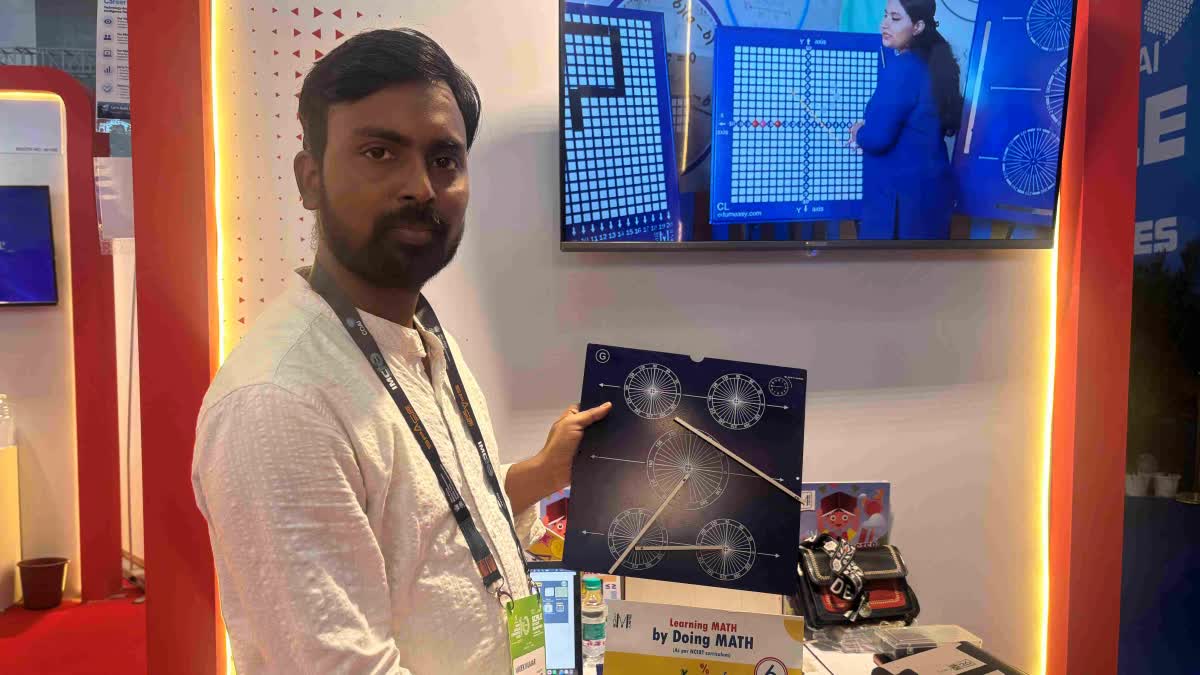
In the backdrop of this, two startups at the India Mobile Congress (IMC) 2026 at Yashobhoomi, the India International Convention and Expo Centre, EduMEasy and Wooda, have exhibited activity-based tools that aim to address the problem. Both seek to focus on innovation and the experience of the students rather than memorisation as a mode of study.
Delhi-NCR-based EduMEasy was founded by a group of IITians who wanted to end maths phobia among students. Co-founded by Vivek Sahu, the startup has set up math labs in over 500 schools across the country.
Sahu said the company's philosophy (Education Made Easy) is to ensure that math is learnt by not merely memorising. He demonstrated this with probability on the “Fraction and Probability Board” where a circle is filled with coloured magnetic plates. “If 3 of the 10 plates are red and 4 are green, the child can see that the chance of picking red is 3/10 and green is 4/10,” he said, adding that a tricky topic turns into a colourful puzzle.
"Teachers are given manuals in Hindi and English, and every class has its own workbook, such as Learning Math by Doing Math for Class 6, which follows the NCERT curriculum. The EduMEasy App adds practice and quizzes for Classes 1 to 10," said Sahu.
"The idea is to make children curious. Instead of asking what is the answer?, they begin to ask what if?, try different routes and even invent their own variations," Sahu added.
A few stalls away, Rohan Parulekar, founder of Wooda, an innovation-driven education brand by Arlin Ventures, is showcasing a set of patented, multi-sensory learning systems to the young people. He said that if children can hold something in their hands, they are more likely to remember it.
Parulekar said, "Children often memorise math before they understand it." "Using physical pieces, children discover number sense, addition, subtraction, multiplication, division, fractions, factors and patterns through play. They also build logical thinking, spatial reasoning and creativity. The system is aligned with the NCF 2023, which promotes learning by doing."
He also explained about the Braille-integrated design that allows visually impaired children to learn alongside their classmates. Further elaborating, Parulekar said that children place wooden blocks, each marked with a letter or symbol, into a smart base. "When they spell a correct combination such as 'Red Apple' or 'Big Dog', they hear a voice cheer them on. Each block holds a passive RFID tag, and the base plays spoken audio and positive feedback. A companion app lets parents and teachers choose languages, track progress, and unlock new word themes that encourage communication, creativity, and critical thinking," he said.
Parulekar said thirteen blocks stand for the notes of an octave, and the height of each block matches its pitch. "Children stack and arrange them to understand how notes relate and how scales are built. Each block carries an RFID/NFC tag, and a smart base gives instant audio feedback and prompts such as 'Build a Major Scale' or 'Match This Rhythm'. Music becomes a hands-on, screen-free activity," he said.
Related Stories
 Technology
Karnataka’s sting operation politics: threat of a video is half the battle
1 hour ago
 Technology
Big tech can’t ‘tell us what to do,’ Carney says on Musk’s separatism talk
1 hour ago
 Technology
Autonomy, space and logistics startups detail their newest capital raises
1 hour ago
 Technology
Legasea Launches Subsea Basket Rental Program
1 hour ago
 Technology
Too many quantum startups, too little money to keep them alive
2 hours ago
 Technology
TVS Motor Makes European Track Debut at Misano | Automotive and Technology
3 hours ago
 Technology
GenScript Launches Life Sciences Startup PitchFest with NVIDIA to Accelerate Biotech Innovation
4 hours ago
 Technology
Dalhousie Demo Day showcases student
4 hours ago