
Yukon remains only place in Canada where residents have no legal right to municipal records
Yukon remains only place in Canada where residents have no legal right to municipal records
Published 2:30 pm Thursday, July 2, 2026
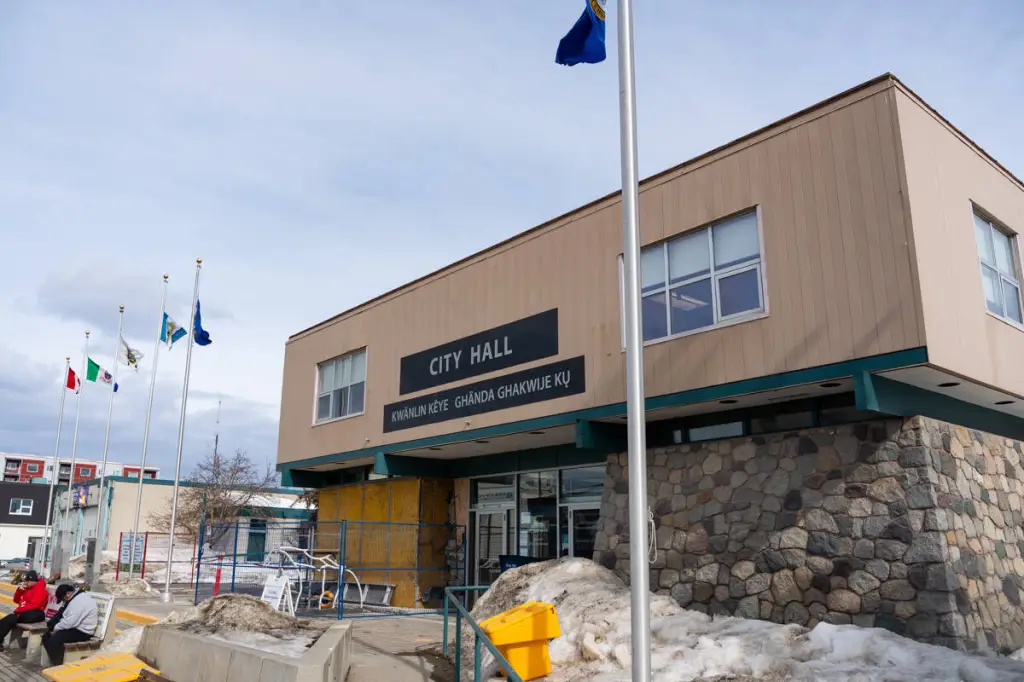
Whitehorse City Hall seen under renovation on Tuesday, April 7, 2026. (Noah Korver/Yukon News)
The Yukon stands alone in Canada as the only jurisdiction where no municipality is covered by access‑to‑information laws, leaving residents with no legal right to obtain internal records from city halls.
That gap places the Yukon outside national norms, said Toby Mendel, executive director of the Centre for Law and Democracy, who noted every province and both neighbouring territories have at least written municipalities into their access‑to‑information laws.
Mendel said the Northwest Territories and Nunavut amended their laws in recent years to allow municipalities to be designated as public bodies, even if neither has yet taken the final step.
“There has been a recognition that municipalities should probably be covered,” Mendel said in an interview.
Transcripts from the N.W.T. Legislative Assembly show MLAs debating those changes in 2019 and 2021, describing them as part of a larger effort to modernize transparency rules. The amendments created a pathway for cities like Yellowknife and Inuvik to eventually fall under territorial access laws.
The Yukon’s Access to Information and Protection of Privacy Act, passed in 2018, does not include municipalities in its definition of public bodies. The accompanying regulation outlines designated public body entities, none of which are municipal governments.
That means residents cannot file formal requests for emails, memos or other records held by the City of Whitehorse. When the News attempted to do so, the city’s acting communications manager replied that municipalities are not designated public bodies under that legislation and are therefore not subject to its provisions.
Mendel said the absence of municipal coverage has real‑world consequences.
“Without one of those laws, they can just refuse you anything,” he said.
“Municipalities are a very important level of government.”
Mendel pointed to conflicts‑of‑interest records as one example. In other jurisdictions, those documents can be requested under access laws. In Whitehorse, councillors declare conflicts verbally at meetings, and the only public record is a note in the minutes.
The Yukon government says the act was designed with flexibility in mind. In a written response, spokesperson Myra Nicks said the legislation allows additional entities to be brought under the Access to Information and Protection of Privacy Act framework through regulation, where appropriate and as capacity and resources allow.
Nicks said some respondents supported extending access‑to‑information obligations to municipalities during the act’s development, but also noted concerns about the strain it could place on small communities. The next legislated review is set to begin in April 2027, she said.
Mendel acknowledged capacity challenges in remote communities but said larger centres should already be included, noting that Whitehorse has a population of approximately 37,000 people.
“There are hundreds of municipalities across this country of a much smaller size than that, and they are still subject to the law,” Mendel said.
He suggested the Yukon adopt a phased approach, bringing larger municipalities under the access law immediately and giving smaller communities a few years, written into the legislation, to build capacity. He pointed to Nunavut, where no municipality has been designated nine years after the law was amended, as an example of the kind of delay the Yukon should avoid.
“A nine‑year delay is not doing the job at all,” Mendel said.
The Centre for Law and Democracy’s ratings show the Yukon’s access law scoring 93 out of 150 points, higher than the N.W.T. and Nunavut, but Mendel said the score reflects the act itself, not its implementation.
“The quality of the laws across Canada is fairly weak,” Mendel said, adding that excluding municipalities is “a remarkable exclusion.”
For journalists, researchers and residents, the gap means limited ability to scrutinize decisions involving land use, development, procurement or conflicts of interest at the local level. Mendel said transparency helps prevent problems before they occur.
”Things start to slip because you can get away with it and nobody notices,” Mendel said.
The Yukon government says the upcoming review will assess whether the act is meeting its intended purposes, including transparency and accountability. Whether municipalities will be added remains an open question the government has not addressed.
Contact Jake Howarth at jake.howarth@yukon-news.com
Related Stories
 Canada
Former premiers urge Albertans to vote to stay in Canada
43 minutes ago
 Canada
Tesla to pause Canadian sales of cheaper Chinese Model 3s
43 minutes ago
 Canada
David Eby defends his family’s use of $10-a
1 hour ago
 Canada
BREAKING: Proof of Canadian citizenship wait reaches 34 months in October, as queue shrinks for the first time
1 hour ago
 Canada
Parts of northwestern Ontario moving to permanent daylight saving time in November
1 hour ago
 Canada
Vote on Alberta’s future brings together former premiers who once sparred in legislature
1 hour ago
 Canada
Prime Minister Carney to attend 2 Forever Canadian rallies in Alberta ahead of Oct. 19 referendum
1 hour ago
 Canada
‘This little bit of perfection’: Canadian astronaut Joshua Kutryk on seeing Earth from space
2 hours ago