
Youth camp organizers coming to grips with new wildfire reality
Youth camp organizers coming to grips with new wildfire reality
Canoe trip participants evacuated by float planes due to nearby blazes
Canoe trip and outdoor recreational organizers are coming to terms with the new reality of persistent and disruptive wildfire seasons that pose a danger to young campers paddling through parts of Manitoba and northwestern Ontario.
"With the constant and just more frequent reality of forest fires and wildfires in the area, we know that we need to take a different approach," says Sara MacArthur, who oversees Camp Stephens, the popular outdoor recreational children's camp administered through the YMCA.
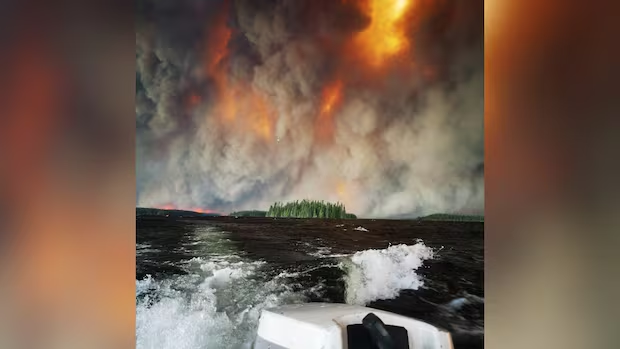
Over the past two days, they've had to evacuate campers on two canoe trips — a boys trip and a girls trip, with no more than 10 people each — because of wildfires in Wabakimi Provincial Park.
Camp staff received word Wednesday morning the Ontario park was going to be evacuated, MacArthur said.
"We had an outfitter who very generously helped to evacuate both our boys and girls trips, and then we ended up taking a float plane — a couple of float planes, actually — with our gear and shuttling our boys and girls trips out of that area," MacArthur said Friday.
"And then they ended up in Sioux Lookout, and then our camp staff went and picked up our trips, and then got them safely to our island at Camp Stevens, just south of Kenora, yesterday."
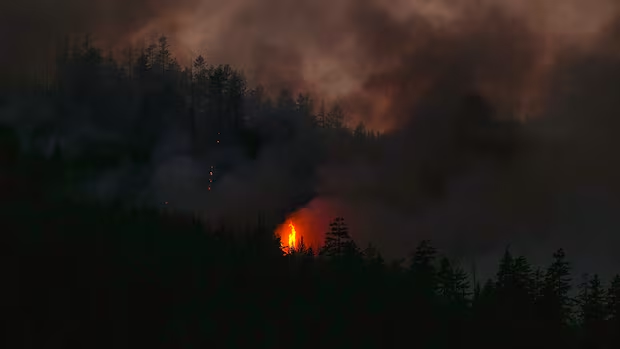
Evacuation orders were issued for many parts of northwestern Ontario as there are currently 165 active fires in northern and northwestern Ontario as of late Friday afternoon, the province's forest fire info map shows.
Jennifer Magierowicz's daughter was two weeks into a Camp Stephens canoe trip before the campers needed to be flown from the area because of the wildfires nearby.
"It's a little bit scary to give your kids over to the care of someone else, and then when something so scary as a forest fire happens. It really — it tends to make you feel a sense of panic," she said.
"My daughter said they could see ash in the air."
Magierowicz's daughter went on a two-week canoe trip at Camp Stephens last year and enjoyed it so much she said she wanted to come back this year and do the four-week trip, she said.
Her mother says the group is now back on the water, rerouted to the Lake of the Woods area to finish off their journey.
Magierowicz worries that as this trend continues — years with fire bans, wildfire smoke, and orange haze – future generations might not get to experience a typical Canadian summer, something she holds dear.
"Having grown up in northern Ontario, for me, this was an important experience for my daughter to have," she said, and her kids might not have the same experience.
"It's a little bit sad when you think about it that way."
Bruce Erickson, an associate professor at the University of Manitoba in the department of environment and geography, says youth outdoor recreation camps are going to have to adapt to a new reality with more frequent, significant and unpredictable wildfires.
"There's going to have to be a set of questions around how far you're going to go, what kind of alternate routes you're going to have and what kind of costs you're going to incur in order to be safe in these areas," he said.
Erickson says camps will have to think about alternative logistics for trips, which routes to take and how frequently to take them, and what timelines they'll need to have for getting people out of areas.
Campers evacuated amid northwestern Ontario wildfires
MacArthur says they've had conversations about how their wilderness program will need to evolve.
"Of course, we will take any means necessary to ensure the safety of our participants, but a big piece of us securing and thinking about our routes is having access points and evacuation points along our routes, which is something that we think of all of the time," MacArthur says.
"So really, it's looking at how we adapt our program to the new realities of climate change."
Erickson says while many living in cities only experience wildfires through periodic spells of smoke and seeing people come from evacuated areas, the impact for people in more remote areas is much greater.
"So, being on a canoe trip where you have to reroute or or get evacuated because of this might make you recognize that the impacts of climate change are really unevenly distributed throughout the country."
Erickson says it's possible that because the fires started in low-priority areas, they "became more pronounced and uncontrollable."
"Many of the areas that these canoe trips go to are not high priority for forest firefighting or immediate detection," he said.
"And, of course, a significant dynamic of that is that First Nations communities are the ones that are most impacted by forest fires and are most often impacted by the impacts of climate change more broadly as well."
Erickson says it's "certainly feasible to start rethinking" how we predict and fight forest fires in remote areas, and the fact these areas are less populated is not a reason to not devote resources to them.
Ford defends Ontario emergency firefighting budget as province asks Ottawa to help with evacuations
Northwestern Ontario Wildfires Latest: Evacuation order issued for area near Lac des Mille Lacs
"We know that with the right resources, you can actually start to address these in a way that we haven't been at this point in time."
Despite observing how the effects of global warming are impacting our daily lives, Magierowicz is remaining hopeful for future generations.
"There's a lot of great things going on in science these days when you look at how we are trying to mitigate some of these problems," she said.
"And so, you know, there's always hope for the future generations to do better than we're doing, right?"
Justin is a journalist with CBC Manitoba’s investigative unit. His first job at the CBC was as an intern with the Parliamentary Bureau in Ottawa. After finishing his master’s degree in journalism at Carleton University, he was selected as a Joan Donaldson and Peter Gzowski CBC summer news scholar, working with the CBC investigative unit in Toronto before moving to Winnipeg to report for CBC Manitoba. His primary interest is in the intersection of sports and global politics. He can be reached at justin.fiacconi@cbc.ca.
With files from Gavin Axelrod and Maggie Wilcox
Related Stories
 AI News
World Cup 2026: Spain training session cancelled before World Cup final
6 minutes ago
 AI News
Iran attacks US allies in Middle East as renewed conflict enters second week
6 minutes ago
 AI News
Video. Latest news bulletin | July 18th, 2026
6 minutes ago
 AI News
Hungary's president agrees to stand down after parliament backs removal
6 minutes ago
 AI News
N.S. crews continue battling out-of
7 minutes ago
 AI News
Film on Sikh activist banned in India finds support in Surrey, B.C., and elsewhere in Canada
7 minutes ago
 AI News
4 hospitalized after multi
7 minutes ago
 AI News
B.C. wildfire tally surges past 100 as barrage of lightning strikes transforms fire season in a flash
8 minutes ago