
Yogi's new welfare politics: Cash, security and a new constituency of outsourced workers
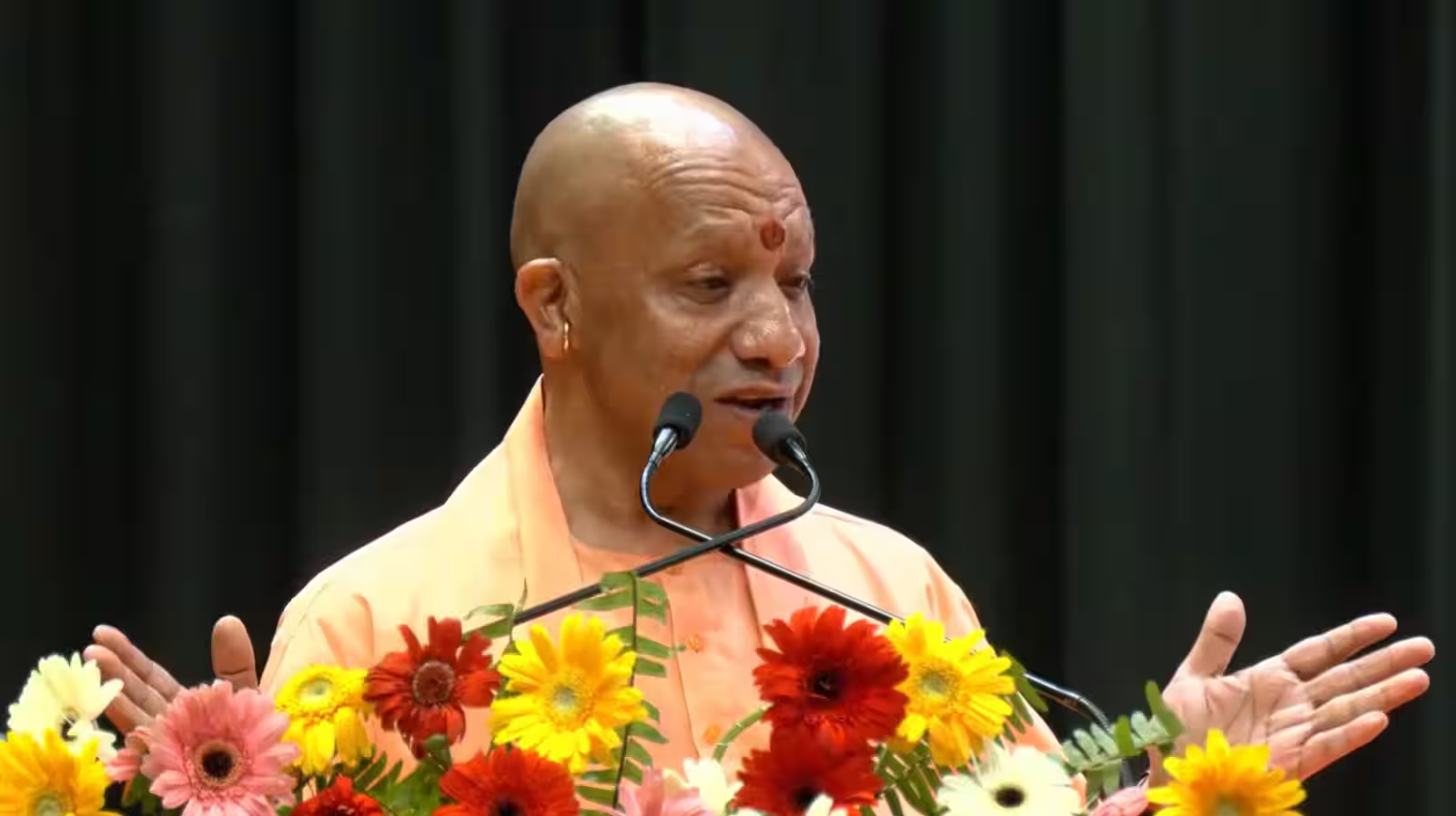
Yogi's new welfare politics: Cash, security and a new constituency of outsourced workers
The Yogi Adityanath government is expanding the BJP's welfare constituency in Uttar Pradesh by bringing a large and politically significant group into its social security net: outsourced workers.
The launch of the Uttar Pradesh Corporation for Outsourcing Services, or UPCOS, has put around 3.5 lakh outsourced employees and their families at the centre of a new welfare framework. The government says the initiative could benefit 17 to 20 lakh people when family members are included.
For the BJP the significance of the move goes beyond administrative reform. Outsourced employees work across government departments, hospitals, local bodies and other public institutions, making them a sizeable workforce with direct links to the state machinery.
The new system seeks to address some of their longstanding concerns, including delayed salaries, deductions by agencies, lack of social security and uncertainty over employment.
Under UPCOS, salaries are to be credited directly into workers' bank accounts, while EPF and ESI contributions are to be deposited regularly. The government has also said outsourcing agencies will not be allowed to deduct service charges from workers' remuneration. Accident insurance of Rs 20 lakh to Rs 40 lakh, depending on the category, has also been announced.
The move comes as the Yogi government is increasingly using higher cash benefits as the entry point to a wider welfare model that combines income support with healthcare, insurance and employment security.
The latest example came on September 16, when the government agreed to raise the monthly honorarium of more than 57,000 panchayat assistants from Rs 6,000 to Rs 9,000, a 50% increase.
The package went beyond the increase in honorarium. Women panchayat assistants were promised maternity leave, while assistants and their families were to get cashless medical treatment. The government also agreed to withdraw cases registered during their agitation and reinstate assistants who had been removed.
It further decided that panchayat assistants could not be removed arbitrarily. Their removal would require the approval of a committee headed by the district magistrate. Their honorarium is also to be paid directly into bank accounts through DBT.
The decision followed the August increase in the honorarium of around 3.53 lakh mid-day meal cooks from Rs 2,000 to Rs 3,000 a month. Along with the increase, the government announced cashless health cover of up to Rs 5 lakh, accident assistance of Rs 2 lakh and an increase in uniform allowance from Rs 500 to Rs 1,000.
Anganwadi workers have also been brought into the expanding welfare net. On September 8, Yogi announced an increase in their monthly honorarium from Rs 8,000 to Rs 12,000, along with an increase for helpers and health insurance.
The individual amounts may appear modest compared with larger welfare schemes, but the political significance lies in the number and nature of the groups being covered.
"These are not conventional beneficiaries who simply receive assistance from the government. Many are women or low-paid workers who operate within the government's delivery system at the grassroots level. Increasing their monthly income gives the welfare programme a direct employment component," said political analyst Rajendra Kumar.
It also gives the government multiple points of contact with households. The government is simultaneously increasing the reach of its pension and healthcare programmes.
The monthly pension for elderly people, destitute women and persons with disabilities has been raised from Rs 1,000 to Rs 1,500. Together, these three categories account for around 1.18 crore beneficiaries, according to government figures.
The BJP government had increased the pension from the levels prevailing before 2017 and had promised the Rs 1,500 amount in its 2022 Assembly election manifesto.
Kumar said: "The change is significant because a pension is not a one-time benefit. It creates a recurring payment and therefore a continuing relationship between the beneficiary and the state".
The same logic is increasingly being applied to healthcare. Cash assistance is being supplemented with cashless treatment and insurance so that beneficiaries are protected not only against inadequate income but also against sudden medical expenses.
The government has extended cashless treatment facilities to several categories, including teachers, PRD personnel, mid-day meal cooks, anganwadi workers and helpers.
This is gradually creating a welfare package in which the benefit is not restricted to money received every month. It can also include protection against illness, accidents and loss of employment.
Nomita P Kumar, Associate Professor in Giri Institute of Development Studies in Lucknow said the measures indicated a change in the government's welfare approach.
"From a 50% increase in the honorarium of panchayat assistants to enhanced economic and social security for anganwadi workers, mid-day meal cooks and outsourced employees, a new pattern of welfare politics is emerging in Uttar Pradesh ahead of the 2027 Assembly election," she said.
Nomita clarified the focus is no longer limited to money being transferred into beneficiaries' accounts. "This means the beneficiary is not only told how much money the government has given, but also how much he or she can save on treatment, what assistance the family will receive in case of an accident and whether the honorarium or salary will be paid regularly," she said.
This effectively expands the definition of a welfare beneficiary. It now includes sections of the workforce that are linked to the state machinery but do not enjoy the benefits available to regular government employees. That makes outsourced workers particularly important.
The political importance of this group will be closely watched. The government is potentially creating a new beneficiary constituency among workers who are young, employed and spread across government-linked institutions.
The emerging welfare contest is also taking shape alongside competing promises from the opposition.
Samajwadi Party president Akhilesh Yadav has criticised the government's recent honorarium increases, arguing that the issues of workers such as anganwadi employees and shikshamitras remained unresolved for years.
The BJP, meanwhile, is highlighting the expansion of its existing welfare architecture and the move from simple financial assistance to a combination of income support and social protection.
Whether these measures translate into electoral support is a separate question. For the BJP, however, the political opportunity is clear: expand the beneficiary base by bringing new groups into a system where cash benefits are combined with social and employment security. Outsourced workers could become one of the most important new groups in that expanding welfare constituency.
Discover the latest Business News, Sensex, and Nifty updates. Obtain Personal Finance insights, tax queries, and expert opinions on Moneycontrol or download the Moneycontrol App to stay updated!
Find the best of Al News in one place, specially curated for you every weekend.
Stay on top of the latest tech trends and biggest startup news.
Related Stories
 Finance
Iran war squeezes Iraq’s economy as oil revenues fall and prices rise
4 hours ago
 Finance
7 dead as Russia, Ukraine exchange strikes and aerial war intensifies
5 hours ago
 Finance
When Trump’s narrative meets voters’ realities
5 hours ago
 Finance
Xi leaves US after summit with Trump
13 hours ago
 Finance
Winnipeg woman speaking out after alleged romance scam
14 hours ago
 Finance
COLUMN: Reflecting on the One Canadian Economy Act
16 hours ago
 Finance
Marineland belugas that died in Chicago had rocks, maybe paint in stomachs before arrival: initial necropsy
17 hours ago
 Finance
Province confirms $1.3 billion deficit for last year
23 hours ago