
Yesterday Through the Eyes of Today
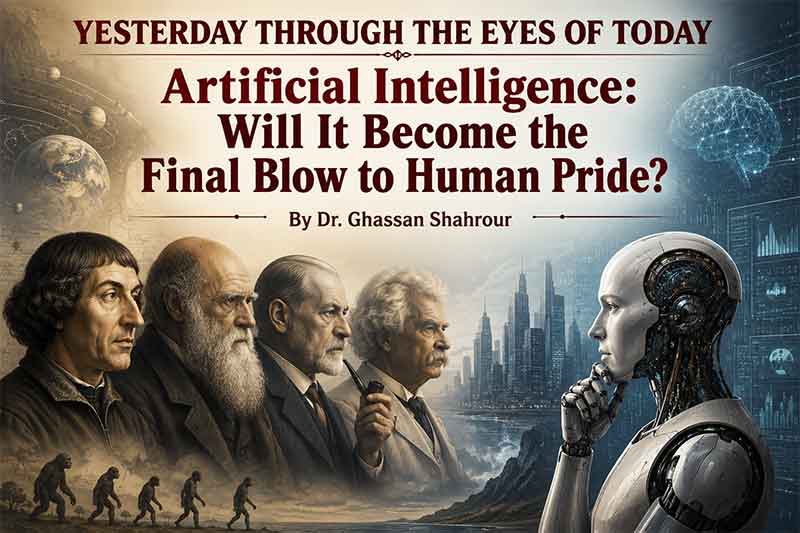
Throughout history, humanity has built a powerful story about itself. We have long believed that reason, creativity, language, and intellect set us apart from all other forms of life. This confidence shaped philosophy, science, religion, and culture for centuries. It became more than an observation about human ability; it evolved into a belief that humanity occupies a privileged position in the natural order.
Yet history repeatedly shows that every generation encounters discoveries that challenge this certainty. Scientific progress has forced humanity to reconsider not only what it knows about the world, but also what it believes about itself.
The first major challenge came in 1543, when Nicolaus Copernicus demonstrated that the Earth is not the center of the universe but one planet orbiting the Sun. Humanity suddenly found itself displaced from the center of creation. This was more than an astronomical breakthrough. It transformed philosophy, theology, and humanity’s understanding of its place in the cosmos.
More than three centuries later, Charles Darwin published On the Origin of Species in 1859. His theory of evolution showed that humans are part of the same biological history as every other living organism. Rather than standing apart from nature, humanity emerged from it. Once again, long held assumptions about human exceptionalism were challenged.
In 1917, Sigmund Freud proposed another unsettling idea. Human behavior, he argued, is shaped not only by conscious thought but also by powerful unconscious processes. Rationality, long regarded as humanity’s defining characteristic, no longer appeared to govern every decision. The human mind itself became less transparent than previously imagined.
Around the same period, the American writer Mark Twain offered a different but equally uncomfortable reflection. In The Damned Human Race, he questioned whether intelligence alone makes humanity morally superior. Cruelty, greed, hatred, and needless violence, he argued, reveal that knowledge without conscience can become a source of destruction rather than progress. His criticism remains relevant in an age where technological capability advances faster than moral reflection.
Today, artificial intelligence may represent another historic turning point. Unlike previous scientific revolutions, this challenge arises from humanity’s own creation. For the first time, we have developed systems capable of performing tasks once regarded as uniquely human. AI systems can draft essays, translate languages, compose music, generate images, summarize complex information, assist scientific discovery, write computer code, analyze medical data, and engage in conversations that appear thoughtful and creative.
This development raises a deeper question than whether machines can perform calculations faster than people. Computers surpassed humans in arithmetic decades ago. The real question is whether reasoning, language, creativity, and problem solving remain exclusively human capacities or whether they can be replicated by machines trained on enormous quantities of data.
Many scholars argue that artificial intelligence represents another challenge to humanity’s understanding of itself. It is not simply a technological innovation. It is a mirror forcing us to reconsider what intelligence means and whether intelligence alone defines human identity.
The greatest challenge, however, may not be that machines are becoming more capable. It may be that humans become less willing to exercise their own intellectual abilities. Every major technology changes human behavior. Writing reduced reliance on memory. Printed books transformed education. Maps reduced the need for navigation by memory. Calculators diminished routine mental arithmetic. Smartphones reshaped attention, communication, and access to information. Artificial intelligence may similarly influence how people learn, write, analyze evidence, solve problems, and even make moral judgments if its outputs are accepted without reflection.
This concern is no longer theoretical. AI is already part of everyday professional practice.
In healthcare, clinicians increasingly use AI systems to assist in interpreting medical images, identifying disease patterns, supporting diagnosis, and improving workflow efficiency. Properly designed systems may help detect certain abnormalities earlier and reduce diagnostic errors when used alongside clinical judgment. Yet medical organizations emphasize that AI should support, not replace, physician responsibility. Clinical decisions require expertise, ethical reasoning, communication with patients, and accountability that no algorithm can assume.
Education offers another example. Students use generative AI to organize ideas, summarize material, improve writing, and draft assignments. These tools can expand access to knowledge when used responsibly. At the same time, educators warn that excessive dependence on AI may weaken critical thinking, originality, and independent reasoning if learners accept generated answers without evaluation.
Scientific research has also entered a new era. AI systems assist researchers by analyzing large datasets, identifying patterns, accelerating drug discovery, and reviewing thousands of publications within hours. Tasks that once required months can now be completed rapidly. Rather than replacing scientists, these systems function as powerful research assistants that expand human capability while still requiring interpretation and judgment.
In this context, the principles of peace and human security offer a vital compass. They remind us that technology must serve the protection of life, dignity, and coexistence—not merely efficiency or power. Integrating these values into AI governance ensures that progress strengthens humanity’s collective safety rather than its divisions.
If artificial intelligence can assist in science, medicine, education, and communication, then the central issue is no longer whether it is useful. The real question is how humanity will preserve judgment, responsibility, and moral agency in a world shaped by intelligent systems.
The danger is not that machines will become human. The danger is that humans may behave as if thinking is optional. When convenience becomes the highest value, people may surrender the discipline required for reflection, patience, and intellectual effort. In that sense, AI does not merely challenge human pride; it tests human character.
History shows that every major advance carries both promise and risk. The printing press expanded knowledge but also spread propaganda. Industrialization increased productivity but also exploitation. The internet connected the world but also amplified misinformation. AI belongs to this pattern, though its speed and scale make the consequences more immediate. It can widen access to expertise, but it can also concentrate power in the hands of those who control data, algorithms, and infrastructure.
This is why ethical governance matters. AI systems must be transparent, accountable, and subject to human oversight. Their use in medicine, law, education, finance, and public administration should follow standards that protect fairness, privacy, and human dignity. Technology should remain a tool of service, not a substitute for conscience.
At the same time, humanity must resist the temptation to define itself only by efficiency. Human worth does not depend on speed, accuracy, or computational power. Compassion, empathy, moral responsibility, imagination, and the capacity to care for others remain profoundly human qualities.No machine can suffer, hope, forgive, or love in the way a person can. These are not weaknesses; they are the foundations of our humanity.
Perhaps AI is not the final blow to human pride, but the final warning against misplaced pride. It reminds us that intelligence is not wisdom, and capability is not virtue. If humanity uses AI to deepen knowledge while preserving humility, then this new era may become an opportunity for growth rather than humiliation.
The real measure of progress will not be whether machines can imitate us. It will be whether we can remain fully human while using them wisely. If we succeed, AI will not diminish human dignity. It will reveal what is most valuable in it.
Get the latest CounterCurrents updates delivered straight to your inbox.
Dr Ghassan Shahrour is a prolific author and Coordinator of the Arab Human Security Network, and a medical doctor specializing in health, disability, disarmament, and human security. He is recognized in the Global Biographical Lexicon of Medical Informatics, 2015 for his contributions to the field.
Related Stories
 AI News
Bill Gross bets AI can help mass
5 hours ago
 AI News
Nigeria records 93% rise in AI micro
5 hours ago
 AI News
The Italian gelato maker using AI to invent new flavours
5 hours ago
 AI News
Closing the Gap Between Agentic CX Pilots and Production
5 hours ago
 AI News
New Brunswick data centre debate highlights cross
6 hours ago
 AI News
How to Structure an AI Agent Referral Fee Agreement Between Startups
6 hours ago
 AI News
No, AI didn’t delete a Swedish reality TV series
6 hours ago
 AI News
There is no AI in Armageddon. Artificial intelligence is a tool, not an apocalypse
6 hours ago