
Yellowknifer retires Friday print edition, moves to publishing once a week
Yellowknifer retires Friday print edition, moves to publishing once a week
NNSL moves Weekender edition online as tech giants, production costs and shifting habits reshape local news
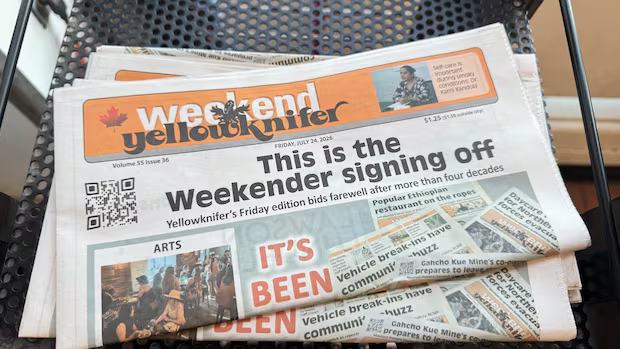
The Friday print edition of the Yellowknifer is officially coming to an end.
An announcement in the Wednesday edition of the newspaper detailed how the 54 year-old publication will reduce its print schedule from two weekly issues down to one, published on Wednesdays only.
The announcement said the weekend coverage will shift entirely to digital platforms, primarily distributed through Northern News Services Limited’s (NNSL) daily emailed newsletter, the Morning Alert.
In the newspaper's final Weekender edition released on July 24, Shane Weaver, general manager of NNSL, noted that while the Friday paper has served the community since March 1986, reader habits have evolved.
“However, in the modern era, there are now more options available to readers than ever,” Weaver wrote.
The paper's former publisher said the loss reflects the cost of printing and the rise of tech competitors. The move also mirrors an issue across the country as local newsrooms are either closing or downsizing.
Northern News Services bought by B.C.-based Black Press Media
Northerners hopeful for survival of local newspapers, as Black Press files for creditor protection
Tech platforms and shifting economics
Bruce Valpy, who is the former publisher of NNSL and worked for the outlet for 32-years, said the decision to scale back physical printing reflects long-standing economic pressures on traditional print media.
“You only have to compare a giant machine that’s being serviced and operated by a number of people to a website that can deliver news with code that’s easily replicated and maintained,” Valpy said.
“It doesn’t take grease, oil and electricity very much. All of those things change the economics.”
Beyond production expenses, Valpy pointed to the mid-2010s emergence of major digital platforms as a primary disruptor to traditional advertising revenue.
"It was really the rise of Facebook and Google that signaled the shift,” Valpy said.
"Their costs are much lower, they could undercut us and they could hit a huge audience.”
The shift in Yellowknife mirrors broader changes occurring across the Canadian media landscape.
April Lindgren, lead researcher for the Local News Research Project at Toronto Metropolitan University’s School of Journalism, tracks newsroom openings, closures and shifts in operations across the country.
Local news coverage in Canada in steep decline, inviting misinformation: report
One year after news ban, Canadian journalism is suffering — but Meta isn't budging
"It's been a slow, steady trickle of news outlets shifting to eventually online-only, or at least reducing the number of print editions," Lindgren said.
"It's part of a cost-cutting measure.”
She said since 2008, more than 600 local news outlets have closed in Canada. As physical papers scale back or disappear entirely, Lindgren warns that local communities face growing risks of news deserts and unverified information online.
“People have less access to timely, verified local news,” Lindgren said. “And this is a particularly serious consequence now in an era where there’s more mis- and disinformation showing up online.”
Lindgren said when readers lose the habit of picking up a physical paper, finding reliable community reporting often requires far more intentional effort.
The internet is full of misinformation. That's by design, experts say
Social media firms catching more misinformation, but critics say 'they could be doing more'
"If a print edition of a newspaper isn't showing up on your front step every week, then you have to make the decision to have a look at it online … Increasingly, people have to work harder and harder to find local news that they can count on,” Lindgren said.
NNSL confirmed that daily local reporting will continue uninterrupted on its website and digital channels.
Management for the publication declined an interview request prior to publication pointing to the official announcement in Friday’s paper.
Samanntha Lee is a multimedia journalist and a 2026 CBC summer news scholar in memory of Joan Donaldson and Peter Gzowski. You can reach her at samanntha.lee@cbc.ca
Related Stories
 Technology
When Tech Companies Die, What Happens To The Products They Leave Behind?
3 days ago
 Technology
Two Finns supplying Russia with missile tech worth tens of millions
3 days ago
 Technology
Drones with pepper spray, four
3 days ago
 Technology
Micron Technology stock pre-market at EUR 800.50: memory storage - ad
3 days ago
 Technology
TAIEX Ends at 4
3 days ago
 Technology
ZAWYA: Technology, start-ups can double India
3 days ago
 Technology
Czech government to consider CZK 1 billion fund for startups
3 days ago
 Technology
GDIN Supports Eight Startups at CEATEC 2026 in Japan, Opens Door to Local Investor Collaboration
3 days ago