
World's largest sea turtles return to Panama's Pacific coast
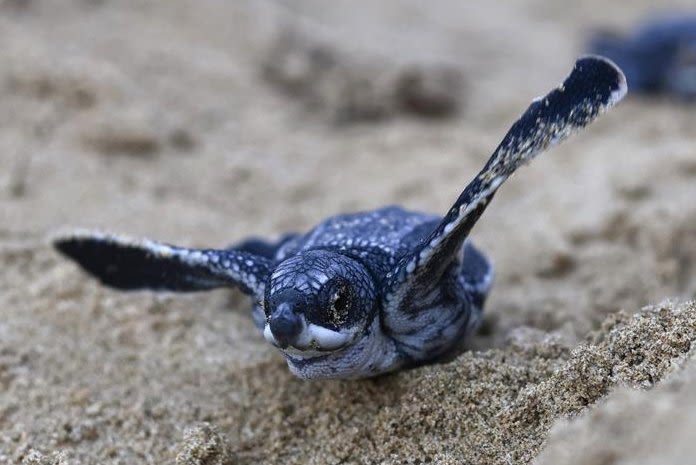
Aug. 24 (UPI) -- Leatherback sea turtles, the world's largest marine turtle species, have returned to nest on Panama's Pacific coast after nearly a decade, the country's Environment Ministry said.
Conservation teams documented three nesting events at El Fondiaderito, a remote beach in Darién province near Panama's border with Colombia.
Community members, a local environmental organization and Environment Ministry technicians relocated 178 eggs to a protected hatchery to shield them from predators, poaching and coastal erosion. Authorities expect the hatchlings to emerge between September and October.
The Environment Ministry called the return a "historic milestone" for marine conservation in Panama because of the dramatic decline in the eastern Pacific leatherback population.
Although leatherbacks continue to nest with some regularity along Panama's Caribbean coast, researchers had not confirmed a nest on the country's Pacific shoreline since 2017, according to the Environment Ministry.
Previous records were also scarce. Two nests were documented in Los Santos province in 2014, while two others were recorded in Veraguas province, one in 2014 and the last in 2017, according to data from Panama's Agua y Tierra Foundation cited by authorities.
The eastern Pacific leatherback population has declined by more than 95% since the 1980s. Marino Ábrego, deputy director of the Environment Ministry's Coasts and Seas Directorate, said fewer than 500 adult nesting females are estimated to remain across the tropical eastern Pacific.
Leatherbacks, scientifically known as Dermochelys coriacea, can grow to more than 6.5 feet long and weigh over 1,000 pounds. Unlike other sea turtles, they do not have a hard shell. Instead, they have a flexible covering of thick, leathery skin, according to the U.S. National Oceanic and Atmospheric Administration.
The eastern Pacific population is considered critically endangered because of threats that include accidental capture in fishing gear, illegal egg harvesting, plastic pollution, artificial lighting and the loss of nesting beaches.
Coastal erosion, unplanned development and climate change are also reducing the areas where females can lay their eggs, Panamanian broadcaster TVN Noticias reported.
Leatherbacks migrate thousands of miles between feeding and nesting areas. In Panama, researchers use satellite transmitters to identify their migration routes and feeding grounds. Data from those projects have contributed to the creation of marine wildlife refuges.
Panama is home to five of the world's seven sea turtle species. All are listed under Appendix I of the Convention on International Trade in Endangered Species of Wild Fauna and Flora, which strictly restricts international commercial trade.
Related Stories
 World
World
Man stabs at least 8 people in South Korean mall
1 hour ago
 World
World
Houthi rebels sa airstrikes targeted them in Yemen, and other Mideast developments
2 hours ago
 World
World
US emergency call records reveal confusion after failed execution of Christa Pike
2 hours ago
 World
World
Wanda Diamond League publishes 2027 calendar
3 hours ago
 World
World
IPCC is under pressure to delay publication of key global climate report
3 hours ago
 World
World
Euronews tops rankings as fastest growing English
3 hours ago
 World
World
Smashing Stats: Denmark Open 2026
4 hours ago
 World
World
Qatari Emir says country has faced ‘exceptional circumstances’
5 hours ago