
Will Alberta pipeline proposal move voters ahead of separation vote?
Will Alberta pipeline proposal move voters ahead of separation vote?
Alberta premier unveiled proposal on Thursday for West Coast pipeline
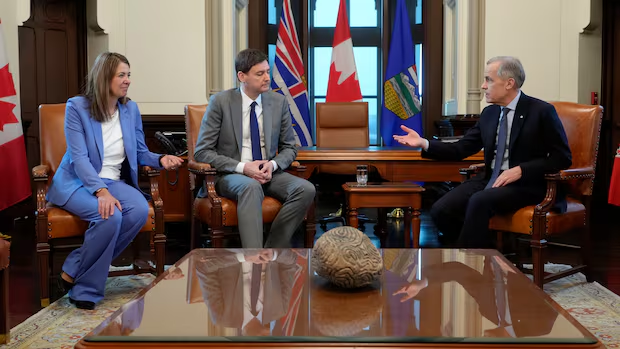
Standing alongside Prime Minister Mark Carney, Premier Danielle Smith unveiled Alberta's official proposal for an oil pipeline to the West Coast on Thursday, a project she's pointed to as proof her province can work with Ottawa.
But while one pollster said the project could move some "soft separatist" voters to instead support remaining in Canada, some Albertans supporting independence are still skeptical the pipeline will ever be completed.
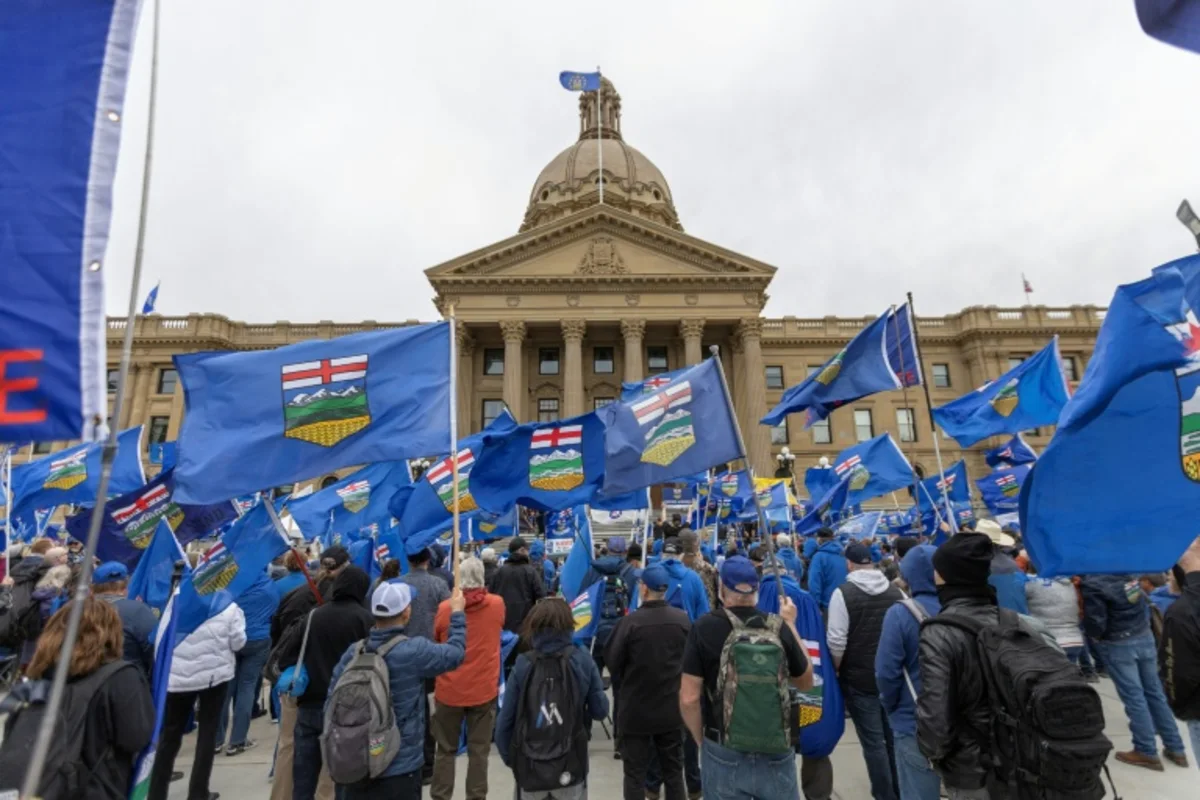
Let Alberta Decide, a third-party advertiser advocating for Albertans to vote in an October referendum in favour of exploring separation from Canada, said the announcement “proves the problem with Confederation.” The group argued a year of negotiations only led Alberta to an “uncertain starting point.”
"It feels a little bit like a promise that at some point there will be a pinky swear that this will happen, and I just don't place a lot of weight on it,” said Tanya Clemens, co-chair of Let Alberta Decide.
Alberta pitches new West Coast oil pipeline to B.C.'s South Coast
Smith’s announcement on Thursday included a proposed pipeline route to British Columbia’s southern coast to export oil to Asian markets. The federally-owned Trans Mountain Corporation is partnering on the project, with Calgary-based Pembina Pipeline acting as the private proponent.
Early work on the project could begin in 2027, with its completion projected for between 2032 and 2034. More detailed funding and the cost for taxpayers “remains to be negotiated,” Smith said on Thursday.
The federal government also announced a multibillion-dollar deal with British Columbia, which included a commitment to maintain an oil tanker ban on the province’s north coast.
Clemens argued too many federal conditions still plague the deal, including Ottawa calling for a proposal to be coupled with a carbon capture agreement.
But on Friday, Smith said the announcement signalled Alberta and Ottawa can co-operate constructively.
“The demonstration that Canada and Alberta can work together is the proof point in itself. Canada and Alberta were not working very well together for the last 10 years,” said Smith on CBC Radio’s Calgary Eyeopener on Friday.
“It's demonstrated that we can take a different path that can not only support Alberta's economic prosperity, but also be good for the country."
Taxpayers could be on hook for West Coast pipeline, but it's a 'good investment': Energy minister
But Christopher Scott, CEO of Let’s Talk Alberta, argued the deal still has too many hurdles that could drag out a pipeline deal.
“There’s lots of talk, lots of hype, and I think it’s a means by which the federal government and the provincial government are trying to extinguish the independence movement,” said Scott.
“I’ll believe it when I see it.”
Scott's organization hosts conversations on Alberta independence. He said he’s not a separatist, but he believes Alberta should have more authority over its own resources, which can currently only be achieved through seeking independence.
Some voters won't be convinced: Lukaszuk
To some federalism supporters, Smith's announcement signalled Confederation can still work.
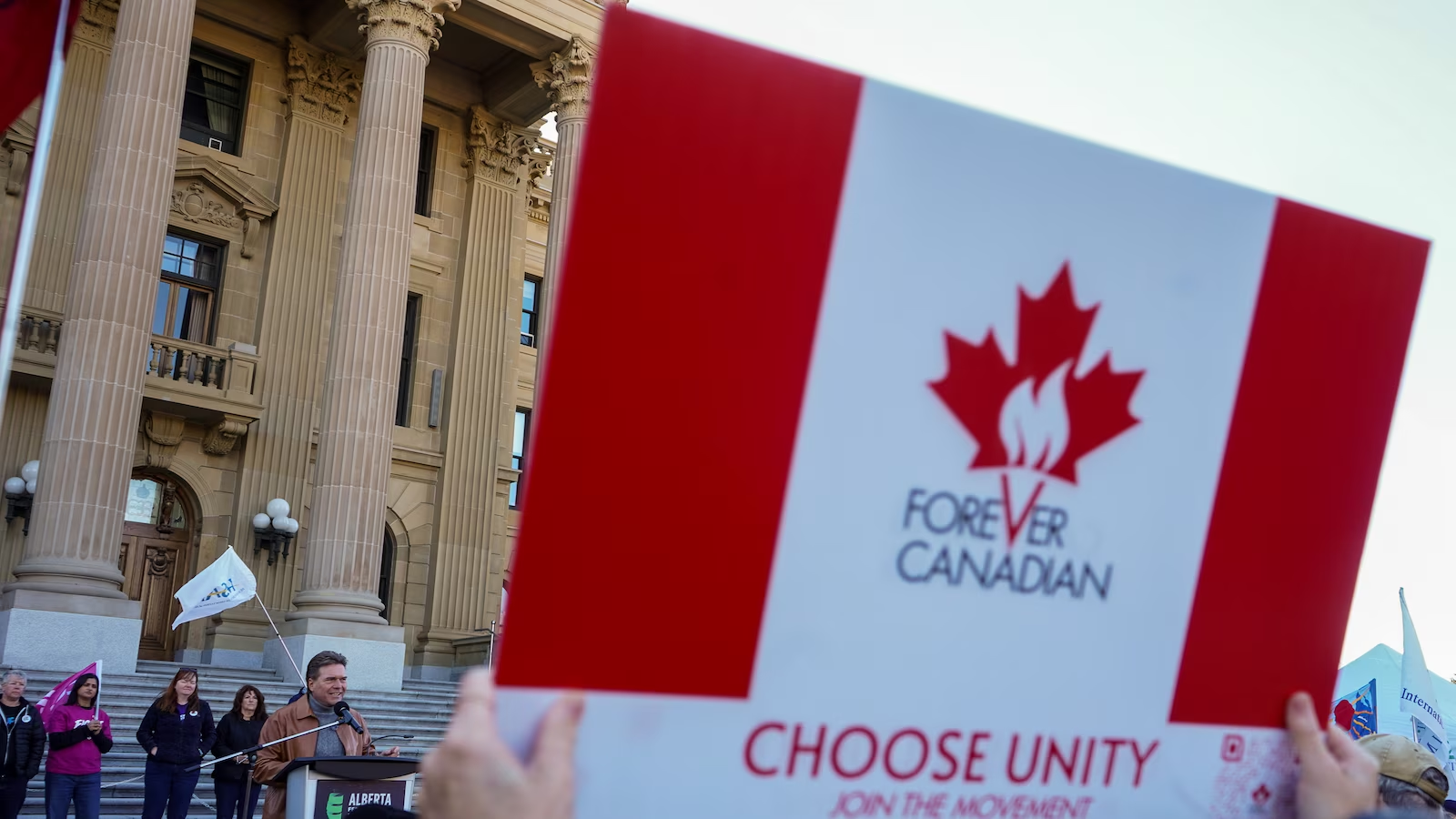
That’s how former Progressive Conservative deputy premier Thomas Lukaszuk sees it. Lukaszuk, who spearheaded the Forever Canadian petition last year, said Thursday's announcement shows why separation should not be supported.
He argued that for some voters “hell-bent on separatism," nothing is likely to convince them to change their vote. He argued they cannot support the pipeline proposal, because it undermines their argument that Canada cannot work.
But to more open-minded voters who are weighing evidence, Lukaszuk said the pipeline proposal could push them to support remaining in Canada.
"This will serve as an evidence that if they ever wanted to send a message to Ottawa, the message has been sent and it has been heard,” said Lukaszuk.
Proposal exceeded some expectations
Most Albertans were not confident the memorandum of understanding Smith and Carney signed last year would actually result in a new pipeline, polling by Janet Brown Opinion Research for CBC News showed.
On Friday, Brown said a private proponent being involved in the project, a carbon capture deal, and British Columbia not opposing the project all together ticked a lot of boxes for skeptical Albertans.
A guide to the (many) groups running Alberta's separatist and remain camps
Why expansion of Delta, B.C., container port is going hand-in-hand with Alberta pipeline
She said while polling has consistently shown about 20 per cent of the population is locked into supporting separation, there is a narrow band of nine to 11 per cent of Albertans whose votes are up for grabs. Brown referred to this group as “soft separatists."
If any of those voters are driven by economic concerns, Brown said the pipeline proposal is likely to give them more confidence in Confederation.
"This could be proof to them that Canada can work, that Alberta can make headway [in] the things the premier has said about trying to make progress within the federation rather than without,” said Brown.
“I think this should give soft separatists pause."
Andrew Jeffrey is a multimedia journalist with CBC Calgary. He previously worked for CBC News in his hometown of Edmonton, reported for the StarMetro Calgary, and worked as an editor for Toronto-based magazines Strategy and Realscreen. You can reach him at andrew.jeffrey@cbc.ca.
With files from Bryan Labby, Maggie Kirk and CBC Radio's Calgary Eyeopener
Related Stories
 Canada
Albertans head to polls in historic referendum on whether they want to stay in Canada
2 days ago
 Canada
In the news today: four soldiers killed, Alberta referendum, AI privacy fears
2 days ago
 Canada
How a grass fire at a Canadian military base killed four soldiers
2 days ago
 Canada
How will household electricity rebate reduction, temporary winter pricing change impact Ontarians?
2 days ago
 Canada
Residents told to boil tap water due to bacteria
2 days ago
 Canada
Oil
2 days ago
 Canada
Albertans vote on path to independence as Carney fights to keep Canada united
2 days ago
 Canada
Two of 4 soldiers killed in fast
2 days ago