
Wildfire smoke transforms skies as air quality plummets across Canada
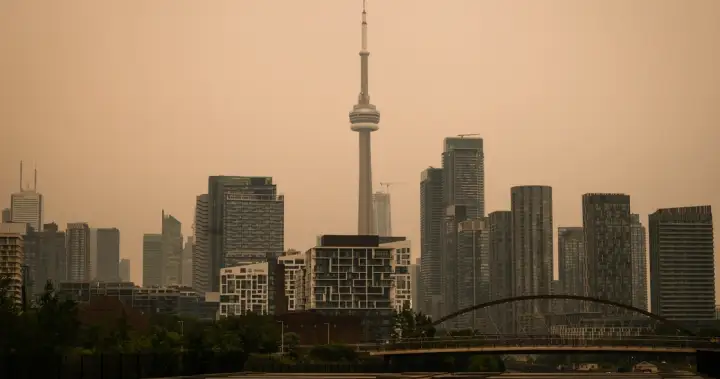
Canadians across many parts of the country woke up to smoky skies as Environment Canada issued air quality alerts for several major cities on Wednesday.
Smoke from wildfires in northwestern Ontario is causing very poor air quality and reduced visibility, with hazy conditions expected to persist until Friday morning, Environment Canada said in an alert on Wednesday.
A similar alert was issued for parts of northern Manitoba, where poor air quality is expected to last until Thursday.
A yellow alert was also issued for Vancouver, with residents of British Columbia being asked to watch out for wildfire smoke over the next 24 to 48 hours.
“Northwest winds picked up and spread the smoke from the fires which continue to burn thousands of hectares of boreal forest a day in northwest Ontario towards the big population areas of southern Ontario,” said Global News meteorologist Anthony Farnell.
What’s behind the ‘red skies’?
The wildfire smoke caused the sky in many parts of the country to turn an orange-red hue.
“The smoke is so thick that it is completely blocking out the sun, creating a very eerie filtered light and causing cars to use headlines in the middle of the day and residents to need lights on in their homes or businesses just to see,” Farnell said.
The thickness of the smoke is blocking out solar radiation, causing temperatures to be around five degrees cooler than expected on Wednesday, Farnell added.
“The red skies that we’re seeing across the region are due to particles that are being emitted by wildfires, primarily in northwestern Ontario,” said Greg Evans, professor of chemical engineering and applied chemistry at the University of Toronto.
“The plumes from those wildfires are reaching us. They scatter the sunlight and scatter out the blue light, let the red light through so it looks like a very ominous red light,” he added.
Wednesday’s smoke event was “comparable” to the hazy skies many Canadians witnessed in the summer of 2023, Evans added.
What does the air quality index mean?
Toronto had the worst air quality among major cities in the world on Wednesday, with Environment Canada saying the city scored eight on the Air Quality Health Index.
Toronto now on top of the major city world rankings for worst air quality. Considering skipping that morning run today. pic.twitter.com/iy4NFGgaQb
— Anthony Farnell (@AnthonyFarnell) July 15, 2026
The AQHI is a scale ranging from one to 10 and shows the risk that air quality in your area may pose to your health. An AQHI score of one to three is considered “low risk,” four to six is considered “moderate risk” and seven to 10 is considered “high risk.”
Yellowknife joined Toronto as the other Canadian city at high risk on Wednesday, with an AQHI of seven.
During such conditions, everyone’s health is at risk regardless of their age or health status, Environment Canada says.
Edmonton and Fort Smith, Alta., were both at “moderate risk” with an AQHI of four, along with Fredericton, N.B., at an AQHI of five.
While Thursday could be the “worst day for air quality” in some parts of the country, the smoke could clear out before the weekend, Farnell said.
“The wind direction will finally change late Friday, helping to clear some of the smoke out by the weekend,” he added.
Environment Canada is asking Canadians to limit time outdoors and reschedule or cancel outdoor sports, activities and events.
I guess the good news is that this thick smoke is blocking out enough sunlight that temperatures are running over 5 degrees cooler than forecast. Hey ECCC, maybe we drop the heat warning so we concentrate on the Orange Air Quality Alert? pic.twitter.com/sYnbMAi0Hd
People aged 65 and older, pregnant people, infants and young children, people with an existing illness or chronic health condition, and people who work outdoors should avoid strenuous activities outdoors and seek medical attention if experiencing symptoms, the agency said.
Can you smell the campfire? Today is smoke day in Toronto. pic.twitter.com/UZnfpdXNZj
“When indoors, keep windows and doors closed as much as possible. When there is an extreme heat event occurring with poor air quality, prioritize keeping cool,” Environment Canada said in its alert.
For those who need to spend time outdoors, using a well-fitting face mask, such as an N95 mask, can help reduce exposure to fine particles in the smoke.
While larger polluting particles can cause symptoms such as irritation, burning eyes and scratchy throat, it is the smaller particles that Canadians should be concerned about, said Dr. Martin Kolb, professor of medicine at McMaster University and research director of the Firestone Institute for Respiratory Health at St. Joseph’s Hospital.
“You can inhale them deep into the lungs, into the air sacs, and then from there, they get into the bloodstream. And those are the ones that are more toxic, both short-term and long-term,” he added.
Since smaller particles can get into your bloodstream, they can also cause non-respiratory chronic illnesses to flare up.
“It’s not limited to the lungs. If you have a heart condition, you would be at a higher risk for this also to be affected,” he said.
The best piece of advice is the simplest one, Kolb said – stay indoors.
This advice holds even for healthy people who don’t have any pre-existing conditions, he said.
“Postpone that run. Because you feel it even if you’re healthy,” he said.
But for those who have to go out, he recommends wearing an N95 mask.
“N95 takes a good portion of the PM2.5 (tiny particles) out. The surgical masks, they don’t,” he added.
The Canadian Medical Association said the ill effects of the wildfire smoke will cause strain on Canada’s public health infrastructure.
“Patients struggling to breathe through smoke-filled air, more people arrive at the emergency room with heat stroke and cardiac events, and sometimes hospitals are forced to evacuate,” the CMA said in a statement.
“The CMA continues to push for the federal government to invest in sustainable, climate-resilient infrastructure to protect patient care, strengthen system reliability and support long-term economic stability while supporting public and planetary health,” it added.
Related Stories
 Canada
Albertans head to polls in historic referendum on whether they want to stay in Canada
4 days ago
 Canada
In the news today: four soldiers killed, Alberta referendum, AI privacy fears
4 days ago
 Canada
How a grass fire at a Canadian military base killed four soldiers
4 days ago
 Canada
How will household electricity rebate reduction, temporary winter pricing change impact Ontarians?
4 days ago
 Canada
Residents told to boil tap water due to bacteria
4 days ago
 Canada
Oil
4 days ago
 Canada
Albertans vote on path to independence as Carney fights to keep Canada united
4 days ago
 Canada
Two of 4 soldiers killed in fast
4 days ago