
Why the Modi Government Is Tightening the Grip on NGOs: Understanding the Politics, Policy, and Impact of India’s FCRA Regime
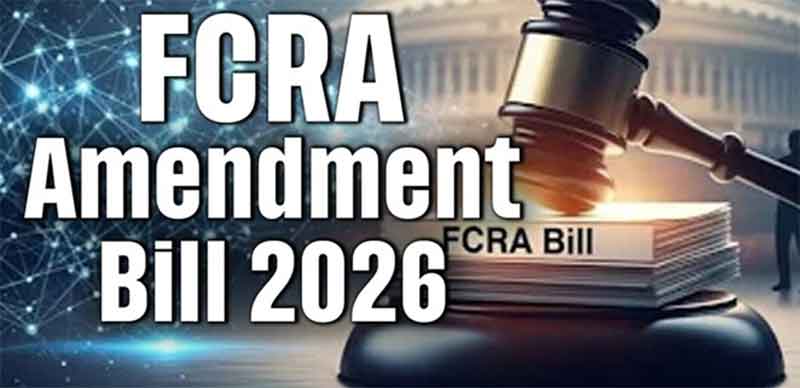
Successive FCRA amendments and administrative rules have fundamentally reshaped India’s civil society sector, raising questions about democratic freedoms, accountability, and the future of grassroots activism.
For over a decade, the Narendra Modi government has steadily expanded regulatory control over India’s non-governmental organisations (NGOs), particularly those receiving foreign funding. While the government argues these measures are essential to ensure transparency, national security, and accountability, but the fact is the critics are right when they contend they represent one of the most significant restrictions on civil society since Independence.
Of course the Govt fears their power as the NGOs have remained pressure groups when they question the government and make them accountable. However,
The latest changes in 2026 continue a pattern that began soon after the BJP assumed power in 2014: if legislative amendments face political resistance, the government increasingly relies on executive rules and administrative notifications to achieve similar outcomes.
Supporters describe these reforms as necessary safeguards against foreign influence. Opponents argue they weaken independent voices, shrink democratic space, and disproportionately affect organisations working among India’s poorest and most marginalised communities.
The Growing Regulation of Civil Society
India has long regulated foreign donations through the Foreign Contribution (Regulation) Act (FCRA), first enacted in 1976 during the Emergency and substantially revised in 2010. The law requires organisations receiving foreign donations to obtain government registration and comply with financial reporting requirements.
However, under the Modi government, FCRA has evolved from a regulatory mechanism into one of the government’s most powerful tools for controlling civil society, according to numerous legal scholars and human rights organisations.
Amnesty International, Human Rights Watch and the International Commission of Jurists have repeatedly expressed concern that FCRA enforcement has become increasingly restrictive. However, it has barely affected the Modi government as their intentions have been clear, which is to regulate these groups and put an end to their voices which often go against the ruling regime.
1. Rules Instead of Legislation: A New Governance Strategy
One notable feature of recent governance has been the increasing reliance on executive rule-making rather than parliamentary legislation. When proposed amendments face opposition in Parliament, governments can often introduce similar provisions through subordinate legislation or administrative rules, provided the parent law permits it.
Legal experts note that while this practice is constitutionally permissible in many cases, excessive reliance on executive rule-making reduces parliamentary scrutiny and public debate. This broader trend extends beyond NGO regulation and reflects a growing preference for governance through executive powers.
2. The 2026 Rules: What Has Changed?
The latest rules governing FCRA-registered organisations introduce several additional compliance requirements.
Among the reported provisions are:
While the people in the BJP camp argue that these measures increase transparency and prevent misuse of foreign funds. However, at the backend, there are several provisions that remain broadly worded giving authorities considerable discretion in determining what constitutes political activity or permissible NGO work for obvious reasons.
3. The FCRA Amendments of 2020: A Turning Point
The most transformative changes occurred through the Foreign Contribution (Regulation) Amendment Act, 2020, which significantly altered how NGOs operate.
A Single SBI Branch for Foreign Donations: All organisations receiving foreign contributions were required to open an FCRA account at the State Bank of India New Delhi Main Branch located on Sansad Marg. The government stated that centralising foreign fund inflows would improve monitoring and compliance.
However, many organisations argued that this imposed logistical burdens, especially on smaller NGOs operating in remote states. According to Ministry of Home Affairs data, over 22,000 organisations held valid FCRA registrations around the time these changes were introduced, while only a fraction were based in Delhi.
Administrative Expenses Capped at 20 Percent: The 2020 amendments reduced the ceiling on administrative expenditure from 50% to 20% of foreign contributions.
Administrative expenses include:
The government argued that donors expect funds to reach beneficiaries directly rather than support organisational overheads.
However, researchers in the non-profit sector note that effective development work requires professional staff, legal compliance, monitoring, evaluation, research, and institutional capacity. Excessively low overhead limits may weaken programme quality rather than improve efficiency.
Studies published by the Center for Global Development and the Bridgespan Group have highlighted the “nonprofit starvation cycle,” where unrealistic limits on administrative spending reduce organisational effectiveness rather than increase accountability.³⁴
Ban on Regranting Foreign Funds: Perhaps the most controversial amendment prohibited NGOs from transferring foreign contributions to other FCRA-registered organisations. Before 2020, larger organisations often partnered with smaller grassroots groups that possessed local knowledge but lacked fundraising capacity.
The amendment effectively dismantled many collaborative networks. Development experts argue that India’s civil society has historically relied on partnership models, particularly in rural health, education, women’s empowerment, disability inclusion, and tribal development.
Large national organisations frequently served as intermediaries, mobilising international funding while local organisations implemented programmes. Without regranting, many small community-based organisations struggled to sustain operations.
The Government’s Justification
The Modi government has consistently defended tighter FCRA regulations on several grounds:
The Ministry of Home Affairs has argued that organisations receiving foreign contributions must meet higher standards of financial oversight because such funding has implications beyond ordinary domestic charitable donations. Government data also indicates that thousands of FCRA registrations have been cancelled over the past decade for alleged violations of compliance requirements.
Civil Society Sees a Shrinking Democratic Space
Civil society organisations, legal experts, and international observers offer a sharply different interpretation. Reports by CIVICUS classify India’s civic space as “repressed,” citing restrictions on NGOs, journalists, and activists.
Similarly, the Varieties of Democracy (V-Dem) Institute has documented declining indicators related to civil society participation and freedom of association in India. The Civil Society advocates argue that restrictive funding rules disproportionately affect organisations engaged in:
Unlike businesses, they note, NGOs face significant limitations on foreign funding despite both being part of the non-government sector.
Another recurring criticism concerns differing standards applied to political parties, corporations, and NGOs. A notable example arose from a 2014 Delhi High Court judgment, which found that both the BJP and the Congress had received donations from entities linked to foreign ownership in violation of the FCRA as it then stood. Subsequent legislative amendments retrospectively altered the definition of a “foreign source,” effectively validating such donations. Critics argue this demonstrates inconsistent application of foreign funding rules across different sectors, while supporters contend the amendments merely clarified outdated provisions to reflect modern corporate structures.
What the Research Says About Civil Society
International research consistently links a strong civil society with improved democratic outcomes.
According to the Organisation for Economic Co-operation and Development (OECD), civil society organisations play an essential role in:
Likewise, the United Nations Development Programme identifies civil society as one of the core pillars of inclusive governance. Many development economists argue that governments and NGOs perform complementary rather than competing roles, particularly in reaching vulnerable populations.
The Road Ahead – The Final Thought
The debate surrounding NGO regulation reflects a broader tension between two competing visions of governance.
1. One prioritises strong state oversight to safeguard national interests and financial integrity.
2. The other emphasises the importance of an independent civil society as a cornerstone of democratic accountability and citizen participation.
The 2026 rules continue a decade-long trajectory of expanding executive oversight over non-profit organisations. Whether these measures ultimately improve transparency or constrain civic freedoms remains the subject of intense legal, political, and public debate.
What is clear is that India’s non-profit sector now operates under one of the most tightly regulated foreign funding regimes among the world’s major democracies. The message is clear – the ruling regime wants to play safe and do not wish to face any tough question from the civil society.
Get the latest CounterCurrents updates delivered straight to your inbox.
(Mohd Ziyauallah Khan is a freelance content writer & editor based in Nagpur. He is also an activist and social entrepreneur, cofounder of the group TruthScape, a team of digital activists fighting disinformation on social media.)
Related Stories
 AI News
Canada is 13th wealthiest nation in the world, according to annual global wealth rankings
3 seconds ago
 AI News
SpaceX to acquire the AI coding startup Cursor for $60 billion
3 minutes ago
 AI News
Sparrow Capital raises Rs 475 crore in third fund to bet bigger on early
3 minutes ago
 AI News
Neo
57 minutes ago
 AI News
World Cup 2026: Mexico squad return watches gifted by content creator Stevewilldoit
58 minutes ago
 AI News
Can I take the day off for England’s World Cup game
58 minutes ago
 AI News
Evening news wrap: Ram Temple scam deepens; Prashant Kishor to enter politics; Mojtaba skips father’s fun
59 minutes ago
 AI News
Goose shot with crossbow bolt at water park
59 minutes ago