
Why Lindsay Clancy, on trial for the deaths of her 3 children, has so many supporters
Why Lindsay Clancy, on trial for the deaths of her 3 children, has so many supporters
Jurors began deliberations Thursday in case where defence blames postpartum psychosis
WARNING: This article contains details about violence against children and suicide.
Outside the Massachusetts courtroom where Lindsay Clancy is on trial in connection with the deaths of her three children — she doesn't deny that she killed them, but jurors must decide if she's criminally responsible — Clancy's supporters have gathered again.
On Thursday, ahead of the closing arguments, they were again dressed in pink. Once again, they were mostly women. And just like during their previous gatherings and in the discourse happening online, a similar message emerged: new moms need help, and they aren't getting it.
"As a physician myself, I’ve been on both sides of this coin when women are dismissed for our concerns, and it’s not fair," supporter Marta Quijano told The Associated Press outside the Plymouth County Superior Court in Plymouth, Mass., Thursday.
What to know about the trial of Lindsay Clancy, woman accused of killing her 3 children
"I don’t think people really understand unless they’ve been through it," said Danielle Buckley, who drove five hours from Maine to watch the closing arguments.
"They just want to see her be punished for what happened to her children."
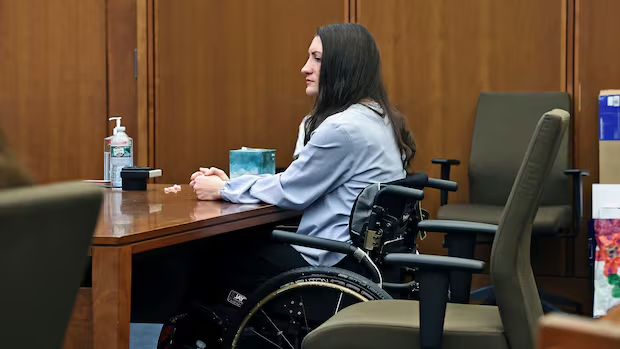
Clancy, 36, is accused of killing her three children in 2023 while her then-husband was running an errand. Jurors have heard that Clancy strangled Cora, 5; Dawson, 3; and eight-month-old Callan with exercise bands in the basement of their home in the Boston suburb of Duxbury. She then attempted to take her own life by jumping out of a second-floor window, which left her paralyzed.
Clancy's defence doesn't dispute the killings. But they argue she isn't criminally responsible because she had bipolar disorder and was suffering from postpartum psychosis, a rare and little-understood mental health condition that can affect a new mom's sense of reality.
Prosecutors argue Clancy is guilty of three counts of first-degree murder, because she plotted to get her husband out of the house so she could carry out the killings.
On Thursday, after lawyers finished their closing arguments in the month-long trial, jurors started their deliberations.
If convicted, Clancy faces life in prison without parole. If she's found not guilty due to lack of criminal responsibility, or by reason of insanity, she would be committed to a state psychiatric hospital.
The Lindsay Clancy trial and maternal mental health
Court heard that Clancy suffered from hallucinations and delusions that started after her third child was born. On the day of the killings, Clancy said she heard a voice telling her, "This is your last chance. Kill the children so you can kill yourself," according to her lawyer during opening arguments.
In addition to the courthouse rallies, there's been a massive wave of online empathy. On social media, people have been sharing their own experiences with trying to get mental health support after childbirth. Some have posted statements like, "I am Lindsay Clancy." Others have posted photos of themselves during times of struggle along with the words, "same, Lindsay."
"No matter what we say, nothing useful happens. Many of us lie, fearful of having our kids taken. Those of us who tell the truth are usually met with some combination of stigma, dismissal, and blame — rarely any meaningful support," Zawn Villines wrote on Substack Thursday.
What is postpartum psychosis, the illness at the centre of Lindsay Clancy's murder trial?
Testimony concludes in trial of U.S. mother accused of killing her 3 children
"This Lindsay Clancy trial has hit me so viscerally, and it’s so close to home," Liz Cadeaux said in a tearful TikTok video where she urged other moms having a hard time to seek help.
Conversely, there's also been backlash against the social media campaigns, and opinion pieces and columns that question how so many mothers can possibly sympathize with a woman who killed her children.
Dr. Crystal Clark, the head of psychiatry at Women’s College Hospital in Toronto, says she thinks people are resonating with the trial, but not because they identify with Clancy's final actions.
"They resonate with the suffering, the help-seeking, the distress and despair she was experiencing prior to that, that they recognize in themselves," Clark, also the Canada Research Chair in reproductive mental health, told CBC News.
Because of the overall increased awareness of mental conditions like postpartum depression, Clark says more people are able to identify and name what they have experienced. And that can include not feeling heard.
"Not being heard is very scary."
Lindsay Clancy’s murder trial hears closing arguments
More support needed: psychiatrist
Jurors have heard that Clancy was prescribed 13 different psychiatric medications across different providers, and her attorneys say Clancy did everything she could to seek help, including going to the emergency room, calling a suicide hotline and checking herself into a psychiatric hospital.
The trial is triggering for many women, who have a long history of having their health and mental health concerns dismissed or misinterpreted, psychotherapist Kaytee Gillis recently wrote in Psychology Today.
"It touches something many women already know intimately: the feeling of asking for help and being unable to find it," Gillis wrote.
In Canada, postpartum depression and anxiety affect almost one-quarter of mothers who recently gave birth, according to 2019 Statistics Canada data. Postpartum psychosis — the sudden onset of psychotic symptoms after childbirth — is much more serious. Researchers estimate that the condition afflicts one to two women per 1,000 after delivery.
Clark, with Women’s College Hospital, says she doesn't believe new moms are getting enough support during what can be a very vulnerable and scary time. More needs to be done to identify when moms are suffering and need help, and to provide early intervention, she says.
While the trial has raised awareness of postpartum psychosis, Clark says she's worried about increasing stigma. For instance, Clark says she's seen an uptick in the number of patients worrying about whether they could be at risk of killing their children, even though it's an extremely rare outcome of a rare postpartum mental illness.
According to a 2024 research paper published in the Archives of Women's Mental Health, untreated postpartum psychosis is associated with an infanticide rate of about four per cent.
"Postpartum depression, postpartum anxiety and postpartum OCD are not associated with postpartum psychosis. It is very unlikely that those illnesses will lead to infanticide," Clark said.
Deliberations in Clancy's trial will resume Friday at 9 a.m. ET.
If you or someone you know is struggling, here's where to look for help:
Natalie Stechyson has been a writer and editor at CBC News since 2021. She covers stories on social trends, families, gender, human interest, as well as general news. She's worked as a journalist since 2009, with stints at the Globe and Mail and Postmedia News, among others. Before joining CBC News, she was the parents editor at HuffPost Canada, where she won a silver Canadian Online Publishing Award for her work on pregnancy loss. You can reach her at natalie.stechyson@cbc.ca.
With files from the Associated Press
Related Stories
 Canada
U.K. warns against Israel removing it from Gaza ceasefire centre, and other news in the Middle East
18 minutes ago
 Canada
Where do young people stand in Alberta’s separation debate?
19 minutes ago
 Canada
King Harald V, Norway's reform
19 minutes ago
 Canada
Canada extends Ebola travel restrictions
19 minutes ago
 Canada
Canada extends Ebola travel restrictions for additional 30 days
19 minutes ago
 Canada
Premier Danielle Smith takes questions at virtual town hall on data centres in Alberta, NDP calls for pause
24 minutes ago
 Canada
Posthaste: How Canada could trigger the biggest investment ‘supercycle’ in decades
1 hour ago
 Canada
The intensifying trade war may have permanent repercussions, says a U.S. economist
1 hour ago