
Why do we salute with 21 guns?
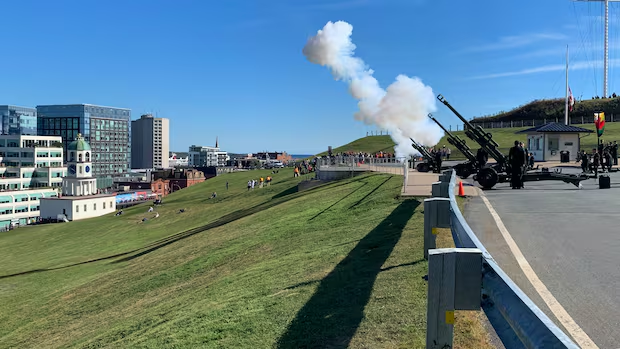
The custom originated as a cost-saving measure in the British Navy
Twenty-one-gun salutes will ring out across the country in celebration of Canada Day today, from Signal Hill in St. John’s, N.L., to Fort Rodd Hill in Colwood, B.C.
The Canadian military ceremonially fires 21 guns to honour heads of state and commemorate occasions like Remembrance Day, and the tradition isn’t unique to Canada. Countries as diverse as China, Egypt, France, the United States and the United Kingdom accord dignitaries the privilege of a 21-gun salute.
Twenty-one is literally an odd number to choose.
Why not opt for a nice, round number like 10 or a classic dozen? If grandeur is the goal, a square 25 would be impressive, or an even 30.
How did armed forces the world over settle on an uneven number like 21 that has no obvious symbolic value?
The answer goes back to an age-old pursuit: administrative cost-cutting.
During the Age of Sail, it was etiquette for European ships passing each other at sea to show a sign of their goodwill and peaceful intent, either by firing their cannons or — when paying respect to a ship of the nation in whose territorial waters they were sailing — by lowering their topsails.
The word “salute” descends from Latin salutare, meaning literally “to wish someone good health.” There was no clearer way to demonstrate that you wished someone well and weren’t a threat to their safety than by discharging your weapons.
It took several minutes to reload a cannon even under ideal conditions, so a ship that had emptied its guns was effectively toothless. It’s no coincidence that “salvo,” which refers to a volley of several gunshots at once, derives from the same root as salutare.
Gun salutes weren’t reserved for ship-to-ship communication; they were also fired between ships and fortresses on shore, to welcome officials, and even when crews toasted high-ranking officers.
The only problem was that sailors proved to be a bit too trigger-happy. According to The Oxford Companion to Ships and the Sea, “gun salutes were fired on every possible occasion and were often unlimited in extent, largely due to a predilection of naval officers of all nations for loud and prolonged noise.”
In a journal entry for May 22, 1660, famous English diarist Samuel Pepys recounts being aboard a naval vessel when two dukes arrived, leading the entire fleet to fire their guns in salute. At dinner, two shots were given as each officer drank to the king’s health, then again when they toasted the duke’s health.
When word reached them that the king was nearby, the fleet fired off another two volleys, and Pepys, bending too low over his own cannon, almost lost an eye in the process. Taking stock later that evening, he wrote: “Nothing in the world but going of guns almost all this day.”
At the time, Pepys was a clerk in the office of the exchequer — a government bureaucrat. He would eventually rise through the ranks to become chief secretary to the Admiralty, the department responsible for the Royal British Navy.
By 1675, the Admiralty considered gun salutes a significant waste of gunpowder. The efficiency-minded Pepys was tasked with reining them in, one of many steps he took to regulate the navy during his tenure as chief secretary.
Instead of letting sailors blast away with any number of guns, Pepys developed a system of salutes based on rank, starting from a volley of three guns for a minor official and increasing by odd numbers up to 19 guns for the admiral of the fleet.
He added two more guns for a salute to the monarch, for a total of 21.
Pepys seems to have chosen odd numbers of guns because even numbers had a decidedly unfestive connotation: they were associated with death.
In 1688, former British naval commander Nathaniel Boteler wrote that when an even number of guns was fired it was “received for an infallible sign, that either the captain, master or master gunner is dead in the voyage.”
Over the course of the 19th century, several nations including the U.K. and the U.S., agreed on international standards for saluting, adopting 21 guns as the highest honour exchanged between nations. Today, the 21-gun salute serves to pay tribute to a country and its most senior representatives.
It’s not the only salute still in use. A version of Pepys’ ranked saluting system survives in Canada to this day.
Members of the royal family and the governor general may receive a salute of 21 guns, but the prime minister and armed forces field marshals are due a salute of 19 guns, the minister of national defence and military generals are due 17 guns, lieutenant governors, lieutenant-generals, and various other officials are due 15 guns, and so on down to 11 guns.
The 21-gun salute is not to be confused with the three-round volley, often referred to colloquially as a 21-gun salute. In a three-round volley, seven guns, usually rifles, fire all at once three times. In a true 21-gun salute, artillery cannons fire individually 21 times.
Though in both cases 21 shots are fired, the three-round volley is typically used as a sign of respect at military funerals rather than a greeting for leaders.
So, if you have a chance to witness a 21-gun salute this Canada Day, spare a thought for Samuel Pepys and all the money he’s saved us in gunpowder.
Ainsley Hawthorn, PhD, is a cultural historian and author who lives in St. John’s.
Related Stories
 Canada
Connor’s late goal lifts Winnipeg Jets to 3
53 minutes ago
 Canada
Family overjoyed after beloved pet bunny Biscuit, who was stolen from Markham fair, safely returned
54 minutes ago
 Canada
Calgarians' quality of life declining amid affordability concerns: survey
1 hour ago
 Canada
Ottawa, Alberta highlight military defence partnership ahead of referendum
1 hour ago
 Canada
Elon Musk says Quebec, Alberta and Saskatchewan should separate from Canada
1 hour ago
 Canada
Canned, frozen vegetable merger cancelled after Competition Bureau push
2 hours ago
 Canada
Federal update on MAID legislation
2 hours ago
 Canada
Average asking rent down 2.9% in B.C. in September, marking 2 years of decreases: report
2 hours ago