
What you need to know about using a heat pump in northern Ontario
What you need to know about using a heat pump in northern Ontario
Local experts recommend a backup, but say operating costs are 'fantastic'
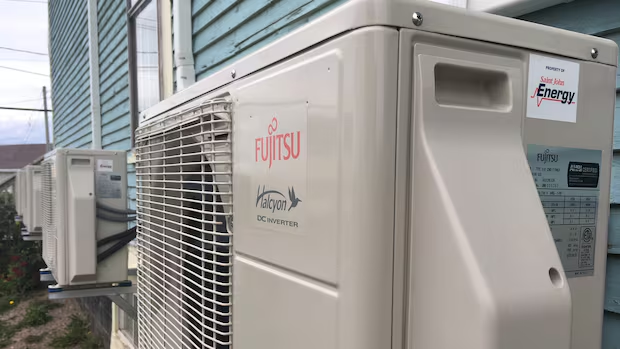
After news broke Tuesday that the Canadian government will pay $2 billion to homeowners who install heatpumps, starting early next year, CBC News Sudbury reached out to experts to learn more about how effective the technology is in frigid temperatures.
Ottawa to provide $2B in rebates for homeowners who install heat pumps
What we know about Ottawa's $2B rebate plan for heat pumps
Do heat pumps work in low temperatures?
Heat pumps are rated on a scale called SEER, or Seasonal Energy Efficiency Ratio, explained Anthony Davis, the operations manager at Greater Sudbury Plumbing, Heating, and A/C. The higher the SEER rating, the more efficient a heat pump is.
He said the most efficient heat pumps available in Canada right now can handle around -35 degrees celsius, give or take.
Those are often called "cold climate heat pumps," said Steve Filioglou, the general manager at Tombari HVAC in Sault Ste. Marie.
But both Filioglou and Davis said they recommend pairing a heat pump with another heat source — be it natural gas, propane or electric heat — for those times in northern Ontario when the temperature dips to -40 degrees celsius and below.
Davis said that he thinks the day is coming when a heat pump will be the home's only and primary heat source, and the technology is "improving substantially, year after year."
How heat pumps work: A visual guide
Martin Luymes, the vice president of government and stakeholder relations for the Heating, Refrigeration and Air Conditioning Institute of Canada, told CBC News that consumers should be careful which contractor they work with, because there's a mistaken impression among some contractors that the latest heat pump technology can't handle cold temperatures.
"[The contractor] will say, 'well, I don't know, I don't really trust that equipment,'" said Luymes. "What they're really saying is, 'I don't understand it. I've not taken the time to master it, so I'm gonna recommend an alternative solution,' which is likely a natural gas furnace or boiler, right, because that's what they're comfortable with. That's a bit of a problem in the industry."
Is it worth it to install a heat pump?
Even though they recommend having a heat pump installed alongside an additional heating system, Filioglou and Davis both agreed that installing a heat pump is worth it for the savings.
A heat pump is cost-effective because of how energy efficient it is, Davis explained, calling the operating costs "just fantastic."
"You're only getting -40 [temperatures] for maybe a week or two in the middle of late January, early February, whenever it comes," Davis said.
"Or maybe we don't see it at all; sometimes we get mild winters. So that heat pump might be working 365 days a year, saving you money."
Filioglou said a lot of people in rural areas, who are on forced air propane or forced air oil, have been able to supplement that with centralized heat pumps.
"Especially with oil and propane prices, they're astronomical these days, so a lot of people in those rural areas wanna offset [that]," said Filioglou.
"The nice thing with these systems is that you get the best of both worlds, right?"
Both Filioglou and Davis said they frequently get requests for heat pump installations, and expect to hear from a lot more customers after the government's announcement.
Gabrielle is a journalist for CBC News in Ottawa and Sudbury who loves to learn new things. She has a bachelor's degree in the humanities and journalism from Carleton University and has previously written for tech outlets like TheGamer and MobileSyrup. Reach out to her for any reason at gabrielle.huston@cbc.ca.
Related Stories
 Canada
Carleton University's Indigenous journalism program welcomes first Inuit students
12 minutes ago
 Canada
High costs haunt Canadian ornamental pumpkin farm
12 minutes ago
 Canada
Alberta separation raises questions about agricultural exports, trade agreements
12 minutes ago
 Canada
France envoy: Canada key partner in turbulent world
12 minutes ago
 Canada
Ample rainfall brings mushroom boom to Nova Scotia
1 hour ago
 Canada
Northern Lights illuminate west Wales and England's south coast
1 hour ago
 Canada
1 dead, 1 hospitalized after 2
2 hours ago
 Canada
El Niño vs. the polar vortex: Canada’s winter wildcard is waking up
2 hours ago