
What the CIA director’s mystery trip to Moscow says about Putin's next move
What the CIA director’s mystery trip to Moscow says about Putin's next move
Russia's president appears poised to escalate conflict in Eastern Europe
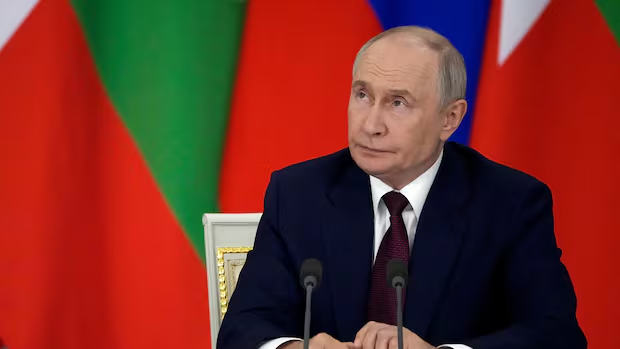
As Russia’s war against Ukraine reaches an inflection point, a conspicuous U.S. intelligence mission to Moscow this week has revealed a fractured debate among allies over Vladimir Putin’s next move.
For weeks now, analysts have speculated that Russia’s strongman president has given up on the notion that U.S. President Donald Trump might be able to coerce Ukraine into meeting his maximalist surrender terms. The thinking is Putin may have decided his five-year war against the country can only be concluded by expanding the conflict.
With Russia’s economy worsening and the pool of volunteers willing to accept a generous paycheque to fight in Ukraine dwindling, Putin could be facing several options.
Ukrainian intelligence officials believe he will soon initiate an unpopular mass mobilization that could send hundreds of thousands of new conscripts into battle, with the goal of overwhelming Ukraine's overstretched defences.
Soldiers from Russia’s poorer regions have made up a disproportionate amount of the fighting force in Ukraine. A country-wide mobilization could draw in men from the more affluent major cities.
Military think-tanks on both sides of the Atlantic have also warned Putin could try to divide Ukraine’s backers in NATO by staging some kind of provocation in Eastern Europe aimed at splitting the alliance.
Carney says Putin's 'barbarism' against Ukraine will not succeed
Presumed and confirmed Russia hybrid attacks across Europe — including attempted assassinations, sabotage and frequent drone incursions — have all intensified of late. But planners remain concerned that Russia could be tempted to seize a slice of Russian-speaking territory in a neighbouring country as a test to see how the alliance would respond.
Russian officials themselves have raised the possibility this week that they could strike directly at Western weapons manufacturers who supply Ukraine, most notably in Great Britain.
The speculation over Putin’s next move hit a fever pitch earlier this week after the unusual visit by CIA Director John Ratcliffe to Russia.
Rather than slipping into Moscow on a business jet, the standard protocol for clandestine diplomacy, Ratcliffe arrived at Vnukovo airport aboard a massive, highly visible U.S. Air Force C-17 Globemaster.
Its transponder broadcast the flight path openly across the Atlantic.
U.S. officials appeared to want the world to know Ratcliffe’s visit to Moscow was significant and that they had something they wanted the Russians to hear clearly.
"It kind of reached a point inside the administration where they said, ‘We need to read the Russians the riot act,'" said Glen Howard with the Saratoga Foundation, a Washington, D.C.-based security think-tank with a focus on Ukraine.
But what message was Ratcliffe trying to convey?
Initially, the Wall Street Journal reported the mission was a direct ultimatum to Putin: Back off an escalating grey-zone campaign of hybrid sabotage against NATO's eastern flank or risk triggering a direct allied response.
Military planners have long contemplated whether Putin, in order to get a favourable settlement in Ukraine, might try to draw the United States or NATO directly into the war. Staging a modest attack on a small Baltic nation and testing the Article 5 collective defence provision of the NATO treaty might be one way to do that.
The following day, however, Trump himself appeared to dismiss this, saying he wasn’t worried about a Russian attack on NATO, calling Radcliffe’s trip "semi-routine."
Hours later, the New York Times published an account along the lines of what Trump said that contradicted the earlier reporting. It suggested NATO was not the main topic of the meeting; instead, the warning was for Putin to end his war on Ukraine before Russia’s economic and military situation worsened.
Canada’s largest overseas military deployment is in the Baltics. More than 2,000 soldiers are based in Latvia, tasked with the goal of deterring any Russian adventurism there.
Canadian military and security analyst Wesley Wark doesn’t believe Putin is interested in provoking NATO directly, even with the U.S. politically and militarily weakened by the war in Iran.
"I think concerns about Article 5 are overblown," Wark told CBC News in an email. "My main guess is that Ratcliffe went to Moscow to deliver a message primarily about the seriousness with which the U.S. intends to mount economic sanctions against Iran, with a warning to Russia not to interfere."
Russia is one of Iran’s key international military backers and Putin’s government may be giving Iran targeting information to help guide strikes on U.S. military bases in the Persian Gulf.
The immediate reaction to Ratcliffe's visit from countries such as Latvia also downplayed the risk of a confrontation with NATO. The country’s foreign minister posted on social media that "Latvia’s threat assessment remains unchanged."
Yet in Britain — where Putin’s agents have notoriously staged attacks before, including the deadly 2018 Novichok attack in Salisbury — intelligence agencies have warned that sensitive industries in the defence sector should be on high alert.
On Wednesday, Russian foreign ministry spokesperson Maria Zakharova was unusually direct with her threats, warning that Russia could strike at targets inside and outside the U.K. if the British government didn’t back off on its assistance to Ukraine.
On his recent visit to Kyiv, Prime Minister Andy Burnham said he would give Ukrainians the blueprints to make their own long-range missiles that could hit targets deep inside Russia.
Ukrainian authorities appear convinced the potential Russian threats against NATO, Great Britain and other targets in Europe are just distractions, and that when Putin’s escalation comes, it will be directed almost entirely at them.
"I think Putin sees a window of opportunity," said Yuriy Boyechko, who runs the U.S.-based Hope for Ukraine, a humanitarian organization that sends emergency supplies to the country in the aftermath of Russian bombing.
"I think Putin is planning this winter to basically bring Ukrainian society to pain and despair, because of lack of energy or the lack of food ... and they [Ukrainians] will turn on the Ukrainian government."
While Putin's plan stands to bring immense hardship to Ukraine in the coming months, he says it won't break the country's spirit.
"As we know from the past, none of his strategies are successful. So I'm optimistic about that."
The ferocity and intensity of missile attacks on the capital, Kyiv, and other cities has escalated of late, with as many as 800 Russian drones being launched on a single night.
The scarcity of interceptor missiles, such as U.S.-made Patriots, has left cities defenceless and sent civilian casualties soaring.
Boyechko says as Ukrainian cities are being terrorized, he believes Putin will use his newly mobilized army of recruits to try to overwhelm the country’s defences in the south.
"His hope is that those 600,000 new troops will be able to break through the front lines and capture some territories. He is not looking just to take Donetsk, Luhansk region or Zaporizhzhia — he wants to go all the way to Kyiv."
Putin reportedly believed the invasion he launched in February 2022 would only last a few days and that Kyiv would fall easily. Instead, Western sources claim Russia has suffered up to 1.4 million casualties, including those killed, wounded or missing.
A mass mobilization carries risks for Putin, too, says Howard of Saratoga. It will be immensely unpopular and could spark a new brain-drain from the country. Civilian factories and agriculture could also be robbed of workers required to maintain basic supply chains and keep Russia’s wartime economy going.
"What he may do is in increments try to generate the forces," Howard said.
Whether Ratcliffe’s recent flight was meant to shore up NATO, protect the Baltics or isolate Iran, the grim reality on the ground suggests Ukraine will bear the immediate brunt of whatever direction Putin chooses.
Chris Brown is a foreign correspondent based in the CBC’s London bureau. Previously in Moscow, Chris has a passion for great stories and has travelled all over Canada and the world to find them.
Related Stories
 Business
Her Startup opens second cohort for African women founders
1 hour ago
 Business
South Korea picks 10,000 for second ‘Startup for All’ amid 9.3:1 competition
2 hours ago
 Business
News that Winnipeg homelessness data was inflated could hurt funding, researcher says
2 hours ago
 Business
Scimplify Bags $25 Mn To Scale Its Semiconductor Chemicals Business
5 hours ago
 Business
Fintech census puts Canberra’s startup tax debate to the test
5 hours ago
 Business
Minto business centre reflects on industry, hosts workshop series
7 hours ago
 Business
Business News: Major BC brands expanding
9 hours ago
 Business
RBL Bank taps Emirates NBD network to expand NRI banking, Gulf business
9 hours ago