
What is your seafood eating? Investigation traces problems in global feed supply
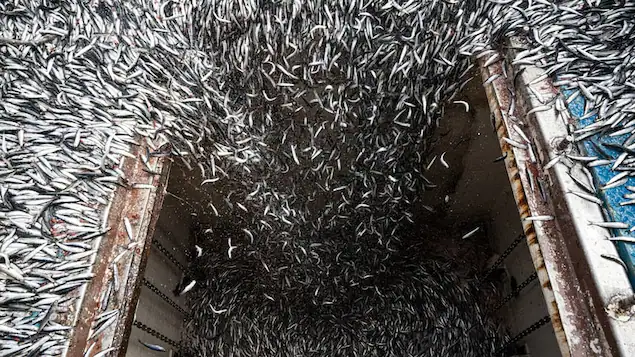
Small fish like these Peruvian anchoveta are harvested from the wild to produce fish oil and fish meal that feeds aquaculture operations around the world. An investigation by The Outlaw Ocean Project traces those global supply chains that are linked to pollution, labour abuses, overfishing, and food insecurity in poorer countries.
Photo: (Ernesto Benavides/AFP/Getty)
Ian Urbina (new window) · for CBC News
In 2020, a team of government investigators in Goa, India, arrived at a factory named United Marine Products to find out how it was disposing of its toxic wastewater.
The following story is part of a larger investigation (new window) conducted by an international team of journalists (new window) based at The Outlaw Ocean Project, a news organization in Washington, D.C.
For years, local residents had complained that the factory was making their air unbreathable and their drinking water deadly. This factory produces fish meal, a protein-rich powder used to feed farmed fish, which is made by pulverizing and cooking wild-caught fish.
Soon enough, the inspectors discovered that the plant operators had employed a new and illegal way to dispose of the facility's wastewater, drilling bore holes into the ground in a field behind the plant. The authorities later concluded (new window) these holes likely contaminated groundwater and sickened villagers and livestock.
The plant owner (new window) denied wrongdoing.
Seafood consumers in Canada might think they have no connection to these sorts of far-away problems.
But this factory in India supplied Skretting, a major feed producer used by dozens of fish farms in Canada — so its product may feed the salmon from British Columbia and New Brunswick or trout from Quebec you see on store shelves.
A five-year investigation by The Outlaw Ocean Project (new window), a news organization in Washington, D.C., uncovered a variety of similar hidden costs involved in producing this feed, including the loss of artisanal fishing jobs, chronic chemical exposure, avoidable worker deaths, and violent protests spurred by the horrid stench from fish meal factories.
These social and environmental impacts exact a price primarily paid by the poorer countries where the feed ingredient is harvested and processed, far from where the resulting luxury types of seafood are eaten.
Whether domestically raised or imported, the most popular types of farmed seafood consumed in Canada – salmon, shrimp, trout, sea bass, sea bream – are fed fish meal, which is made from the very kinds (new window) of wild fish that aquaculture claims (new window) to be saving (new window), thereby accelerating ocean depletion, say fisheries scientists.
Any accounting of the true impact of aquaculture has to start not with the farm, but with the feed, said Daniel Pauly, project director of the Sea Around Us initiative at the University of B.C. in Vancouver.
And that kind of accounting offers a very different picture than the industry offers.
Canada’s reliance on global fish meal
Since 2022, more than half of the seafood eaten globally has come from fish farms rather than wild catch, according to the UN Food and Agriculture Organization (new window). Aquaculture is a $444-billion industry and the fastest-growing segment of global food production. Most of these fish farms are powered by fish meal and fish oil, made from wild fish pulled from the ocean.
Unlike growing bivalves such as oysters, clams, and mussels, which do not typically require external feed, the toughest challenge to raising carnivorous seafood, such as salmon and trout, is feeding them.
Canada has more than 200 fish farms, most of which rely on fish meal or fish oil that, when made domestically, comes primarily from Pacific anchoveta, chub mackerel, herring, haddock, pollock, sardines, and frigate tuna.
Canada prohibits boats targeting fish for the sole purpose of making fish meal or fish oil, so domestic fish meal is typically made using skin, bones and other byproducts of processing that would otherwise be thrown away. That’s widely viewed as a more sustainable way to produce feed protein than using whole human-edible fish.
However, at least two-thirds of the fish meal used in Canada, primarily by aquaculture farms – roughly 53,000 tonnes in 2023 – is sourced from abroad, which ties Canadian consumers to these hidden and overseas social costs. Canada also imports more than $4 billion in seafood annually, of which a third is primarily farmed salmon and shrimp, which rely heavily on fish meal and fish oil.
The Outlaw Ocean Project’s five-year investigation (new window) mapped roughly the entire global fish meal industry, including more than 1,400 fish meal factories across 64 countries, tracing supply chains from fishing vessels to processing plants, feed mills, fish farms and seafood retailers.
The reporting effort involved dozens of journalists from as many countries who visited factories and farms and boarded fish meal ships at sea.
In Gambia and Mauritania, the investigation documented how the industry drives food insecurity as fish that once sustained local communities are diverted into fish meal factories for export.
The investigation assessed more than 2,400 ships tied to fish meal production in at least 30 countries. It found that most of these ships do not fully comply with the Global Charter for Fisheries Transparency (new window), a guide created by ocean-focused civil society groups detailing accountability standards for industrial fishing fleets.
For example, less than 30 per cent of the fleet had publicly available location information and less than 25 per cent had a unique vessel identification number (or ship licence plate). Such opacity makes the fleet difficult to police.
At least half of the species landed by the assessed fish meal vessels were classified by scientific studies as overexploited or worse — including flat and round sardinella in Senegal, oil sardines in India, and anchoveta in Chile.
Most of the vessels in the global fish meal fleet are purse seiners or trawlers, which deploy vast nets to capture dense schools of fish, which can indiscriminately sweep in bycatch and non-target species.
At least 165 of the ships in the fleet were bottom trawlers, a destructive gear type that scrapes the ocean floor with weighted nets.
Fish meal reliance declining, industry says
In response to questions from The Outlaw Ocean Project about the sustainability of fish meal, the IFFO (new window), which is the international fish meal association, emphasized that its role is not to advise which markets should use fish meal and fish oil.
Véronique Jamin, a spokesperson from the organization, said that fish farming is the most efficient animal protein system and is becoming more efficient over time.
In response to a question about overfishing by the fish meal industry, Jamin said, Because small pelagics are fast-renewing stocks, their sustainable harvest threshold is much higher than for slow-growing species like cod, tuna, or deep-sea fish.
The feed and aquaculture industries have emphasized that they are decreasing their reliance on fish meal and fish oil by adding other ingredients to the mix, such as insects, algae, and krill. Between 2000 and 2020, the share of fish meal in global aquaculture feed fell from 23 per cent to eight per cent, according to the IFFO (new window).
Producers of salmon, which typically requires larger amounts of fish meal and oil to thrive, say they have made progress, too. Members of the Canadian Aquaculture Industry Alliance, which includes large producers like Cermaq and Mowi, reduced the proportion of these ingredients in salmon feed to less than 20 per cent, according to a November 2025 press release (new window).
These results show salmon farming companies have adopted science-based methods that have improved the standard of salmon farm sustainability overall in Canada, said Timothy Kennedy, president of the Canadian Aquaculture Industry Alliance, in the release.
However, as aquaculture overall grows so too has demand for fish meal.
For example, to meet demand, five of the world’s largest salmon companies increased their absolute use of fish meal or fish oil made from whole wild fish by as much as 39 percent between 2020 and 2024, according to a report (new window) from the Farm Animal Investment Risk and Return Initiative.
Two of the salmon companies that increased their absolute use of fish meal have a presence in Canada: Mowi, which announced in June 2025 that it was selling its Canadian farms to Cooke; and Grieg Seafood, whose Canadian farms have since been acquired by Cermaq. (Mowi, Cermaq, Cooke, and Grieg Seafood did not respond to a request for comment.)
As of 2025, there were at least seven factories processing fish meal and fish oil in Canada, and these plants are not without problems.
Between 2021 and 2024, at least two of the plants were tied to pollution or unsustainable fishing practices, according to Bait to Plate (new window), an online tool created by The Outlaw Ocean Project that tracks the fishing and seafood industries. Neither company responded to the project’s request for comment.
However, the far greater burden of food insecurity, collapsed fish stocks, social unrest, and air and water pollution is borne by the poorer countries that produce the fish meal or farmed seafood that Canada imports.
For example, Canada imports over a third of its shrimp from India, where the investigation found explosions, fires, and worker asphyxiations at factories producing fish meal that supplies the country’s shrimp farms.
As recently as 2022, United Marine Products, the Goan fish meal plant that was found to be illegally dumping wastewater, supplied fish meal to Skretting Canada, which produces feed for many of Canada’s fish farms.
At another factory called Bismi Aquatic Products in 2021, a migrant worker died while he was cleaning a wastewater tank and passed out from the fumes. Major shrimp brands like IFC and AZ Gems, which source much of their shrimp from India, are sold across Canada at major supermarket chains like Metro Canada, Loblaws, and Costco Canada.
Skretting (new window) has a zero-tolerance policy for breaches of its policies that clearly state business partners abide by all applicable laws and regulations that govern their business activities, said the company’s Sustainability and Communications Director, Jorge Diaz, and has opened an investigation to verify the information found in this reporting.
In response to questions from Outlaw Ocean, Metro spokesperson Stephanie Bonk wrote (new window): All Metro suppliers are required to respect working conditions across the supply chain as outlined in our Supplier Code of Conduct for responsible procurement.
IFC, AZ Gems, and Loblaws did not respond to a request (new window) for comment.
Related Stories
 World
World
Alexander Zverev to end year as world number one after Carlos Alcaraz loses
51 minutes ago
 World
World
Elon Musk quietly becomes biggest known donor in midterm contests as he tries to save Republicans
51 minutes ago
 World
World
On Yemen's desert battlefield, a war with global consequences is being waged
51 minutes ago
 World
World
Six Ukrainian energy sites hit by Russia since Trump announced ceasefire, Zelensky says
51 minutes ago
 World
World
Iran ‘almost certainly’ behind US air
1 hour ago
 World
World
Global News Podcast | French supermarkets say fridges targeted in cyberattack
2 hours ago
 World
World
Video. Latest news bulletin | October 12th, 2026
2 hours ago
 World
World
Rugby League World Cup 2026: Schedule, dates, format, results from men's, women's, and wheelchair tournaments
5 hours ago