
What connects Canadian and Mexican workers? This artist explains, with the help of a piñata
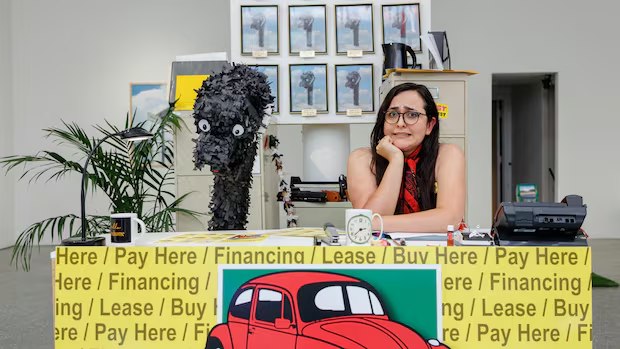
What connects Canadian and Mexican workers? This artist explains, with the help of a piñata
Hamilton exhibit runs until Dec. 11 at the Workers Arts and Heritage Centre
For Manuela, an overworked and underappreciated immigrant, it's hard to compete with her co-worker Willie.
Sure, Willie's a goose and a piñata — but he doesn't ever stop working. And management likes that.
"He's the employee of the month, every month, because he sells so much. He's so committed. He works 24/7," said Anahí González. She performs as Manuela in her new exhibition, Para Ayer.
The Mexico-born artist's show runs until Dec. 11 at Hamilton's Workers Arts and Heritage Centre (WAHC) and looks at the "urgency that shapes labour within trade and production networks connecting Mexico and Canada."
On her Instagram account, González says the show, Para Ayer includes "scenarios highlighting the impact of Canadian imperialism in Mexico."
Para Ayer means "due yesterday" in Spanish. It's a term often used when something needs to be done immediately.
"Many bosses have told me that," said González.
"'This was for yesterday.' Meaning, 'you're already late.' You didn't even know you needed to do that, but you're late."
This is not González's first exhibit and she has performed with Willie before. She said people have related to her character on different levels. From immigrants who feel like they can't speak their language at work to Canadian women who also feel underappreciated.
González said she hopes visitors leave with curiosity.
“If, from my exhibition, someone says, 'I didn't know that,' and they go back home and do a quick reading. That's the goal," she said.
González is originally from Saltillo in the state of Coahuila, Mexico.
The city is an industrial hub in auto manufacturing. Cars and parts made in Saltillo are sold in Canada.
The exhibition looks at what that industrial relationship means for the people and communities connected to it, from the movement of migrant workers to the movement of products, capital and resources.
González explores how trade affects workers directly, such as the loss of 3,813 jobs in the state of Coahuila, according to Mexican media such as Proceso, amid tariff uncertainty.
González said she also wanted Mexican people to be more aware of her neighbours in the far north.
"In the north of Mexico, we always talk about the United States, but what about Canada?" she said.
Canada represents the largest group of foreign investors in Mexico’s mining sector which, according to a Simon Fraser University journal article, has had devastating affects for "small, poor, rural [and] especially agricultural and indigenous communities."
González said it goes beyond mining, however, as Saltillo, which is in a desert region with limited water, sees companies receiving quick permits because of the promise of employment.
“But there's no unions, but there's no protection of workers, but it's cheaper,” she said. “And who benefits from that?”
Exhibit like this only possible in Canada
González said an exhibit like this, however, would not be possible back home. She's tried.
"Immediately the reaction is, well, 'why are you criticizing the person that gives you the food?' And I'm like, 'you don't question [it]?'" she said.
She also said in conversation with migrant workers in Leamington, Ont., Mexican farmworkers who have gone through various hardships and difficult working conditions while in Canada, still have a similar mindset.
“Of the 10 people I talked to, they were like, 'it pays things in Mexico,' 'I'm grateful to be here,' 'it's better than the States,'” she said.
“Why are we conditioned to be grateful of the work that we have, of the pain that we have and accept bad conditions just because.” she said.
During the exhibit, González is also working with Kaite Lawson, a Toronto-based artist, will also be talking about migrant workers advocacy and food systems during a free workshop.
Post cards designed by Laura Rojas will also be featured at the workshop on Oct. 8.
"They have beautifully designed slogans like 'no temporary workers in a permanent system,' … making it very clear where we stand on how important and valuable agricultural workers are in food security in Ontario," said Sylvia Nickerson, programming and exhibitions specialist at the WAHC.
Participants will be asked to write on the postcards and mail them to the Office of the Prime Minister. Food will be provided by a local Mexican restaurant. Registration for the event is required.
"There's an opportunity at that workshop to do some action around that issue, as well as talk about it and reflect on it and become a little bit more educated about it."
Aura Carreño Rosas is a reporter at CBC Hamilton. She's originally from Venezuela. She has extensive experience in covering stories about immigrants and migrant workers as well as interesting people with diverse journeys. You can contact her at aura.carreno.rosas@cbc.ca
Related Stories
 Canada
Canada prosecutors drop charges against two in Toronto gold heist
55 minutes ago
 Canada
CEO who posted about wearing ’Lake America’ sweatshirts to Halifax is no longer CEO
55 minutes ago
 Canada
Man shot during Trump assassination attempt in 2024 dead at 76
1 hour ago
 Canada
News of the day: Carney says he’s examined risk of U.S. military action against Canada, and more
1 hour ago
 Canada
Why more than 270,000 Ford vehicles are being recalled in Canada, U.S.
1 hour ago
 Canada
Why Canada's former UN ambassador says Trump has crossed the line
1 hour ago
 Canada
Only 150 first
1 hour ago
 Canada
Canada names Montreal Victoire's Kori Cheverie head coach of women's team
2 hours ago