
What Bundesliga’s Captain tells us about AI
For IT pros, improving customer experience (CX) requires rethinking the architecture, governance, and operating models to support AI-native experiences.
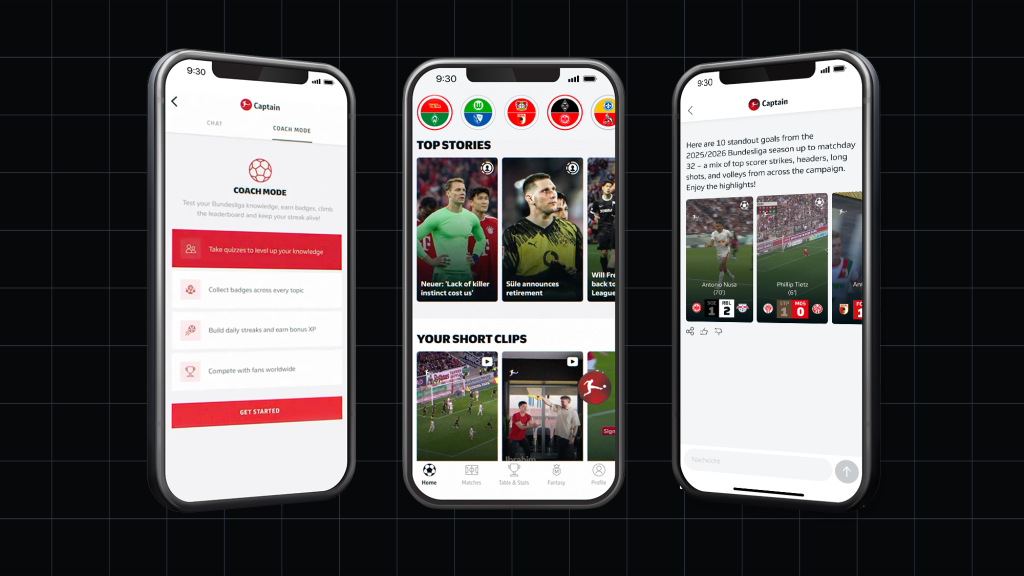
The Bundesliga has long talked about turning “data into devotion,” and now it has an agentic AI companion in its official app that lets fans chat in natural language, access live stats and historical context, and view personalized video highlights—all without leaving the app.
Bundesliga is the premier professional soccer league in Germany. It built its new AI companion, called Captain, on AWS and embedded it in the official league app. For IT pros, this is more than just a clever sports-tech use case. It’s an early glimpse of what the customer experience will feel like when generative and agentic AI are not bolted on but, instead, become the primary way users navigate data, content, and services.
Captain serves as a conversational interface in the Bundesliga app, acting like a knowledgeable friend who watches every game with you. Fans can ask questions like, “How has Jamal Musiala been playing for Bayern this season compared to his national team?” and receive responses grounded in official league data, complete with stats, historical context, and relevant clips.
Under the hood, Captain uses a multi-agent architecture built on Amazon Bedrock and Amazon Nova, dynamically routing each request to the appropriate model and workflow. Simple questions go to a lightweight model, while complex reasoning and data mashups are handled by more capable models, with text-to-SQL pipelines translating natural language into queries against the Bundesliga’s analytics stack. The result is a conversational front end built on a robust data platform.
What makes this notable is not only the UI but also the data infrastructure needed to deliver these capabilities. Historically, the Bundesliga tracked one point per player per second, generating roughly 3.6 million data points per match. With their move to 3D skeletal tracking—21 points per player at 50 frames per second—they now process roughly 200 million data points per match.
That data lands in a modern analytics and AI stack on AWS, including:
On top of this, a set of agentic workflows continuously monitors live events, generates candidate “stories,” and pushes the best ones into Captain so fans see relevant narratives without having to know what to ask. This same foundation is already being used by the league to generate thousands of AI-powered narratives per season for broadcasters and editors, demonstrating how editorial and fan experiences can share a common AI backbone.
For IT leaders, a key lesson learned is that data strategy is as important as model selection in building compelling generative AI experiences.
What this signals about the future of customer experience
Captain illustrates several important shifts that will define AI-driven CX across industries.
Implications for IT pros and CX leaders
For IT pros, CX improvement requires rethinking the architecture, governance, and operating models to support AI-native experiences. Here are some things to consider.
1. Start with a data-first mindset. Captain only works because the Bundesliga invested years in building a robust data foundation. That includes high-fidelity tracking, consistent schemas, and streaming infrastructure. Before promising AI companions to your business stakeholders, you need to:
Without this groundwork, generative AI projects risk turning into expensive prototypes that can’t scale.
2. Think in terms of AI agents, not just models. Bundesliga’s architecture separates concerns into agents: a router agent to determine intent, stats agents to query the right backends, and research agents to autonomously investigate events and propose stories. IT teams should similarly design:
This moves you from one big LLM to an orchestrated system in which different components can evolve independently.
3. Leverage dynamic routing for cost and performance. Bundesliga explicitly uses dynamic model routing. This approach uses lighter models for simple questions and more powerful ones for complex reasoning, cutting chat costs by more than a third without sacrificing accuracy. Enterprise IT can borrow this pattern:
The result is an AI experience that scales economically rather than collapsing under inference costs.
4. Redefine UX around conversation and context. Captain’s UX is not just chat; it’s chat tightly coupled with video playback, stats visualization, and contextual recommendations. For IT and product teams, this means:
Generative AI should be treated as a new interaction layer, not a standalone feature.
5. Treat safety and trust as first-class requirements. Captain is built on official league data and protected by content safety guardrails to prevent hallucinations or inappropriate content. In enterprise settings, this translates to:
Trust will be the differentiator between AI experiences that delight and those that harm brand equity.
How IT pros should think about next steps
For most organizations, the Bundesliga’s Captain should be viewed as aspirational but certainly doable. Practically, IT pros can start by:
The Bundesliga shows what happens when an organization treats AI not as a feature but as a new way to connect with fans. IT leaders who treat generative and agentic AI as central to their customer experience strategy will be the ones who turn their own data into genuine customer devotion.
Related Stories
 AI News
Bill Gross bets AI can help mass
5 hours ago
 AI News
Nigeria records 93% rise in AI micro
5 hours ago
 AI News
The Italian gelato maker using AI to invent new flavours
5 hours ago
 AI News
Closing the Gap Between Agentic CX Pilots and Production
5 hours ago
 AI News
New Brunswick data centre debate highlights cross
6 hours ago
 AI News
How to Structure an AI Agent Referral Fee Agreement Between Startups
6 hours ago
 AI News
No, AI didn’t delete a Swedish reality TV series
6 hours ago
 AI News
There is no AI in Armageddon. Artificial intelligence is a tool, not an apocalypse
6 hours ago