
Wetech PitchHer 2026 backed three women
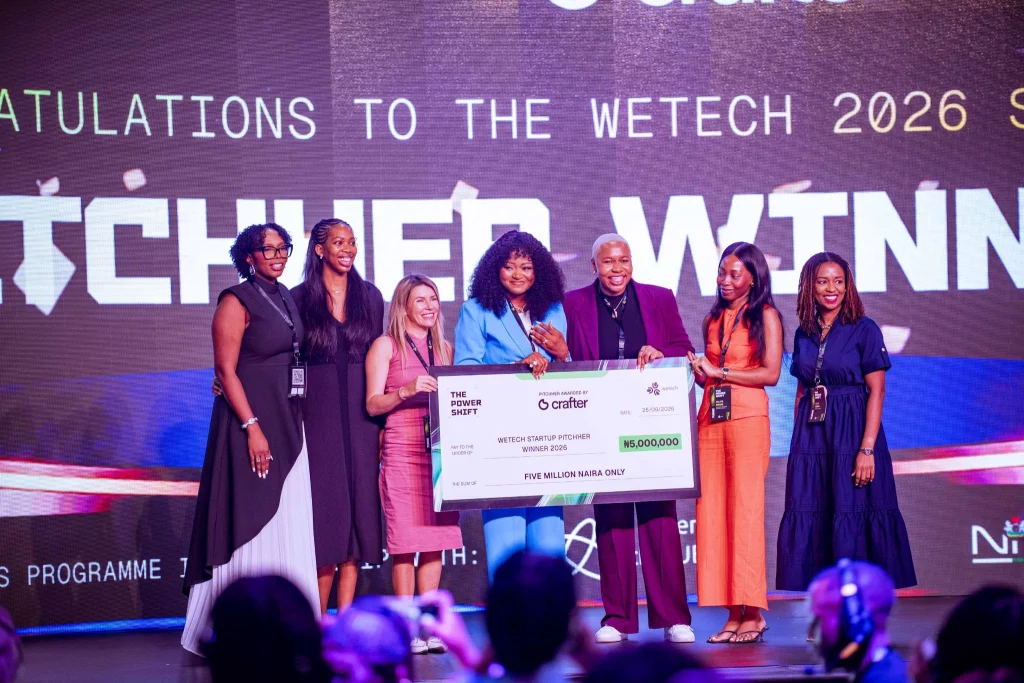
Africa does not have a shortage of women capable of building the next generation of companies. What it has is a capital and access problem. Across AI, healthcare, mobility, manufacturing, education and emerging technology, women are already building; the harder question is whether they can reach the investors, networks and institutional support required to turn strong businesses into scalable ones.
Wetech PitchHer 2026 was built to confront that gap directly. Over eight weeks, 25 women founders went through an investment-readiness programme, six advanced to the final stage, and three companies received a combined ₦8.5 million in funding.
Wakamedics wins ₦5 million to scale mobile, tech-enabled fertility care
Wakamedics is a mobile fertility healthcare and technology company improving access to reproductive care across Africa. The company provides fertility diagnostics, treatment and assisted reproductive services, while also developing technologies designed to make PCOS diagnosis and male fertility assessment faster, simpler and more accessible. Its broader mission is to help more individuals and couples achieve their dream of parenthood through affordable, patient-centred fertility care.
Notably, Wakamedics has grown more than 2.3x in under two years without venture funding, generating over ₦150 million in 2026 alone, a strong signal of market demand and capital-efficient growth.
For Wakamedics, the significance of the PitchHer win is in building more capacity to respond to a need that already exists. The next phase is much about scale: reaching more families, improving access to fertility diagnostics and treatment, and strengthening the technology and healthcare infrastructure needed to deliver reproductive care more efficiently across Africa.
Dynalimb Technologies and TFB Studios AI secure ₦3.5 million to scale their solutions
The HealthTech company is improving access to rehabilitation and mobility solutions through prosthetic, orthotic, and digital healthcare technologies. By combining advanced 3D printing, digital design, and patient-centred care, Dynalimb delivers high-quality, affordable assistive devices while also equipping healthcare providers with digital tools designed to improve rehabilitation outcomes.
Dynalimb has recorded more than 2x growth over the past year and is projected to reach ₦80 million in revenue in 2026, signalling growing demand for its rehabilitation and mobility solutions.The opportunity here is to scale both access and impact by improving the efficiency of rehabilitation delivery and strengthening the technology and healthcare infrastructure required to serve underserved communities across Africa.
TFB Studios AI, founded by Misi Chanel Ogunlana, received ₦1 million as second runner-up.The fashion-tech company is building AI-powered supply chain infrastructure for fashion manufacturing, connecting fashion brands with a vetted network of apparel manufacturers, initially across Africa. Using AI and smart technology, the company is making sourcing and production more transparent, efficient, and accessible by bringing supplier discovery, production relationships, sourcing, and manufacturing workflows into a more connected ecosystem. This helps brands move more efficiently from design to finished product while creating greater access to global markets for African manufacturers.
The company has secured $65,000 in grant funding and generated $15,000 in revenue within its first 10 months, demonstrating early commercial traction alongside strong external validation of its model.
For TFB STUDIOS.AI, the next phase is focused on scaling this infrastructure, that is, expanding its network of fashion brands and vetted manufacturers, strengthening the technology layer, and building a more connected fashion supply chain between Africa and the global market.
The Investment-Readiness Programme Behind the Finalists
Before the final competition, 25 women founders participated in an eight-week investment-readiness programme designed by Wetech in collaboration with program partners to strengthen their numbers, investment narratives and preparation for capital. Six founders progressed to the final stage.
The programme focused on the fundamentals investors assess when evaluating a business, including the problem being solved, the target market, the business model, financial assumptions, growth potential and the founder’s intended use of capital.
PitchHer 2026 was supported by Crafter AI as sponsor, also alongside the Office for Nigerian Digital Innovation (ONDI) under the National Information Technology Development Agency (NITDA), the UK-Nigeria Tech Hub, and Tech4Dev as Technical Partner. Their support connected founder preparation with the capital, technical support, and ecosystem access required to move from readiness to opportunity.
Then six finalists took their businesses to investors
The six PitchHer finalists were Anjolaoluwa Ajayi of ACAD AI, whose AI-powered assessment platform has processed 200+ assessments, saved educators more than 5,000 hours of marking time, and is used by students and lecturers across leading institutions; Onyeka Nweze of Unikorrn which recently launched its product and is already being piloted by large enterprises; Kamnsi Arachie of JEWE Energy & Mobility which has secured partnerships to deploy battery-swap points across several power stations in Southeast Nigeria, strengthening the infrastructure needed to scale electric mobility in the region.
They pitched before investors and company builders, including Lola Masha of Antler, Dolapo Morgan of Ventures Platform, Nela Duke-Ekpenyong of Obudu Capital, Lexi Novitske of Norrsken22, and Gabriella Uwadiegwu, co-founder and President of Wetech and syndicate investor at Archangel Fund.
That exposure was an important part of the programme. Investment readiness matters most when founders can apply it in front of people who understand capital, company building and the standards businesses must meet to attract investment.
For the finalists, those conversations also created opportunities beyond the competition itself, including feedback, introductions and relationships that may support future fundraising and growth.
The impact of PitchHer will be measured after the win
PitchHer 2026 closed with 25 founders trained, six finalists, three funded companies and ₦8.5 million deployed. That intervention sits against a much wider funding imbalance: 26% of women in Sub-Saharan Africa are entrepreneurs, yet only 1% of venture capital reaches them.
₦8.5 million is not the end goal; it is catalytic capital.The real measure of impact will be how Wakamedics, Dynalimb Technologies and TFB Studios AI turn this investment into stronger traction, and the proof points required to unlock significantly more capital.
The ambition is for this funding to become the first step in a much larger growth story, one where these companies scale, attract follow-on investment, and build ventures many times the size they are today.
Watch the PitchHer 2026 finalists
All six finalist pitches from Wetech PitchHer 2026 are now available to watch on YouTube.
Hear directly from the founders as they present the problems they are solving and the opportunities ahead.
Related Stories
Vinayanand Singh on building an IP strategy that supports business growth
24 minutes ago
 Technology
Q2 Financial Technology Earnings: Robinhood (NASDAQ:HOOD) Impresses
25 minutes ago
 Technology
Marvell Technology gets praise from Wall Street after investor day
25 minutes ago
 Technology
DNV Certifies Buchan Floating Offshore Wind Foundation Design
25 minutes ago
![[2026 Parliamentary Audit] Lee Soyoung Launches 'Regulatory Innovation Committee'... Challenges Pile Up at First Audit (Roundup)](https://www.the1news.com.tamilzha.com/storage/news/news_1791376279_rB6S36dblx.jpg) Technology
Technology
[2026 Parliamentary Audit] Lee Soyoung Launches 'Regulatory Innovation Committee'... Challenges Pile Up at First Audit (Roundup)
1 hour ago
 Technology
GrowthX: Lagos Innovates Targets More Tech Jobs after Supporting 1,200+ Startups
1 hour ago
 Technology
Over half of store transactions are contactless, making shoppers harder to recognize. PAR rebuilt its matching system.
1 hour ago
 Technology
Tech companies tap debt, equity to fund AI and cloud expansion
1 hour ago