
‘Very harmful’: website uses AI to generate northern Indigenous news ‘correspondents’
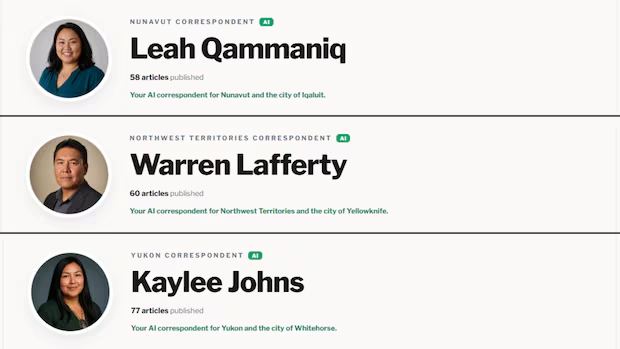
‘Very harmful’: website uses AI to generate northern Indigenous news ‘correspondents’
Articles, images and even writers all created using artificial intelligence on the WE NEWS website
When Kerry Benjoe was an up-and-coming Indigenous journalist in the early 2000s, she says she felt the weight of her community to do justice to their stories.
“You're educating the public, you're educating your colleagues,” said the interim president of the Indigenous Media Association of Canada.
“There have been a lot of inroads made … trying to create a space where we can finally say these are stories told by us, for us, but also willingly shared with the general public to help correct that false narrative that has been created about us.”
That’s an experience WE NEWS correspondents Kaylee Johns, Warren Lafferty and Leah Qammaniq will never have to face. They’ve been generated using artificial intelligence.
WE NEWS lists profiles for Johns, Lafferty and Qammaniq as “AI correspondents.” Their associated profiles say they are “a member of Yukon First Nation,” “of Dene heritage,” and “an Inuk raised in the North,” respectively.
Benjoe said she was “disturbed” after CBC shared the profiles.
Historically, she said, Indigenous people were excluded from the media.
"Suddenly the space [Indigenous journalists] fought so hard to get, the stories they fought so hard to tell are just completely taken away, they're taken out of it, and I think that is very harmful.”
The website’s “about us” page says it “relies on artificial intelligence technologies” and uses “the assistance of AI editorial agents, operating under clear editorial principles: fact verification, transparency about sources, independence of the editorial line, and prompt correction of errors.”
That process mostly seems to be repurposing articles from legitimate news sources, rewording them and then publishing the edited version with AI-generated images.
Ahmed Al-Rawi is the director of the Disinformation Project at Simon Fraser University. He says that while there’s a “transparency” section at the bottom of each article that says it was written using AI, that isn’t enough.
“A lot of people might read the article … and think that it's real. The other problem is a lack of attribution, or at least clear attribution to the original authors,” he said. “It's very unfortunate that they depend on the original work of real journalists in order to generate revenue."
Be wary of AI-generated content on Indigenous cultures, say experts
New tool aims to harness the power of AI to combat internet hate against Indigenous people
According to the website’s “legal notice” page, the site’s publishing company, AZ Medias Limited, is incorporated in Hong Kong, its hosting provider is based in France, and web searches for its publishing director David Dragesco show various profiles referring to an “SEO consultant.”
CBC News sent multiple emails to an email address for a David Dragesco, but did not receive a response. Messages sent to the contact email address on the WE NEWS site bounced back.
Even if the articles are correct and factual, the work behind them isn’t “authentic,” said Tamara Voudrach, executive director of the Inuvialuit Communications Society (ICS).
“Someone who is Indigenous is going to carry those values and beliefs that they were raised with, if they were raised within their culture,” she said. “Their decision-making and the focus of their storytelling is going to be anchored around that.”
An AI entity that doesn’t have that cultural sensitivity and that passes itself off as Indigenous is “just another form of colonialism” and “erasure,” she said.
Voudrach also highlighted the trust that needs to develop between media organizations and Indigenous communities, noting the Inuvialuit Communications Society has been operating since 1983.
“We have a lot of trust that we've earned and a responsibility to the content that we gather and a responsibility to our people,” she said.
Benjoe says using Indigenous-looking entities also “muddies the waters” for readers who may be genuinely interested in learning more about Indigenous communities.
“It’s stealing authority,” she said. “You’re fighting for that same audience all the time.”
That audience also brings eyeballs and ad clicks.
“It's hard enough for news organizations to make a go of it without having an outside artificial intelligence news source using our own content to conceivably take away advertising dollars that could be ours,” said Corey Larocque, managing editor at Nunatsiaq News, who’s had many articles mined by WE NEWS.
Increase media literacy, says CAJ president
According to Benjoe, AI aggregation loses the verification process that comes from a real newsroom.
CBC News found an article on WE NEWS about a shooting that purportedly happened in the Yukon, but the sources were actually from the city of Yukon in Oklahoma.
Canadian Association of Journalists president Brent Jolly said trying to control bad actors that repurpose news content is like “a game of whack-a-mole.”
“One goes down, another pops up,” he said.
The fact the websites are often hosted elsewhere only adds to the difficulties, he said.
“I think we need to be more media literate as Canadians who are looking for information and seeking it out.”
He’d also like to see the federal government strengthen copyright law to send a message that it's not only unacceptable, but illegal to steal people's content and to repurpose it.
However, he also acknowledged that the journalism industry has a long road ahead to grapple with the effects of AI.
“This is about protecting the craft and upholding the public's right to know,” he said. “We need to take this very seriously … Technology moves so fast and it's extremely difficult to keep up with, but we have to keep this in the driver's seat right beside us all the time.”
Francis Tessier-Burns is a journalist based in Yellowknife. Originally from rural eastern Ontario, he has covered communities across Denendeh since 2019. He joined CBC North in April 2023. You can reach him at francis.tessier-burns@cbc.ca
Related Stories
 AI News
In AI answers on Canadian policy, The Hub is cited ahead of every mainstream outlet but one
15 minutes ago
 AI News
King Charles urges tech leaders to mitigate AI risks to humanity
18 minutes ago
 AI News
The king and AI: UK monarch Charles meets artificial intelligence leaders as safety concerns swirl
1 hour ago
 AI News
The Irish Times view on Artificial Intelligence: time for a pause
1 hour ago
 AI News
From self-hosted to self
1 hour ago
 AI News
OpenAI Has Hundreds of Workers Reading People’s Private Chats
1 hour ago
 AI News
SpaceX discusses buying data for AI models from failed startups
1 hour ago
 AI News
SpaceX turns to failed startups for AI training: Here’s why
1 hour ago