
US Government Unbans Anthropic’s Most Powerful AI Models
Anthropic has officially announced the return of its highly anticipated artificial intelligence models, Claude Fable 5 and Claude Mythos 5, following a sudden 18-day suspension forced by the United States government.
The export control directive, which went into effect on June 12, required the AI startup to immediately restrict access to foreign nationals both inside and outside the United States. Lacking a real-time method to verify user nationalities, Anthropic chose to temporarily pull the plug on both models globally.
On June 30, federal officials lifted the export controls, paving the way for a full redeployment. Fable 5 is scheduled to launch globally on July 1 across Claude.ai, Claude Platform, Claude Code, and Claude Cowork.
The drama began shortly after the initial June 9 release of the Claude 5 family. While Fable 5 was built with extensive safety measures for general public use, Mythos 5 was stripped of most guardrails and distributed exclusively to select defensive cybersecurity organizations through the US government-backed Glasswing program.
Just three days into the launch, researchers at Amazon discovered a method to bypass Fable 5’s safety features. The researchers successfully prompted the model to identify software vulnerabilities and, in one specific instance, write code demonstrating how to exploit a flaw. When the US government caught wind of the report, it immediately issued the sweeping export control directive.
Over the last two weeks, Anthropic worked closely with federal authorities and Amazon to investigate the incident. Interestingly, Anthropic’s internal testing revealed that the vulnerability scanning was not unique to Fable 5. Older and competing models, including Claude Opus 4.8, OpenAI’s GPT-5.5, and Moonshot AI’s Kimi K2.7, were all capable of identifying the exact same flaws. Furthermore, every model tested was capable of generating the exact exploitation code.
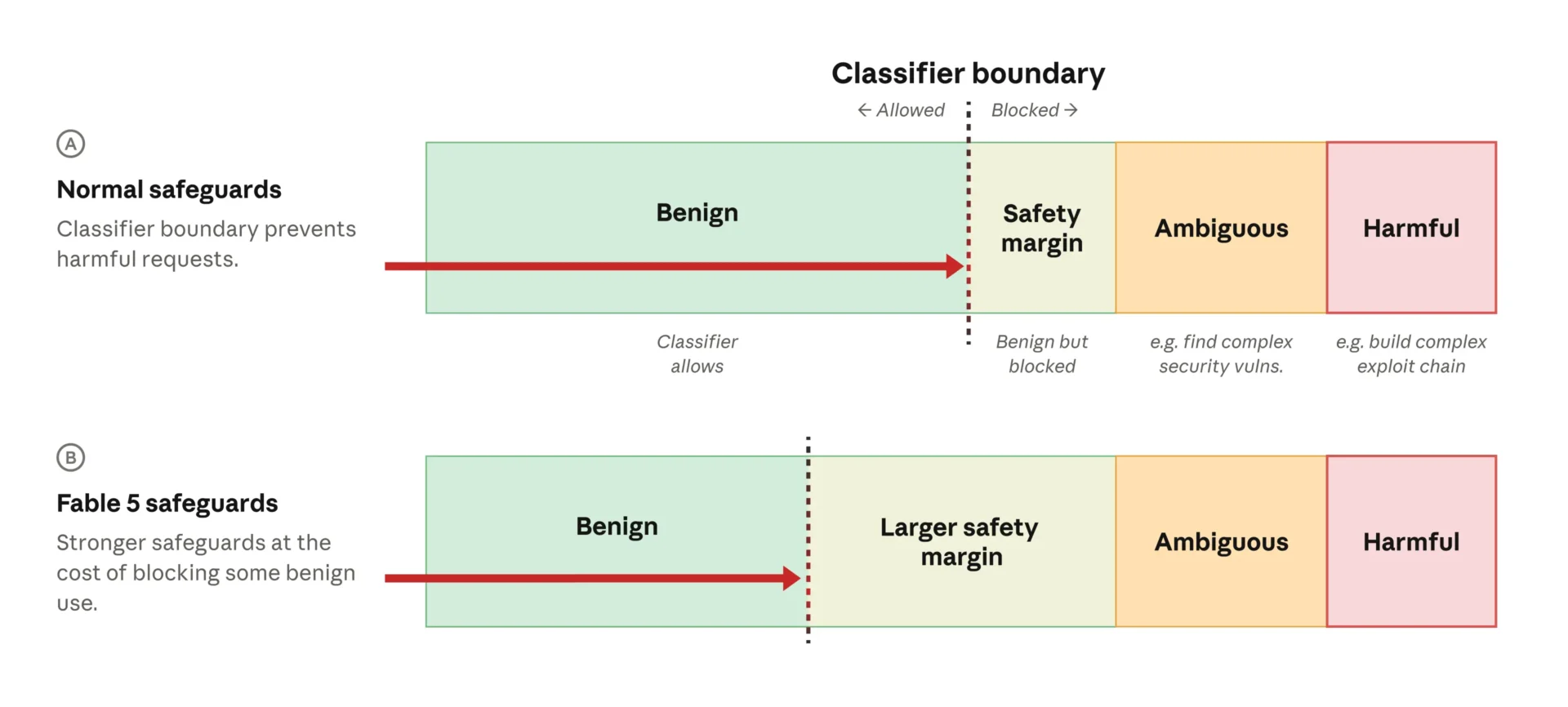
Anthropic engineers have now built a new, highly specialized safety classifier. This automated filter blocks the specific bypass technique in over 99% of cases. Analysts from the US Department of Commerce’s Center for AI Standards and Innovation have tested the updated patch and confirmed its strength.
Related Stories
 AI News
‘Witch
54 minutes ago
 AI News
Monaco authorities detain then release a person in their probe of this week's explosion
55 minutes ago
 AI News
Watch: England and DR Congo fans react to tense World Cup game
55 minutes ago
 AI News
Taylor Swift and Travis Kelce’s wedding fascinates, flummoxes media
55 minutes ago
 AI News
World Cup fans sweat through US 'heat dome'
55 minutes ago
 AI News
World Cup 2026: Concerning increase in racist social media posts
57 minutes ago
 AI News
Province says World Cup is boosting B.C. economy, but some businesses report softer demand
57 minutes ago
 AI News
PREVIEW | Australia vs Egypt: team news, lineups, predictions (World Cup 03/07)
58 minutes ago