
U.S., Canada trade reps expected to speak today, sources say, as Ottawa's counter
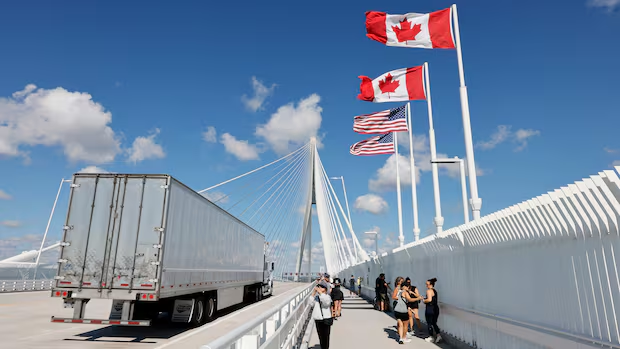
Bombardier shares dip after Trump's U.S. access threats, as Ottawa's counter-tariffs take effect
Canada-U.S. trade war: Ottawa's counter-tariffs take effect
Shares for Montreal-based jet maker Bombardier took a slight dive on Tuesday, the first day of trading following Trump's threats against the company yesterday.
The company's shares are down by about three and a half per cent mid-afternoon — a bit of a recovery from this morning when they fell by closer to seven per cent.
On Monday, Trump took to social media to say the Canadian company's planes shouldn't be sold in the U.S. unless the company started building in the U.S.
The company already has operations in the U.S., including a factory employing 1,200 workers in Wichita, Kansas.
The president hasn't clarified how he would try to stop imports from a specific company wasn't initially clear, either. But the comment seems to have spooked some investors, anyway.
Speaking in Toronto Tuesday, federal NDP Leader Avi Lewis said that while the majority of Canadians are happy Prime Minister Mark Carney is at the negotiating table, his party still has its worries.
"We are concerned about whose concerns he's bringing to the table," Lewis said.
Lewis said the Canada Investment Summit that will be held next week in Toronto, which will see more than 100 of the world's biggest investors come to hear Carney's pitch to invest in the country, needs to be focused on workers.
Organizations invited to the summit include private investment firms such as BlackRock and some of the world's biggest sovereign wealth funds, including Singapore's GIC.
"It's not BlackRock that needs to be centred in this crisis, its autoworkers and steelworkers and the people who don't even have unionized jobs; the gig workers and precarious workers," Lewis said.
Quebec's envoy for the CUSMA review says the province is taking Donald Trump's threat against Bombardier seriously.
Louise Blais told CBC News that Trump's threats alone can create uncertainty for the company and that any action against Bombardier could take forms beyond tariffs.
"They don't have to be tariffs or literal bans," Blais said. "It could just make it that much more difficult for jets to cross the border in a variety of administrative ways."
Blais said the threat is an example of the broader escalation in the trade war, which she described as "bad news for Canada, bad news for Quebec and bad news for the United States."
She said Quebec is working with U.S. stakeholders in Bombardier in the hope they can help persuade the White House to back down.
Blais also said Canada needs to get back to the negotiating table with the United States, even as it works to strengthen its domestic economy and diversify its trading relationships.
"We need to build better at home," she said. "But at the same time, our supply chains with the United States, our continental trade is part of our success story, and we need to bring back some level of predictability in that."
Blaid noted Bombardier is deeply integrated into the U.S. aerospace industry, with thousands of American employees and suppliers.
"There are a lot of companies that want to see it succeed — American companies," Blais said.
Trump's treasury secretary is brushing off the effect that Canada's retaliatory tariffs will have on the cost of living in the U.S.
Scott Bessent says analysis by the treasury's economics team determined that the Canadian retaliation would add just 0.02 percentage points to the U.S. inflation rate.
"The pain to the U.S., there is none," Bessent told Breitbart News during a livestreamed interview on Tuesday.
He said the Trump administration offered Canada the best trade deal and suggested companies will flee Canada for the U.S. if the Carney government doesn't agree to terms.
"If I were the Canadians, I'd be careful," Bessent said. "Now that the arrangements may be splintering, everyone's going to come to our side."
As evidence, he pointed to a report by Bloomberg News that Sapporo Breweries Ltd., will shift its non-alcoholic beer production from Canada to the U.S. by mid-2027.
Neither Sapporo nor its Canadian subsidiary Sleeman has responded to a request for comment.
What counter-tariffs could cost Canadians
The trade war with the U.S. is about to enter the next phase with Canada implementing dollar-for-dollar tariffs. For The National, CBC's Eli Glasner breaks down what the additional levies are expected to cost Canadian consumers.
For Canadian small businesses, the impact of the trade war can extend beyond the products being imported from the United States.
Laurie Arbuthnot, owner of Wild Coast Perfumery on Vancouver Island, makes her natural perfumes in Canada but relies on U.S. suppliers for some of the packaging.
She said a company in Oregon makes her perfume boxes, which will be affected by Canada's new tariffs.
She's considering sourcing her glass bottles directly from China, but that would require her to buy in much larger quantities than she does through her U.S.-based distributor.
"I have to look at renting extra space," she said. "My overheads go up. So, that's going to have a trickle-down effect."
Arbuthnot has been trying to avoid raising prices but she said that may become unavoidable.
Constanza Safatle, owner of a St. John's company that makes clothing for newborns and children, said her business previously sourced much of its fabric from the U.S.
As the trade relationship became increasingly uncertain, she decided to find another supplier.
"My first goal is: change the supplier now," Safatle said. "And that is exactly what we did."
But switching suppliers created new challenges — like learning to design her own fabrics and hire the people who could do that work in-house.
-With files from Eli Glasner and Peter Cowan
Canada is gambling. The Carney government's retaliatory tariffs are designed to inflict economic pain on too-close-to-call states critical to the Republicans in November's midterms.
While many Canadians are cheering on the approach, there are others concerned it just won't work.
"Mr. Trump doesn't really care about Congress," international trade lawyer Mark Warner told me. "I just don't understand the strategy."
He argues Canada should get back to negotiations, but worries Canada is waiting for the Trump administration to climb down completely — something he says will not happen.
"We're one-tenth the size of the United States .… When you get into a tit-for-tat war, it is going to be felt more on the Canadian side than the American side."
There are no negotiations planned now, though it is clear top officials are still speaking. That line of communication leaves open the possibility that talks could resume.
Former U.S. diplomat Maryscott Greenwood says the current trade war has been lose-lose for both sides, and questions why it ever started.
"If the goal is to make America stronger, it's really hard to see how making your largest economic partner weaker gets you there. So I really think in the case of the United States, it's self-defeating," she said.
The Canadian jet maker Bombardier has a factory employing 1,200 workers in Wichita, Kansas. The state is represented in the U.S. Senate by Republican Roger Marshall, who is now facing a surprisingly tough battle for re-election.
This all helps explain why a statement Marshall issued about Bombardier today reads like he's trying to walk a very thin line that neither alienates Kansas voters nor runs afoul of the U.S. president.
"I'm going to fight to keep Bombardier's over 1,200 Kansas jobs," Marshall said in a social media post on Tuesday.
"I've already taken that concern inside the Oval Office," he said, an oblique reference to Trump's threat to block the Montreal-based company from selling aircraft in the U.S.
However, Marshall does not appear to oppose Trump's efforts to pressure Bombardier to shift more of its production to the U.S.
"We agree on the mission: bring more good-paying manufacturing jobs back to Wichita," said Marshall.
"America buys more than half of what Bombardier sells. If that's the market, more of those planes should be built here."
We've been taking your questions, and a reader asked about which U.S. goods are now subject to Canadian counter-tariffs.
They cover a vast swath of goods — more than 600 products in total, all of which can be found in this searchable government list — but they're more concentrated in some sectors than others.
The government targeted the new measures at steel and aluminum, dairy, appliances, agricultural equipment, pulp and paper, plastics and electronics.
Other newly tariffed items like cosmetics and honey appear on the list. Those match items the U.S. chose to tariff in its most recent 50 per cent measures.
And then there are the politically important ones: tariffs on things like motorcycles, for example, would hit Pennsylvania where Harley-Davidson makes its bikes. The goal is to turn up the heat on specific states to create leverage ahead of the U.S. midterm elections in November.
What's not on the list anymore? Tons of seafood, which the Canadian government scrapped from the list a day after first announcing the retaliatory measures. The government said it tweaked the list in response to "feedback" and added a handful of products including steel wire and charcoal in order to keep the dollar-for-dollar response.
If you have a question, email us at ask@cbc.ca and we'll try to answer it.
Canadians aren't backing down from the trade war, at least according to recent polling from Angus Reid.
In an online survey, the institute polled a sample of 1,498 Canadians from across the country.
Almost three-quarters of them said Canada should refuse to make difficult concessions, even if that upped the ante in cross-border tensions — the highest level since the trade war began, according to Angus Reid.
Respondents are even OK with the personal consequences that might bring. Three in five said they would be willing for Canada to keep a hard-line negotiating strategy even if it meant their household expenses increased by 10 or 20 per cent.
And another 52 per cent said Canada should maintain its strong stance even if it led to a recession.
Margaret Atwood says Canadians definitely have the stomach to fight back in this trade war.
“I have heard a catchy saying, which is, Canadians have two modes: ‘Sorry’ and ‘You'll be sorry,’” the Canadian literary icon told CBC Radio’s The Current.
“I think we're in ‘You'll be sorry’ right now.”
Many Canadians have expressed anger at the U.S. since trade talks fell apart last month, with people continuing to choose to buy Canadian and limit travel south of the border.
For Atwood, that fight might also include helping the people struggling financially in your community.
“I know that people can get through it, and I would say we need to possibly form some help-your-neighbours associations — in addition to what the government is doing,” she said.
It also means remembering that lots of Canadians have friends and family in the U.S., adding that “you couldn't ask for nicer, warmer, more welcoming people” when she’s spoken to audiences there about her books.
But that doesn’t mean bowing to U.S. demands, she added.
“People always underestimate Canadians because we have an outward appearance of being nice. And 'nice' translates as weak to some people.”
Her message to those people? Don't underestimate Canadians.
Related Stories
 Canada
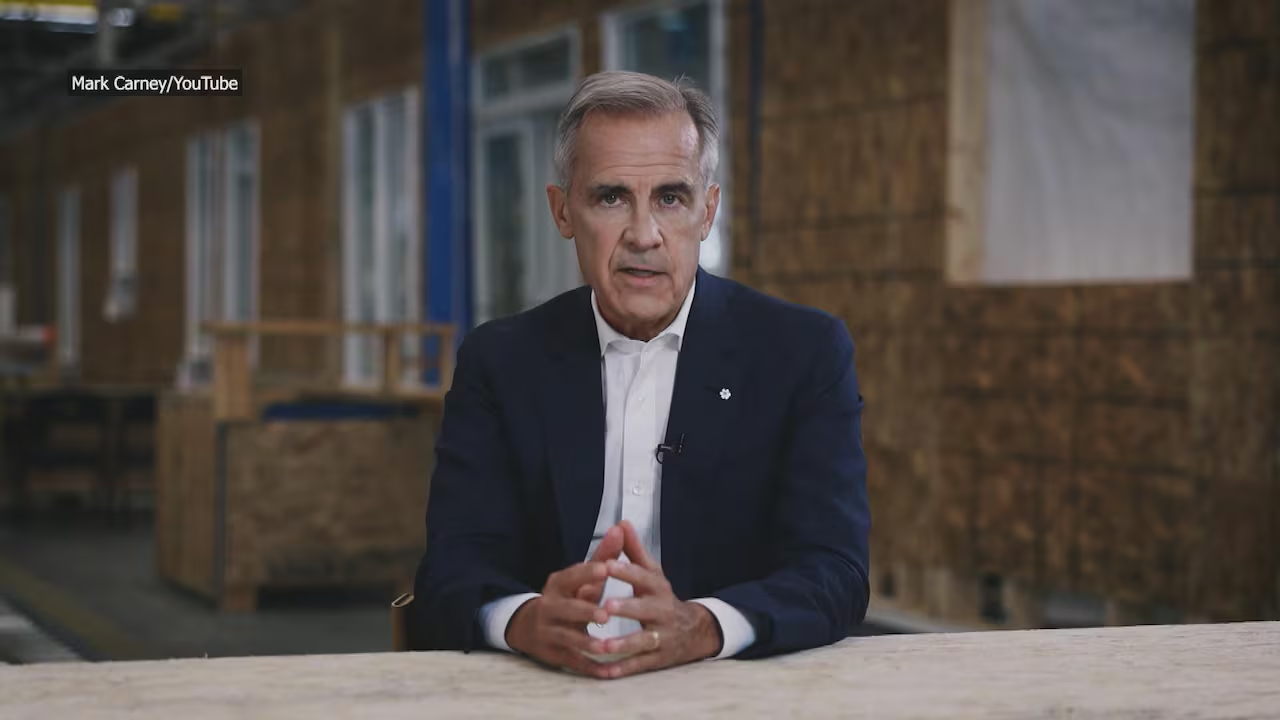
Carney releases video saying U.S. wanted 'dependency' in too many areas
3 minutes ago
 Canada
B.C. Premier David Eby to speak as Canada’s counter
3 minutes ago
 Canada
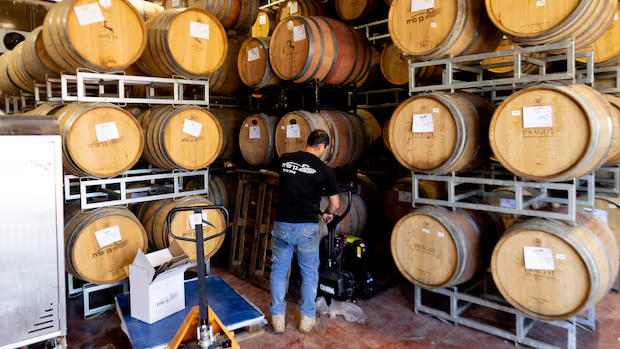
Canada, U.K., France to ban trade of goods from Israeli settlements in occupied West Bank
3 minutes ago
 Canada
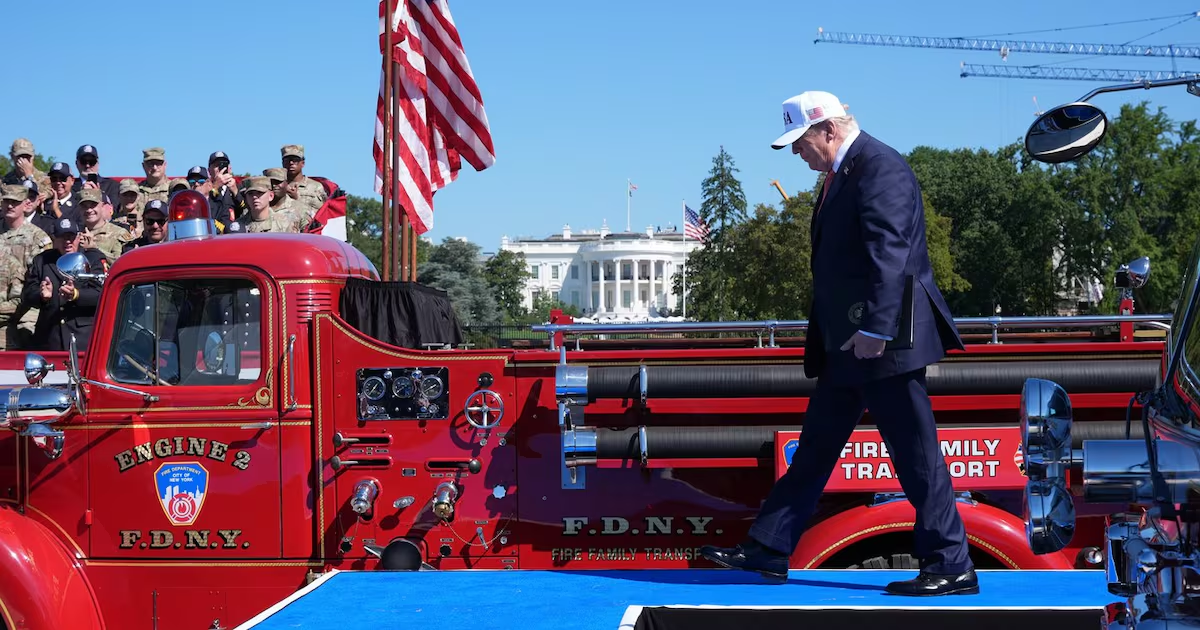
Trump honours 9/11 victims at the Ellipse, pledging to ‘never forget’
1 hour ago
 Canada
Canada hits back with counter
1 hour ago
 Canada
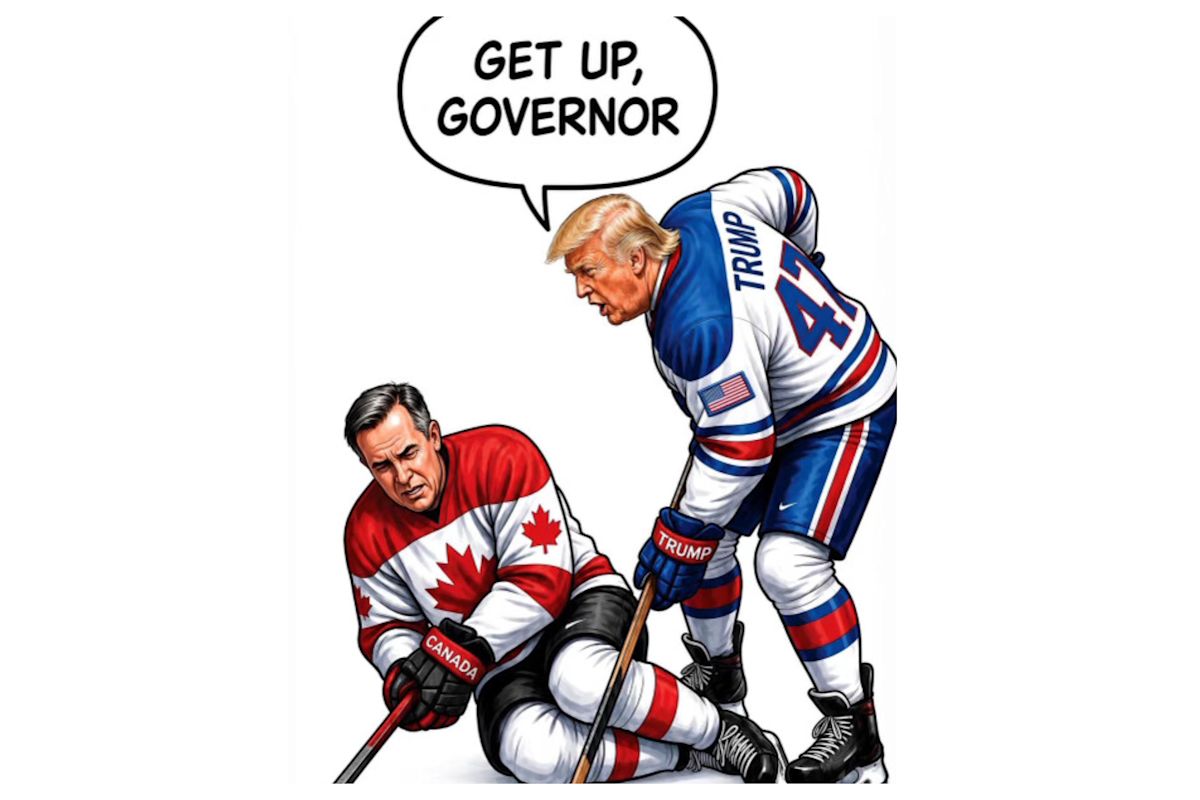
Social media condemns Trump's hockey cartoon as Canada's retaliatory tariffs take effect: 'Carney has been negotiating with a madman'
1 hour ago
 Canada
Prime Minister Carney to hold fall Cabinet Planning Forum focused on building with greater speed and ambition
1 hour ago
 Canada
Carney warns of tough times ahead in video message as retaliatory tariffs kick in
2 hours ago