
Uniquely USask: Six to see on campus this summer
Uniquely USask: Six to see on campus this summer
From historic buildings crafted in classic collegiate gothic style over a century ago, to state-of-the-art one-of-a-kind research centres, the University of Saskatchewan (USask) has a multitude of must-see spaces and places across campus.
Here is a list of six spots you can visit and historic items that you can see on the Saskatoon campus that are uniquely USask:
Nightingale’s medicine chest:
One of the historic hidden gems on campus, USask’s College of Nursing is home to an antique medicine chest used by Florence Nightingale, one of the world’s most famous nurses. Displayed in the fourth-floor E-wing atrium of the Health Sciences Building, the medicine chest was believed to be used by Nightingale during the Crimean War in 1851 when she travelled to Turkey to treat British soldiers. The chest was taken to Saskatoon in 1912 and later given to Dr. Herbert Weaver, who also brought the first X-ray machine to Saskatoon in 1906, and donated both to USask in the 1950s.
“I think it has been one of our best-kept secrets for years,” said Dr. Arlene Kent-Wilkinson (PhD), a registered nurse and professor in the college who has researched the history of the medicine chest.
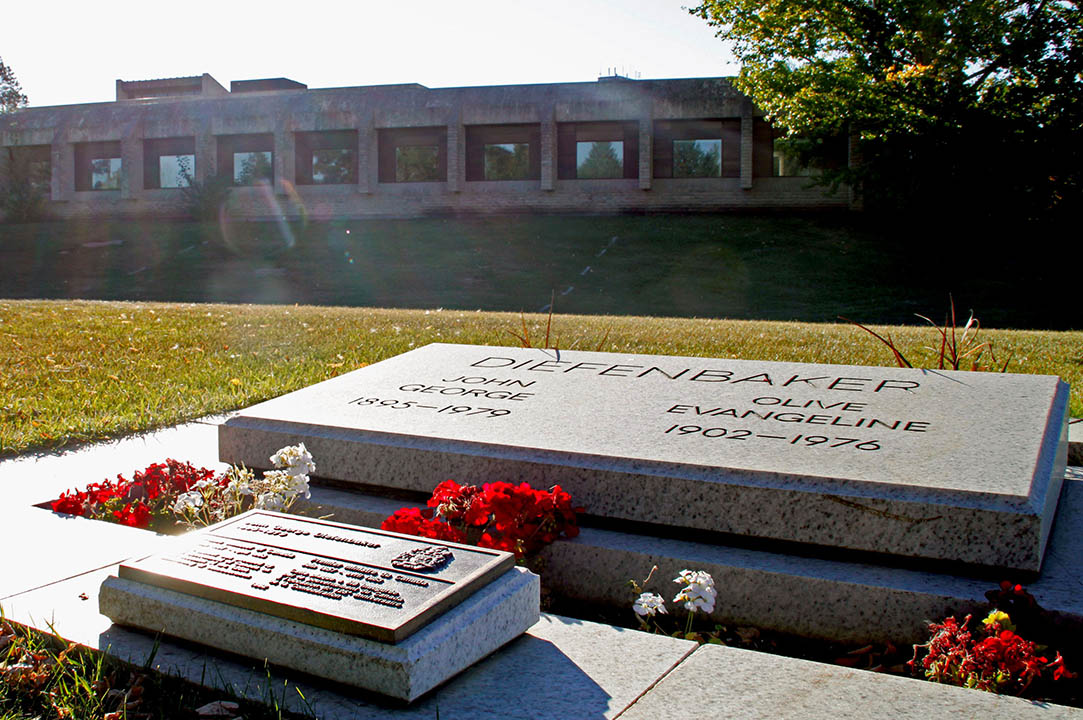
The west side of campus is home to the final resting place of Canadian Prime Minister John Diefenbaker and his wife Olive. Handpicked by Diefenbaker, the burial site required special approval from the provincial government and USask’s Board of Governors to grant him this final request. On Aug. 22, 1979, six days after his passing in Ottawa, the 13th Prime Minister of Canada and former USask chancellor returned to his alma mater to lie forever at rest in a truly unique site near the banks of the South Saskatchewan River, adjacent to the Diefenbaker Canada Centre.
Diefenbaker is the only prime minister to be buried on a Canadian campus, with former Prime Minister Joe Clark beginning his eulogy by stating “John Diefenbaker is home.” An estimated 8,000 mourners attended the funeral for Diefenbaker, who entered university in 1912 and was the first student at USask to earn three degrees—bachelor’s, master’s and law—and donated his estate to the university, contributing to the building of the Diefenbaker Canada Centre that houses his papers, library, and personal items.
One of French emperor Napoleon Bonaparte’s prized possessions was a bronze bust of Carthaginian general Hannibal. The bust that sat on the mantlepiece in his study near Paris is believed by experts to now be housed in USask’s exquisite Museum of Antiquities.
Former curator Catherine Gunderson discovered the Hannibal bust was one of two from the studio of François Girardon—a sculptor for King Louis XIV of France—with the other accounted for.
After Napoleon’s fall from power, the bust wound up in New York where Judge John C. Currelly acquired it and later donated it to USask in 1988.
“We’re still trying to find the exact path that it took to get here. Parts of that journey we may never know,” USask curator Dr. Tracene Harvey (PhD) told Chris Putnam.
The oldest building in Saskatoon, the historic Little Stone School House was built in 1887, before Saskatchewan officially became a province. The one-room school house, which seated 40 pupils and featured a wood stove and gas lamp, has been designated by the city and the province as a heritage property. The school house was built by Alexander Marr and was originally located in the Nutana neighbourhood near Broadway Avenue and 12th Street.
Serving as the original site of Victoria School, the building was also used as a meeting place, dance hall, and election centre. To accommodate more students, a new building was constructed and the Little Stone School House was disassembled one piece at a time, and then reassembled on campus in 1911, where it has sat ever since.
For more than 80 years, a stately sundial has marked the passage of time outside the USask Observatory.
Installed in 1945, the custom-made one-of-a-kind sundial weathered through the decades, was rebuilt and later replaced in 2019 with a new 10-foot-tall sundial that is a replica of the original, featuring the original shadow caster.
The sundial is situated at the entrance to the USask Observatory, which houses a finely crafted three-metre long refracting telescope, as well as a museum open to the public that features exhibits on the solar system.
“A sundial is a really cool feature that draws people’s attention to the movement of the Earth,” said USask astronomy lecturer Dr. Daryl Janzen (PhD).
“And this was a really unique one that had been here for 50 years.”
For more than a century, the Airplane Room—officially the Henry Taube Lecture Theatre in Thorvaldson Building Room 271—has been a must-see spots on campus. The slate chalkboard and oak chart frames are original from the day it opened in 1924, with the wooden chairs replaced by replicas in 2014. The most famous feature is the plethora of paper airplanes embedded in the soft acoustic material in the ceiling. Legend has it the paper airplanes were first fired into the ceiling by pilots in training during the Second World War. The gothic style auditorium featuring a 68-foot domed ceiling has been used in movie sets and even hosted a wedding.
“It’s a window into the past. It’s a classic room that really makes you feel like you’re in a grand institution,” chemistry professor Dr. David Palmer (PhD) said.
The many other must-see spots on campus include the full-size dinosaur skeleton replicas in the Geology Building’s Museum of Natural Sciences, the remarkable pieces in the USask Art Galleries, and buildings like the stunning Gordon Oakes Red Bear Student Centre designed by renowned Indigenous architect Douglas Cardinal.
Related Stories
 AI News
Shakira teases what to expect from World Cup halftime show
47 minutes ago
 AI News
ASIRT releases more details in shooting death of man by police near Irricana, Alta
47 minutes ago
 AI News
Pilot in critical condition after crash near Weyburn
48 minutes ago
 AI News
More than 20K people apply to work Alberta's fall referendum
48 minutes ago
 AI News
Man with Canada
48 minutes ago
 AI News
Horse with head trapped in a bridge near Lytton, B.C., discovered by passing truck driver
48 minutes ago
 AI News
ASIRT releases new details in investigation of fatal RCMP shooting near Irricana
48 minutes ago
 AI News
Türkiye attracts $172 million in startup funding in H1 | Daily Sabah
56 minutes ago