
Trump talks to Putin, then announces diesel deal with Russia, in sharp reversal of U.S. policy
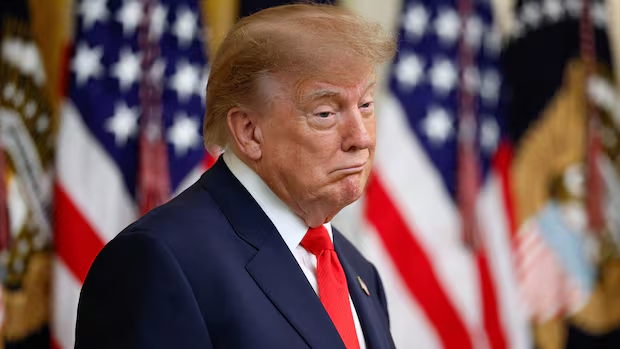
Trump talks to Putin, then announces diesel deal with Russia, in sharp reversal of U.S. policy
Ukraine's Zelenskyy slams 'weak decision' for U.S. to do business with Russia
U.S. President Donald Trump said he has struck a deal to obtain diesel from Russia, a stunning reversal after years of U.S. pressure on Moscow over its war with Ukraine and an attempt to address high fuel prices ahead of the U.S. midterm elections.
Trump said on social media on Friday that he struck the deal with Russian President Vladimir Putin in a phone call in which he was expected to discuss a suspected case of plague in Russia.
Instead, Trump announced that Russia will immediately supply more than 300,000 tons of diesel, followed by an additional 500,000 tons in November and one million tons "immediately thereafter." Russia will deliver another three million tons "within a short period of time" after that, he wrote.
Trump had signed sweeping sanctions law
Trump's shocking announcement was in stark contrast to a sweeping Russia sanctions law he signed last month that aimed to clamp down on the oil and gas revenues that fuel Russia's war against Ukraine.
Ukrainian President Volodymyr Zelenskyy called it "a weak decision, unfortunately, a weak decision by strong partners," according to a statement released by the Ukrainian Embassy in Washington.
War in Ukraine is at a dangerous stalemate, says U.S. Secretary of State Marco Rubio
Trump announced the deal as his envoy Steve Witkoff and son-in-law Jared Kushner were meeting with Ukrainian officials in Miami to discuss a proposal to end the Russia-Ukraine war.
"I believe our team is simply being used as a smokescreen. And that is certainly not fair. It is certainly not how partners should treat each other," Zelenskyy said.
Trump's move casts doubt on the likelihood of the White House imposing new sanctions on Russia, given that the law that passed overwhelmingly by Congress directs the administration to target countries that purchase Russian oil and gas. Lawmakers this week had urged the Trump administration to act quickly to use the tools available to help Ukraine.
'Enough is enough,' Democrats say
Senate Democratic leader Chuck Schumer, along with Sen. Jeanne Shaheen, who is the top Democrat on the foreign relations committee, and Sen. Elizabeth Warren, the ranking Democrat on the banking committtee, called Trump's announcement a betrayal of Ukraine, the European allies and U.S. national security.
"Enough is enough," the senators wrote. "The President must end his war with Iran instead of funding Russia's war machine."
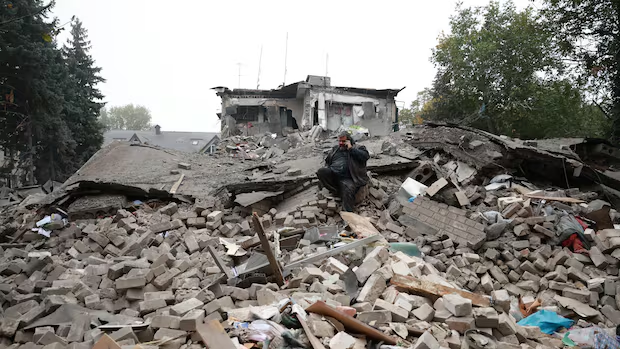
Residents of a neighbourhood in Zaporizhzhia, Ukraine, are seen walking Friday outside a building that was damaged by a Russian strike. (Kateryna Klochko/The Associated Press)
Gas prices globally have surged as the war in Iran upends the energy sector. While diesel future prices dipped on the news on Friday, the national average for a gallon of diesel in the U.S. remained high at $6.28 US, according to AAA, after hitting a record $6.52 on Sept. 22.
Trump did not address the sanctions or Russia's war but said, "Lower prices for Americans, especially our Great Farmers, Ranchers, and Truckers, is my Greatest Priority."
The president said later as he left the White House for a campaign rally that he was thankful for the deal.
"I want to thank President Putin. To be honest with you, we have massive amounts of oil coming into our country, and it's diesel, which is what we want. So, thank you," Trump said.
He did not answer shouted questions about the criticism from Zelenskyy.
The White House did not immediately respond to questions about who was paying for the Russian diesel or when it would become available.
Trump said on social media that he'd struck the diesel-related deal after speaking to Russian President Vladimir Putin. (Gavriil Grigorov/Sputnik/The Associated Press)
A statement from Putin, released by the Kremlin on Friday, said that during their call, he and Trump dedicated "significant attention to the prospects of resolving the Ukrainian crisis" and also discussed "the situation around Iran and various aspects of bilateral relations."
Russia "confirmed its readiness to supply oil and oil products to the American and global markets," Putin said. "I am confident that this will have a positive impact on the entire global economy."
Russian presidential aide Yuri Ushakov, speaking later to reporters, wouldn't say whether the U.S. made any concessions in exchange for the supplies or what, if anything, was promised to Russia in exchange.
Deal 'plays into Russia's hands': Zelenskyy
Zelenskyy, in a lengthy online post reacting to the deal, said Russia would repay it "with further terror and perfidy." He cast it as an investment in the war, allowing it to be prolonged.
"It plays into Russia's hands — allowing it to kill more, wage war for longer, have even less respect for America, and inflict even greater losses and damage on the world," he said.
Ukrainian President Volodymyr Zelenskyy, pictured during a recent interview in Kyiv, said in a social media post that Putin is trying to strike 'backroom deals' to buy time in the war. (Alina Smutko/Reuters)
Democratic Sen. Richard Blumenthal, who co-sponsored the Russia sanctions law, said Trump's decision "makes us complicit in Putin's war against Ukraine." In his scathing statement, he invoked the memory of the late senator Lindsey Graham, a Trump ally and Russia hawk, for whom the sanctions law is named after.
"This agreement with a murdering dictator is a stain on our nation's character, an insult to Lindsey Graham's memory and directly contrary to Congress's intent in our bipartisan sanctions bill," he said.
Rep. Don Beyer, the senior Democrat on the House of Representatives joint economic committee, called Trump's announcement "infuriating."
Russian attack on eastern Ukrainian city of Kramatorsk kills at least 33
"This is what we warned anyone who would listen: Trump isn't the slightest bit trustworthy when it comes to Russia," Beyer said in a statement on X.
The law Trump signed last month envisions sanctions on Russian officials, banks and a shadow fleet of tankers, and bans all new U.S. investment in Russia and the handling of sovereign debt.
It also directed Trump to impose tariffs of up to 100 per cent on the top five importers of Russian oil or natural gas, with an exception for countries that import less than 15 per cent of Russia's natural gas exports and have taken significant steps to reduce those imports.
The U.S. has not imported Russian oil or gas since 2022, when the Biden administration banned them because of Moscow's invasion of Ukraine, according to the U.S. Energy Information Administration.
Shortly after Trump made the announcement, the U.S. Treasury Department said it was immediately issuing a temporary licence allowing Russian diesel to be supplied to the global market.
This is the latest in several licences the U.S. Treasury has issued regarding Russian fuel shipments since the start of the Iran war earlier this year. But it is the first to ease sanctions on diesel for longer than the standard 30-day window since the start of the Ukraine war in February 2022.
Russian strike devastates apartment block in northern Ukraine, at least 25 killed across the country
The licence means U.S. sanctions will not apply until April 2027 on deliveries of Russian diesel that has been loaded onto tankers as of Friday.
The extensions underscore how the fallout from the Iran war has boosted Moscow's ability to profit from its energy exports.
'Great benefit' to Russia, Putin: analyst
"What does this do to prices? I think probably not much," said Clayton Seigle, an energy strategist and expert at the Center for Strategic and International Studies.
But Seigle said the new deal is a "great benefit to Russia and to Putin," who are currently trying to offload their summer-grade diesel for the heavier winter and Arctic grades that they will need in the coming months.
"It's kind of shuffling deck chairs on the Titanic," said Michael Lynch of the Energy Policy Research Foundation, a non-partisan research institution focused on energy and economics.
"If we get diesel from Russia, basically it means that their existing customers are not going to get it and they'll have to go somewhere else, and that will keep the price basically where it is now," Lynch said.
Russia, once a major exporter of diesel, has banned exports since July as it has struggled to meet demand inside the country because of Ukraine's repeated attacks on Russian oil refineries. The International Energy Agency says Russian diesel output has fallen by about 30 per cent.
Russian Deputy Prime Minister Alexander Novak told state news agency Tass that Russia is "immediately starting to lift restrictions on diesel exports ahead of schedule." He said Moscow could start supplies to the U.S. this month and Russia's domestic market will be "fully supplied" with diesel as well.
Related Stories
 World
World
South Africa
29 seconds ago
 World
World
15 killed in Russian strikes on Ukraine after Trump
1 minute ago
 World
World
Trump slams Nobel peace prize, sanctions ICC
1 hour ago
 World
World
ICRC President: We must return to Conventions; peace is responsibility of all
1 hour ago
 World
World
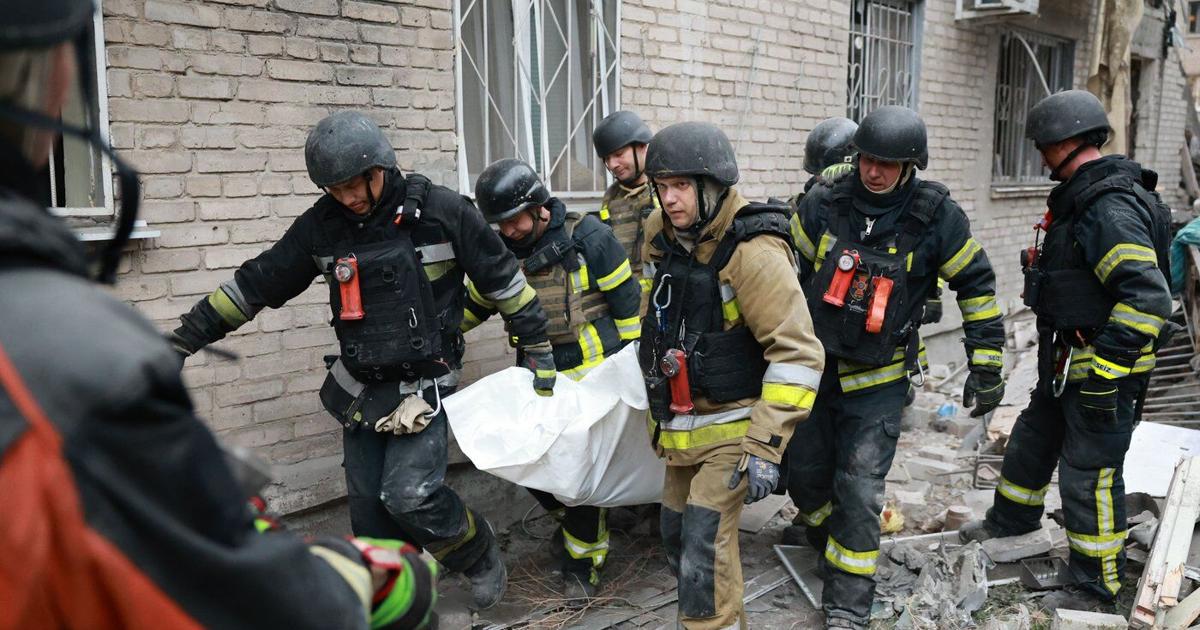
Russian attacks kill 15 in Ukraine after Trump strikes diesel deal with Putin
2 hours ago
 World
World
Wildfires threaten Indonesia's orangutans as rescuers find injured animals
2 hours ago
 World
World
Trump appoints new White House press secretary
3 hours ago
 World
World
Monitoring Global Temperature and Precipitation in September 2026
3 hours ago