
Tornadoes touched down in Verona and Kingston, says Environment Canada
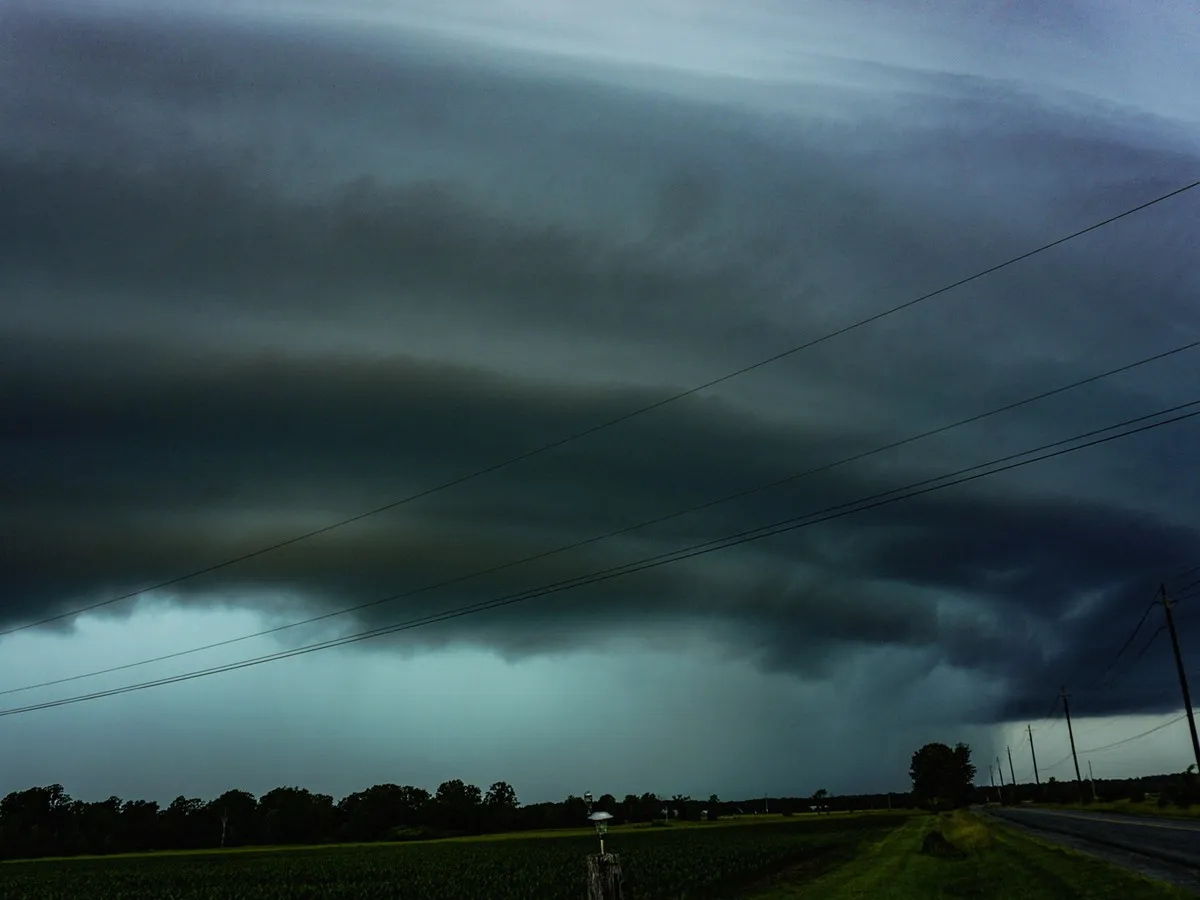
As the sky over northern Kingston turned darker and darker on June 30, Chad Locke knew a storm was coming.
Locke, who lives on Orser Road near the northern edge of Kingston, was working from home when the storm hit. He explained that as the storm rolled in, conditions rapidly changed, leading to what he described as the strongest storm he’s seen since moving to the area in 2013.
“It seemed everywhere you look, there’s either something flying through the air, trees falling down,” Locke said in an interview with The Whig. “It was just pure and utter chaos.”
According to Environment Canada, the damage came from a storm system that produced two tornadoes in the Kingston area on June 30.
Geoff Coulson, a warning preparedness meteorologist with Environment Canada, said in an interview with The Whig that the storm developed as a warm front moved through eastern Ontario around midday, marking the transition between more seasonal temperatures and the hot, humid conditions that followed into Canada Day.
As that warm front moved through the region, Coulson said it generated an organized line of thunderstorms moving northwest to southeast. The line produced two tornadoes including one near Verona at about 12:35 p.m. and another in Kingston at about 12:50 p.m.
He explained that the Verona tornado was rated EF1, which is the second lowest rating on the Enhanced Fujita Scale, with peak winds of 150 km/h. He said it travelled 18.2 kilometres, reached a maximum width of just over 500 metres, and caused both tree damage and damage to nearby barns, with roofs being removed.
The Kingston tornado was rated EF0, the lowest rating, with peak winds of about 115 km/h, he explained. Coulson added that it travelled 10.9 kilometres, reaching a maximum width of 250 metres.
In an interview with The Whig, storm chaser Connor Mockett said that he saw the system coming a few hours before it reached Kingston. Mockett, the co-owner of Canadian Weather Live — a Youtube channel focusing on severe weather events in Canada — left Winchester at 11 a.m. to get to Kingston before the storm arrived, explaining he reached the city with about 10 minutes to spare.
Mockett first headed toward County Road 38, going up to Harrowsmith, before moving along Unity Road out of Glenvale. He said the tornado warning went out while he was tracking it. Shortly after, he stopped near Sydenham Road to take photos of the storm.
Mockett said he and others at Canadian Weather Live were already watching the storm closely before Environment Canada issued the tornado warning. Using radar velocity, he said they had identified rotation northwest of Verona about 14 minutes before the warning was issued.
Because the storm was high-precipitation, Mockett said the tornado itself would have been difficult, if not impossible, to see.
“You’re almost never going to see it, because it’ll be completely wrapped in rain, pretty well invisible for the most part,” he said.
At the time, Mockett didn’t realize how close he was to the tornado’s path. After the path was confirmed, he said he realized the tornado had passed “right beside him.”
After taking photos, Mockett drove toward Highway 15 and into Kingston’s east end, where he saw shredded trees and snapped limbs around the main street area of Highway 15. He said he stopped to help move branches from the road, in an area he said was later confirmed to be part of the tornado’s damage path.
For Locke, he said he wasn’t sure whether he was hit by the tornado or just a stronger part of the storm, but the damage inflicted was still clear.
Notably, his 16-by-12-foot barn door blew off, cleared a fence, and landed in his neighbour’s field. He added that sections of roofing were also torn from his barn, several fences were blown over, and around 20 to 30 trees were knocked down or damaged across the property.
“(We’ve) probably got enough firewood for the next five years,” he said.
Despite this wreckage, Locke said that luckily no trees hit his house.
He added that the storm also left the property without power for about a day and a half, but that wasn’t the only clear indication of the storm’s impact.
“You (could) just drive around and see a lot of the carnage — but you didn’t even have to drive around after the storm — all I could hear was sirens and chainsaws.”
Despite this, he said the response from neighbours and friends stood out.
Locke said his neighbour Jack Shillington came over with his father, Kendall, the next day to replace some of his barn roof panels, despite it being a holiday, while another neighbour lent him a wood chipper for several days.
On Sunday morning, about 15 of Locke’s friends came over to help carry the blown-off barn door back onto his property, while others came with chainsaws to help deal with the debris.
“Everybody helped out,” Locke said. “It was really nice to see that.”
While tornadoes are not an everyday occurrence in the Kingston area, Coulson said they can happen from time to time. He said the region has seen downbursts — which are powerful columns of air within a thunderstorm that produce straight-line winds with no rotation — along with weak tornadoes in the past, including an EF0 tornado in Kingston in September 2021.
He explained information on these storms are publicly available through the Northern Tornado Project (NTP). The project has been used as a resource to track storm activity in a central database, while also using newer technology — opposed to a previous reliance on human reports — through drones, aircraft, and satellite imagery.
Since 2017, the NTP have tracked three major events around Kingston including a downburst near Lemoine Point in Kingston in 2019, the aforementioned EF0 Tornado in 2021 (which took place near Navy Bay), and the most recent tornadoes on June 30.
Coulson said it’s still too early to link a single storm like this to a broader climate trend. However, he said researchers are continuing to study whether tornado and damaging wind patterns are changing in Ontario.
“One of the theories right now is that there seems to be a bit of a shift in more active storms occurring in eastern Ontario, the Ottawa Valley, and southern Quebec in previous years, (and) maybe a little bit less occurring in southwestern Ontario, which was traditionally thought of as being the most active part of the province of Ontario. But (that research is) still very preliminary and I think more work has to be done before anything definitive is said about it,” Coulson said.
As for Mockett, he said the June 30 storm was among the stronger storms he has chased in eastern Ontario.
“It’s not the strongest one I’ve ever chased around here, but it was definitely in the top five for sure,” he said. “It was a very, very strong storm.”
The storm was also part of a larger stretch of severe weather across Ontario. Mockett said Canadian Weather Live had been expecting several active days from June 30 through July 3, and he continued tracking storms after leaving the Kingston area.
For Coulson, the storm is also a reminder that eastern Ontario is fully in its summer severe weather season, which typically runs from April into late September or early October.
He urged residents to stay up to date on Environment Canada forecasts and warnings, especially during days with thunderstorm risk.
“These storms can form very quickly, move very quickly,” Coulson said. “So you want to make sure you’re prepared for changeable conditions.”
He also pointed to the importance of lightning safety. He said if someone hears thunder they should move indoors, even if they don’t see lightning, and remain in a shelter for 30 minutes from the most recent rumble of thunder.
“When thunder roars, go indoors,” Coulson said.
Related Stories
 Canada
Hunters turned away at Bloodvein River First Nation
9 minutes ago
 Canada
France hasn't issued crab licence off Newfoundland, despite surprising pledge: Ottawa
1 hour ago
 Canada
Debris found from missing Ontario
1 hour ago
 Canada
Anti
1 hour ago
 Canada
Stampeders fend off late Riders surge in 37
2 hours ago
 Canada
France has not issued new snow crab licence, Ottawa says
3 hours ago
 Canada
Canada’s first project of national interest carries political weight
3 hours ago
 Canada
Shaffelburg’s brace leads Canada to 2
3 hours ago