
These Are the Droids We’re Looking For: Robotics, Artificial Intelligence and the Race to Build C
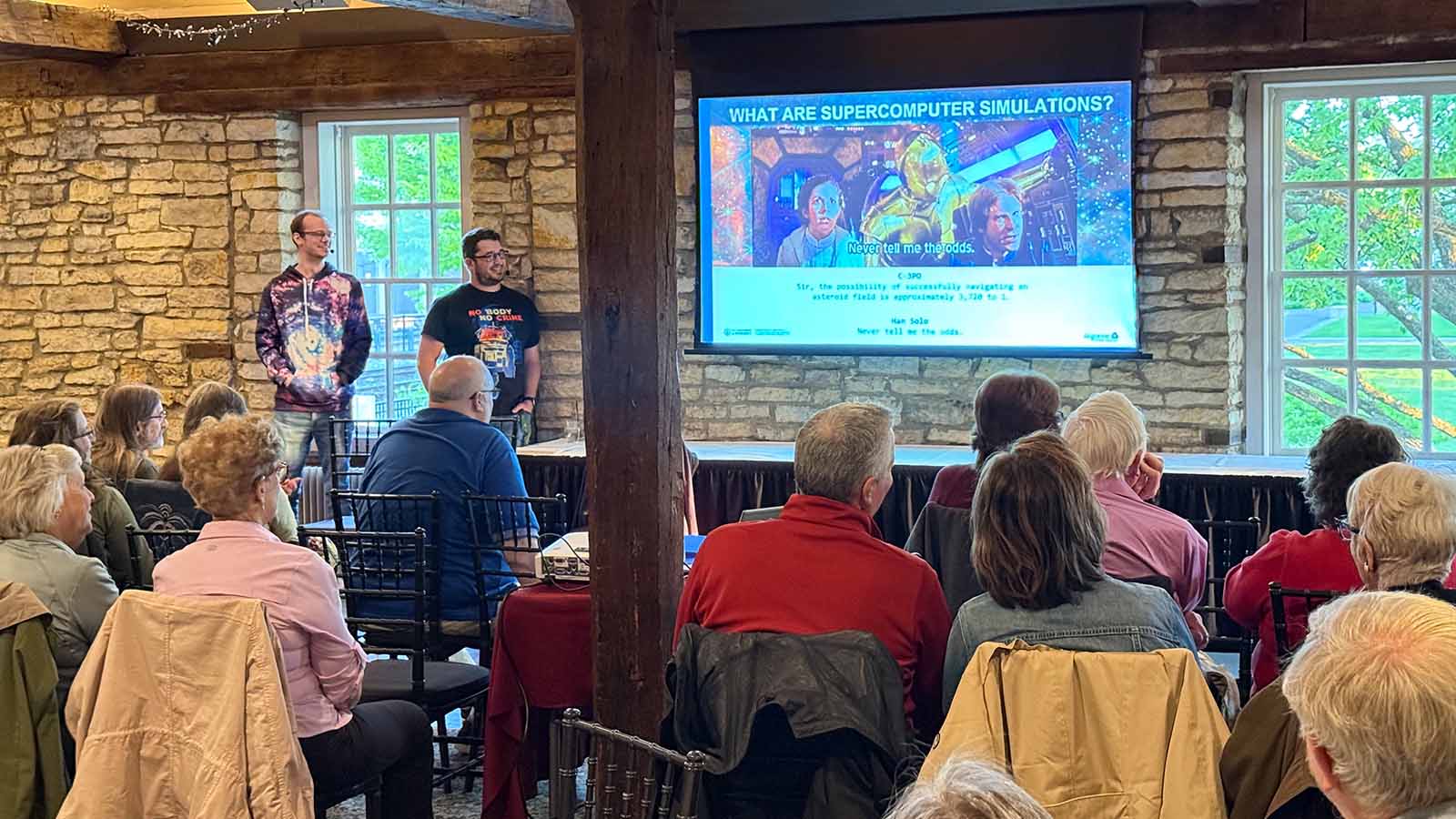
Researchers from the U.S. Department of Energy’s Argonne National Laboratory, brought their Star Wars knowledge and science expertise to a talk titled “These Are the Droids We’re Looking For: Robotics, Artificial Intelligence and the Race to Build C-3POs for Science.” The event at the Gaylord Building in Lockport, Illinois was part of the AI Roadshow series.
Moderated by Gillian King-Cargile, a science communicator at Argonne, the talk brought together nearly 100 people – some who loved Star Wars, some who loved science, and plenty who loved both.
“Never tell me the odds!” Han Solo, a pilot in the Star Wars films, famously shouts this in “The Empire Strikes Back.” He says this right as C-3PO, a droid, has just completed running thousands of simulations to determine their likeliness - or in this case unlikeliness - of surviving a meteor field Solo has flown into. Rapid Prototyping Laboratory (RPL) roboticist Rory Butler was quick to make the connection between this short clip and modern supercomputing.
“Using a supercomputer allows researchers to ask the same question thousands of times in less than a single second. It will help you find the most likely outcomes,” Butler said. He noted that at the RPL, however, they aren’t looking for the most likely answer. “My simulations allow us to explore the strange possibilities or rare deviations outside of the most likely results. We can then test what could happen in those unlikely scenarios from the safety of a digital environment.”
“Artificial intelligence and supercomputing are taking the drudgery out of laboratory work.” King-Cargile added. “Going through all the data created by hand would take lifetimes. AI is like the tool researchers use when they need to find a single needle in a million hypothetical haystacks.”
Matthew Tuftedal, an atmospheric scientist at the Argonne Testbed for Multiscale Observational Science (ATMOS), approaches his research’s connection to Star Wars a different way, citing some of the movie droids that are similar to the tools and sensors he uses in his research.
“Instruments like Celiometers and Drones are like Imperial Probe Droids in a way,“ he said. “They’re these sensors we use to understand cloud height, visibility, and aerosols. Imperial Probe Droids also use environmental sensors, scanning the terrain when looking for rebels. We even have a ceilometer at ATMOS.”
Another piece of technology used at ATMOS with a connection to Star Wars? LiDAR. “This reference is for the two people in the room who have played the video games,” Tuftedal joked before continuing. “LiDAR is great at collecting details that help scientists by scanning the environment. The information we get from LiDAR helps us do things like study the weather and create topographical maps. (Star Wars droid) BD-1 scans environments and objects so it can provide players with additional details for their gameplay.”
During the Q&A, one audience member asked a question that felt especially apt given the advanced humanoid droids in the science fiction world of Star Wars: When will AI stop hallucinating?
“AI will always hallucinate,” Butler said. “You can ask a supercomputer the same question a thousand times and it will give you the most common answer, but ultimately, AI doesn’t know things. It predicts them. Sometimes predictions are incorrect.”
Gaylord Building Director Pam Owens noted the audience’s strong interest in the topic. “By exploring technology, innovation, and their broader impacts through an accessible and engaging format, the event provided an important opportunity for community education and thoughtful public dialogue,” she said.
AI Roadshow events bring AI to unexpected spaces. See the full line-up of upcoming events.
Argonne National Laboratory seeks solutions to pressing national problems in science and technology by conducting leading-edge basic and applied research in virtually every scientific discipline. Argonne is managed by UChicago Argonne, LLC for the U.S. Department of Energy’s Office of Science.
The U.S. Department of Energy’s Office of Science is the single largest supporter of basic research in the physical sciences in the United States and is working to address some of the most pressing challenges of our time. For more information, visit https://energy.gov/science.
Related Stories
 AI News
The great
1 hour ago
 AI News
Pargat Singh takes charge as Punjab Congress chief, calls for ‘positive politics’ ahead of 2027 polls
1 hour ago
 AI News
'More Dangerous Than Drugs': Bill Gates Warns Of Risks Posed By Artificial Intelligence
1 hour ago
 AI News
CU Denver Opens AI Hub To Expand Hands
1 hour ago
 AI News
Pargat takes Punjab Congress charge amid united show, calls for ‘principled politics’
2 hours ago
 AI News
Netflix Expands Asia Production Budgets and AI Tools to Tackle Talent Bottlenecks
2 hours ago
 AI News
Silicon Valley is falling in line with Trump’s attempt to rename AI
2 hours ago
 AI News
The $800,000 jobs fuelling Sydney’s hidden R
3 hours ago