
The teenagers choosing not to go to university
As students across the UK are about to receive their A-level results, many are weighing up their next steps.
The choice is particularly pertinent in Great Yarmouth, which has some of the lowest rates of progression to higher education in the country.
More than 70% of 19-year-olds in the Norfolk town do not go on to higher education, according to BBC analysis of data from the Office for Students.
So how are young people coping with life after college and what is the best option for life after A-levels?
A budding entrepreneur, a new apprentice, a teenager struggling to find full-time employment and an aspiring university fresher all give their perspectives.
'It was nerve-racking at the start'
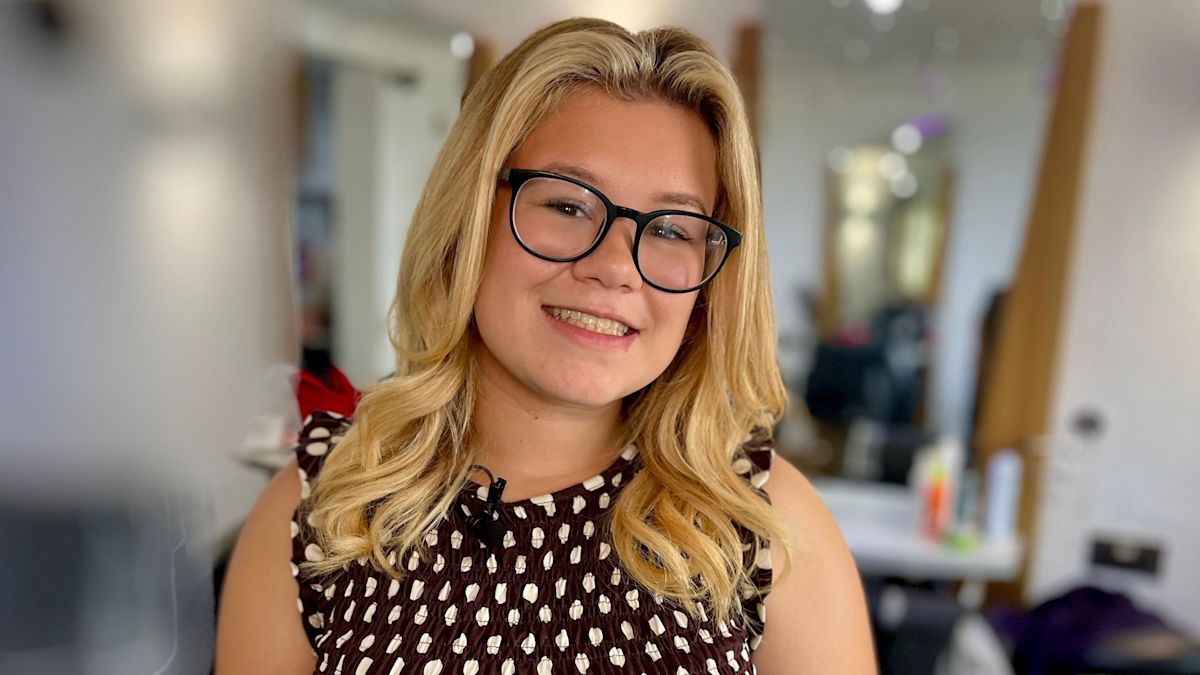
Jessica hopes to one day be on the stage at the Salon International show in London [Martin Giles/BBC]
Jessica Flaxman describes herself as Great Yarmouth "born and bred".
She admits that when she chose to study hairdressing at college, she "didn't have a clue" what she wanted to do for a career.
But after achieving a distinction in her course, and discovering a passion for cutting hair, she found that most salons in her hometown did not employ staff directly, so she became self-employed.
The 18-year-old is based at the Colours and Reveal salon in Bradwell and has spent the past month building her client list.
"It was nerve-racking at the start," she says, but adds that support from other self-employed hairdressers at the salon "builds your confidence as you go along".
Starting a business is difficult at first, she says, and advises others in the same position to have patience.
"The benefits, I'd probably say, is I'm making my own money and I'm making a name for myself," she says.
"I've loved every bit of it so far... I'm just excited to see what the future holds," says apprentice Callum Payne [Martin Giles/BBC]
For some, an apprenticeship offers the chance to earn while they learn.
Callum Payne, 19, took two attempts to secure a placement with Great Yarmouth engineering firm Armultra.
After getting a welding qualification at college, he was drawn to the role so he could earn a wage alongside his training.
Asked if he felt he was missing out on university, he said the thought of taking on so much debt was "stupid".
After being turned down on his first attempt, his advice to others is to "keep going back", apply again and get "more qualifications towards the role you want".
The company makes parts for the nuclear, gas, and wind sectors and currently employs 12 apprentices.
Senior project manager Karl Pull says that with these industries growing, and an ageing workforce, they "need to act to make sure that knowledge is passed on."
'Family-run businesses don't want an outsider'
Reece Pasby says job-hunting has left him feeling "pretty low", though he has found some short-term work [Martin Giles/BBC]
Reece Pasby, 19, is currently looking for work.
"It's pretty hard finding a job in a seaside town," he says.
His dream is to make it in the music industry, but while his band is recording an album, securing work has been tough.
He says most firms are family-run businesses that "don't want an outsider in it".
"All the jobs are in Norwich and it'd be a lot of money to get the bus every day for a job," he says.
Like many in Great Yarmouth, he says university is "not for me". But there are people in the town who buck the trend.
'University was a necessity for me'
Olivia Ojeman hopes to study Medicine at Bristol depending on her A-level results [Martin Giles/BBC]
Olivia Ojeman, 18, has lived in Great Yarmouth with her foster mother since the age of 16, and is now set to go to university to study medicine.
Inspired by American neurosurgeon-turned-politician Dr Ben Carson, she always knew she would have to go to university to become a doctor.
"It was a necessity to get to where I want to be," she says.
If she achieves her predicted grades, she will attend medical school on a scholarship, as her asylum status means she isn't eligible for student loans.
Her advice to others is to "follow your heart" and do what feels right for you.
Olivia has been helped by Into University, which supports young people from disadvantaged neighbourhoods during their education.
Centre leader Amy Rust says many of the young people it supports come from backgrounds that qualify for scholarships and bursaries.
She adds that while university works for some, they also help people explore other routes after A-levels.
"We're looking at how we can support that young person at university or actually if there's a different pathway that's available to them, like apprenticeships or a degree apprenticeship as well," she says.
Do you have a story suggestion for Norfolk? Contact us below.
Follow Norfolk news on BBC Sounds, Facebook, Instagram and X.
'AI couldn't fix a boat': The apprentices keeping a traditional craft afloat
'I fought for change to remove student housing stress'
University life begins for formerly homeless man
Related Stories
 Education
‘Pretty shoddy’: Prof says N.B. education plan attributes to him an article that doesn’t seem to exist
3 hours ago
 Education
Kamal Mitra Chenoy: JNU professor’s education, career and why he is in the news?
2 days ago
 Education
French police detain teen pupil suspected in school shooting in which 2 were wounded
3 days ago
 Education
Mum of disabled girl tells of 'fight' for childcare
3 days ago
 Education
PTM politics hots up; teachers say education taking back seat
6 days ago
 Education
(1) French high school protests continue despite PM’s promise of action
1 week ago
 Education
French police suspend use of stun grenades at school protests as minister rejects accusations of brutality
1 week ago
 Education
Ukrainian school children study at huge shelter
1 week ago