
The Rise of Cockroach Janata Party: Protest, Politics and Questions of Credibility

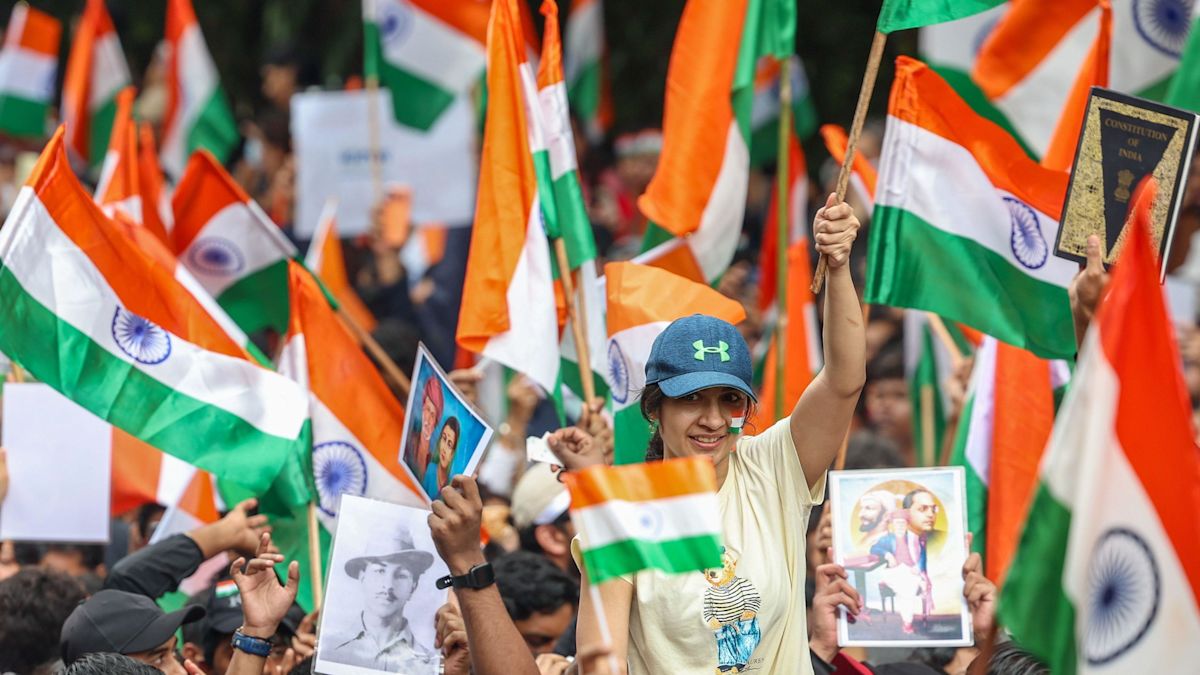
NEW DELHI: Cockroach Janata Party (CJP), which began as a satirical political movement in response to the alleged derogatory comments of Chief Justice of India Surya Kant, reportedly describing unemployed youths as cockroaches and parasites, has been on a sit-in agitation at iconic Jantar Mantar here since June 20. Ladakh-based Sonam Wangchuk, a well-known environmental activist and former head of the Expert Panel for framing the Jammu and Kashmir Education Policy and Vision Document in the alliance government of PDP and BJP with Mufti Mohammed Sayeed as Chief Minister, joined the CJP-led movement by sitting on an indefinite hunger strike with effect from June 28. The main demand of the party is the resignation of Union Education Minister Dharmendra Pradhan over the issue of the leakage of the test papers of the NEET examination held for admission to medical colleges all over the country.
In the last 18 days, Wangchuk has lost 9 kg weight and his health has badly deteriorated as he is not eating food. He is surviving only on some liquid material and water. Hundreds of youths from different parts of the country, particularly from neighbouring Uttar Pradesh, Haryana, Rajasthan and Punjab, have been visiting the protest site daily. Some of the youths have also been staying on the footpaths of the Jantar Mantar day and night since the start of the agitation in solidarity with CJP leaders and its workers.
While the protest and hunger-strike have not been given proper coverage by the mainstream media under the tight control of the central government, no minister or any official from the Central government has so far met the protesters to listen to their grievances and urged them to end their agitation. The government has also not given any assurance to look into their demand. This reflects the high ego and indifference of the government towards its citizens.
What is surprising is that the CJP, whose founder, Abhijeet Dipke, a graduate of Boston University in America and a political communications strategist, returned from the US to launch the movement, is not speaking on any major issues other than seeking the resignation of Pradhan on the issue of NEET exam paper leakage. Is exam paper leakage the only problem facing the youth? Is the NEET exam paper leakage the only failure of the Narendra Modi-led BJP government at the Centre? Critics allege that the BJP government at the Centre is the most corrupt government the nation has witnessed in 75 years history of Independent India. Among the major recent scams are MP Chief Minister Mohan Yadav’s land scam, Ram Mandir donation scam and Adani-Hinderburg scam. Earlier scams of the Modi government include the electoral bonds scam, PM-CARES scam, coal scam, Covid-19 procurement scam, demonetization scam, PNB-Nirav Modi scam, growing unemployment, rising inflation, and the latest mixing of ethanol in petrol, which is likely to take the shape of a scam in due course. Moreover, the washing away of national highways and roads in the first monsoon rain in Maharashtra, UP and Uttarakhand, and the collapse of several bridges soon after their inauguration are other examples of scams that need to be investigated and responsibilities to be fixed.
Apart from these scams and the failure of the government in maintaining law and order, there is an increasing tendency of the leaders and workers of the ruling BJP at the Centre and in states to deliver hate speeches intended to divide the society on communal and religious lines that obstruct foreign investment in the country in the long run. Reports say that the net Foreign Direct Investment has gone down in 2024-25 owing to foreign investors taking out their money and Indian companies investing in other countries due to the unfavourable political atmosphere in the country. The consequence of hate speeches and no action against such speech makers has been the rise in incidents of mob lynching of Muslims in different parts of the country. How can the police take action when the accused include chief ministers, ministers and senior functionaries of the ruling party? Such an attitude of the leaders holding constitutional responsibilities emboldens criminal elements to indulge in crimes when they feel they will go scot-free after committing crimes. Recently, the United Nations flagged the incidents of violence against Muslims and their marginalization during the Modi rule. The UN has also demanded an explanation from the Central government. Such incidents bring a bad name to the country, which had earned a reputation for being a strong democracy with the government giving equal treatment to all its citizens, irrespective of their faith, culture, region or language, during the Congress and other parties’ governments, based on fundamental rights guaranteed to citizens under the Constitution. But the BJP government under Modi has targeted minorities, particularly Muslims, as a part of its domestic political and administrative policy based on the philosophies of the right-wing Hindu ideologues like Vinayak Damodar Savarkar, MS Golwalkar and K. B.
Hedgewar. All of them wanted Muslims to be accorded the status of second-class citizens because their religion had originated from the geographical boundaries of India. Special Intensive Revision (SIR) of the voters’ list throughout the country, reportedly aimed at the exclusion of Muslim voters, depriving them of their political right to cast votes and subsequently, making a large Muslim population stateless, seems to be a step in the direction of achieving the goals of Savarkar, Golwalkar and Hedgewar. For the last few years, the BJP government in states are openly bulldozing mosques, madrasas (Islamic seminaries) and even homes and even entire Muslim habitations on the pretext of them being illegal while similar Hindu properties in the same areas are not touched, indicating open governmental bias towards Muslims. This is the biggest debate in political circlres in India today.
But the CJP with its founder having returned from the US, the greatest champion of democracy in the world, has been maintaining stoic silence on these issues. None of the speakers at the Jantar Mantar have touched even once these burning issues facing today’s India. Why are they avoiding these major issues?
CJP and workers, in their speeches, mostly mention BR Ambedkar. Sometimes, they mention Netaji Subhashchandra Bose. Though they have a small sketch of Mahatma Gandhi, alongside Ambedkar, in a corner of the curtain behind the stage, no speaker mentions Gandhi or other freedom fighters like Sardar Vallabhbhai Patel or India’s first Prime Minister, Pandit Jawaharlal Nehru. Gandhi was the most successful leader in mobilizing the public against the British Raj in South Africa and then in India. The methodology adopted by CJP in its political mobilization to achieve its goal is comparable to that of the RSS, BJP and AAP, whose leaders avoid Gandhi and other leaders in their public speeches. This casts doubt on the CJP’s credibility. Critics suspect that CJP is another political outfit like AAP that was launched surreptitiously by the BJP and RSS with the support of anti-corruption activist Anna Hazare to politically weaken the Congress and achieve their grand objective of a Congress-free India. Anna Hazare had hidden his RSS link during the anti-corruption movement but later got exposed.
There seems to be some truth in the suspicion about CJP being backed by BJP and RSS. While no political party or group is allowed to stay and protest at Jantar Mantar beyond the time permitted by the police, the CJP has been occupying the venue since June 20 without any permission. They have also set up a huge stage with all the paraphernalia. The police have not objected to it. Why are police being so soft and cooperative to CJP while it is very tough with other parties and groups?
Abhijeet was alone when he launched CJP online from the US. How did he find so many people to support him all of a sudden upon his return from the US? He was given a hero’s welcome when he landed at Indira Gandhi International Airport in New Delhi. Why did police allow a huge crowd at the airport? Before Abhijeet landed in Delhi, he got a well-trained young man as CJP’s spokesperson. Who arranged human resources at such a large scale for Abhijeet who even otherwise does not seem to be a good political manager. Who is behind Abhijeet and his CJP? This needs to be investigated to find out the hidden force behind the political activities of Abhijeet. Who is financing the CJP? Even established political parties find difficulty in arranging human resources and fund for even a small protest. These and many other questions about Abhijeet’s claim of being independent. As a discontent has started brewing among the non-committed support-base of the BJP due to failure of the BJP government to fulfill promises and contain inflation and rising unemployment, these voters might shift their loyalty to the Congress. In such a situation, the BJP will have to face a very tough political battle. Critics say that floating CJP might be a political strategy of the BJP to provide a new political platform to the disgruntled voters and prevent Congress and other opposition parties from taking advantage of the situation. In such circumstances, the BJP is sure to benefit in elections. BJP can’t count anymore on AAP, which has lost credibility because of AAP supremo Arvind Kejriwal’s pro-BJP tilt witnessed on many occasions. AAP has now become a persona non grata among the Opposition parties after it quit the opposition bloc, the Indian National Developmental Inclusive Alliance (INDIA), in July 2025.
Possibly because of these considerations, none of the major opposition parties has so far extended support to the CJP. Even prominent social and political activists have maintained a distance from this outfit. In 2012, the Anna Hazare-led movement against corruption of the Congress government had drawn support from students, professionals, middle-class citizens, retired officials, NGOs and members of the Indian diaspora overseas. Prominent activists like Kiran Bedi and legal luminaries including Prashant Bhushan, his father Shanti Bhushan and Santosh Hegde had thrown their full weight with Anna Hazare. Arvind Kejriwal was also one of them. But Anna Hazare cleverly projected Arvind Kejriwal as AAP’s convener. But when it became known that Kejriwal was an RSS plant in the movement, Prashant Bhushan and others who subscribed to a liberal and secular political ideology quit Kejriwal’s company. But by then, Kejriwal had acquired much popularity and managed to establish his party with clandestine and, in some places, with open support of the RSS.
As of now, the CJP has no prominent and credible face to influence the youth and attract them to the movement. Moreover, the youth during the Anna movement were highly outspoken about the corruption allegations levelled against the Congress by opposition parties. They were amplified by media that was totally independent during the Congress Party’s rule. But the situation is entirely different now. The mainstream media, having the maximum reach, have been fully muzzled. It cannot muster the courage to show anything that goes against the interests of the ruling party. An undeclared dictatorship prevails in the country today.
Many youths, whom this scribe talked to at the protest venue, said that the people are aware of the failure of the BJP government and scores of major scams, much bigger than those of the Congress government. A youth from Mathura confided that the youths are scared of the tactics used by the BJP government and their leaders, who implicate the critics and rivals in criminal and legal cases. He gave an example of the registration of FIRs by Union Minister for Road Transport and Highways Nitin Gadkari’s son against three YouTubers who raised the issue of damage to vehicles using petrol mixed with ethanol. Gadkari is reported to be in the ethanol manufacturing and supply business.
The future of the CJP may hinge on the size and strength of the crowd it mobilizes onJuly 20, when the Monsoon Session of Parliament begins. On that day, the party has called for a march to gherao (lay siege to) Parliament. If it fails to reach Parliament or is unable to draw a sufficiently large turnout, its prospects as a political force could be severely diminished. In that event, its founder, Abhijeet, may have little choice but to return to the United States to resume his studies.
Related Stories
 India
India
MIT India’s IRS 2026 Advances 25
4 minutes ago
 India
India
Rahul Gandhi questions India PM Narendra Modi's 'culture shock' comment over women swearing at CJP protest
5 hours ago
 India
India
US military kills four in strike on alleged drug smuggling boat in Caribbean
7 hours ago
 India
India
The question dominating Indian politics: Is it worse when women swear?
7 hours ago
 India
India
What we know about deadly Nepal
9 hours ago
 India
India
India news: Police used 'excessive force' on CJP protesters
10 hours ago
 India
India
24 Canadians among missing in Nepal flash floods: local spokesperson
11 hours ago
 India
India
The politics of religious 'purification'
11 hours ago