
The Pursuit of a More Perfect Union in the Age of Artificial Intelligence
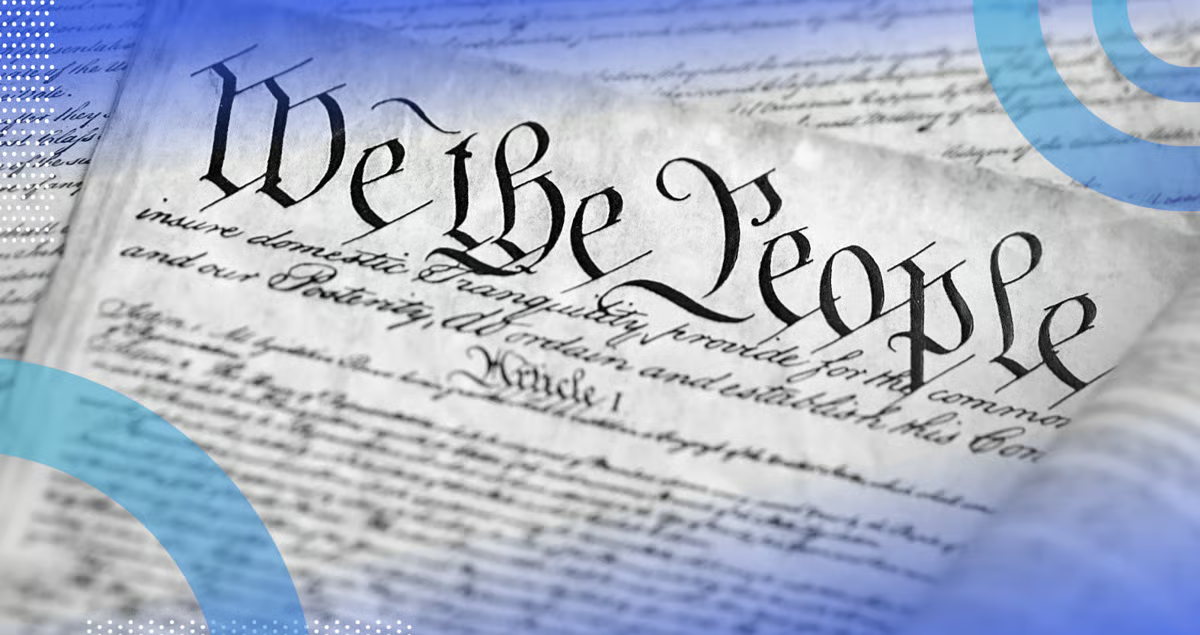
As the United States approaches its 250th birthday, the debate about artificial intelligence is mostly focused on the wrong questions. Will it eliminate jobs? Accelerate misinformation? Can it be regulated before it's too late? These are not bad questions. But they are downstream of something far more important that almost nobody is asking.
For 250 years, power had an address.
It lived in governments, armies, courts, in the instruments of state power the Constitution was built to constrain. Later, it lived in monopolies too, a form of power the Founders hadn’t anticipated and which the Constitution had to be stretched, decades later, to address. Sometimes it resided in charismatic leaders.
But the Founders understood, with unusual clarity, that concentrated power eventually becomes dangerous regardless of who holds it or how good their intentions may be. So, they didn’t try to find better people. Instead, they built a better governance architecture. Checks and balances, federalism, free speech, individual rights — the entire structure was designed around a single insight: Power must be visible to be constrained.
How Does AI Threaten the U.S. Constitution?
AI poses a unique constitutional crisis by redistributing human judgment rather than just changing access to information. By automating decisions regarding employment, healthcare and law enforcement, AI makes concentrated power invisible and unaccountable. This erodes the core assumption of the U.S. Constitution: that ordinary citizens possess the agency and judgment required for self-governance.
The AI-Powered Constitutional Crisis
That insight is now in trouble.
I work in data. I spend my days inside the machinery of how information about people is collected, processed and used to shape decisions. From that perspective, what I see is not a looming crisis. It’s a crisis that’s already underway — quiet, diffuse and largely invisible to the people it affects most. Algorithms are already determining who gets a job interview, who receives a loan, who law enforcement flags as suspicious, who sees which political message, who gets routed to which tier of healthcare. Those decisions aren’t happening because anyone decided to do something sinister. They happen because optimization at scale, left ungoverned, produces outcomes that no individual chose and no institution is accountable for.
That is a constitutional problem. Not eventually. Now.
The steam engine reshaped how humans used muscle. Electricity did the same for light and power. The internet redistributed access to information. Each innovation forced society to renegotiate who held power and on what terms. Each produced legal and institutional responses that lagged behind the precipitating breakthrough by decades — and the gap between the technology and the law was always paid for by the people least able to afford it.
Artificial intelligence is different in one crucial respect. It doesn’t just change access to a resource. It redistributes judgment itself. And judgment — the capacity to reason, to choose, to hold power accountable — is not just another resource. It is the quality the entire constitutional system assumes citizens possess.
The American experiment was never simply about democracy as a philosophical concept. Ancient Athens had democracy. What the Founders wagered on — and it was a genuine wager, contested and uncertain — was something more radical: that ordinary people could be trusted to govern themselves. Not perfectly. Not always wisely. But without kings, without aristocrats, without distant experts making decisions for them.
That wager undergirds everything in American life today. Free speech matters only if citizens can weigh what they hear against competing claims and arrive at their own conclusions. Courts retain legitimacy only if individuals can understand and challenge the case against them well enough to contest it. Elections are valid only if voters are forming their own judgments rather than having those judgments supplied to them. The Constitution is, underneath all its provisions, a document that bets on human agency.
Artificial intelligence is the first technology in history capable of making that bet look naive.
That naivety is not because machines are seizing control. That’s the science fiction version of the AI apocalypse. The real version is quieter and harder to resist. Self-government has always required effort: the effort of gathering information, tolerating uncertainty, weighing arguments, sitting with complexity long enough to form an actual opinion. AI removes that friction. Why read a whole report when the machine summarizes it? Why wrestle with a hard question when the algorithm has an immediate answer? Why accept the discomfort of not knowing when the software can decide for you?
Each individual shortcut is defensible. Collectively, they may erode the very habit on which democratic government depends. A citizen who stops exercising judgment doesn’t lose it dramatically. They lose it the way Hemingway wrote about people going bankrupt: gradually, then all at once.
The constitutional implications of the AI revolution are more specific than most of the current debate acknowledges. The Fourth Amendment was designed to protect citizens from arbitrary surveillance. But an AI system that aggregates your location history, your purchases, your search patterns and your social graph can infer your political beliefs and your psychological vulnerabilities, your private life, without intercepting a single protected communication.
The First Amendment assumes we live in a functional marketplace of ideas. AI-generated content at scale doesn’t just add noise to that marketplace; it can destroy the shared factual ground that makes argument possible in the first place.
Due process guarantees the right to understand and contest decisions made about you. That guarantee is hollow when the decision emerges from a model whose logic is proprietary and whose outputs even its builders cannot fully explain.
How to Protect Democracy in the AI Age
None of this is inevitable. I want to be clear about that because the doomer framing around AI gets the problem backwards. The technology creates real possibilities: legal assistance finally accessible to people who can't afford attorneys, investigative tools that let journalists and watchdogs hold institutions accountable at a scale previously impossible, scientific breakthroughs that could extend and improve lives in ways that dwarf anything we’ve ever seen. The question was never whether AI is good or bad. The question is whether it remains a tool of self-government or becomes a substitute for it.
What separates the two outcomes is not the technology itself but where we choose to preserve friction. The systems worth building are the ones that inform judgment without replacing it: that show their reasoning, leave room for contestation and require a human to take responsibility for the final call. The systems worth resisting are the ones that make the decision invisible, foreclose appeal or quietly substitute convenience for understanding
That distinction is not technical. It is political, in the oldest sense of the word. It is a question of who holds power, how visible that power is and who has the standing to challenge it. Every choice about whether an algorithm explains itself, whether its outputs can be appealed, whether a human remains accountable for its decisions, is a choice about where power sits and whether it can be checked. And right now, those choices are being made by default — by the engineers who build these systems, the companies that deploy them, and the investors who fund them — while the institutions actually built to make exactly these decisions are still trying to understand what a large language model is.
The first great challenge the US faced was whether free people could govern themselves without the guidance of kings. The answer, imperfect and incomplete as it remains, was yes. The country’s next challenge may be whether, given the option of outsourcing the burden of self-governance to machines, citizens still choose to do the difficult work themselves.
The Founders couldn’t have imagined this moment. But they anticipated its structure. They knew that republics don’t fall to outside threats. They fail from the inside out when citizens stop doing the work that free government requires.
The question before every generation is never whether the Constitution is adequate to the challenges of its moment. The question is whether the generation is adequate to the challenges posed by the Constitution.
Related Stories
 AI News
'I applied for 200 jobs'
44 minutes ago
 AI News
Kroger to lay off 3,000 employees as it leans into artificial intelligence
45 minutes ago
 AI News
Nvidia Commits $250 Million To Strengthen Britain’s Artificial Intelligence Safety Efforts
45 minutes ago
 AI News
France carves its own path in AI race with Nvidia’s help
1 hour ago
 AI News
The Big Problem Every Artificial Intelligence Company Faces
1 hour ago
 AI News
OpenAI’s AI misalignment problem is growing
1 hour ago
 AI News
OpenAI engineer arrested, accused of planting listening device inside company's office
2 hours ago
 AI News
Helsinki’s Ambio raises €5.1 million to scale its AI-powered recycled plastics procurement platform
2 hours ago