
The Indian stock market, which was relatively marginalized from the artificial intelligence (AI) cra..
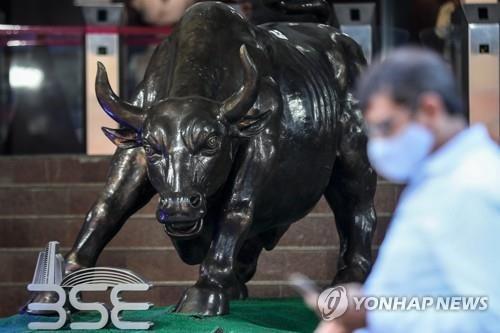
The Indian stock market, which was relatively marginalized from the artificial intelligence (AI) craze, has recently emerged as a new investment destination for global investors. This is because the proportion of AI-related stocks is low, and in the first half of this year, it lags behind Korea and Taiwan, but it is attracting attention as a low-volatile market due to growing concerns over overheating of AI investment.
According to Bloomberg News on the 5th (local time), the Nifty 50, India's leading stock index, fluctuated more than 1% per day in the first half of this year, with 38 trading days, about one-third of the total. This is significantly smaller than the MSCI Emerging Countries Index and MSCI Asia Index (59 days each), and is similar to the US S&P 500 Index (32 days). During the same period, Korea's KOSPI moved more than 1% over 79 trading days, the most volatile among major markets.
This year, global funds have flocked to Korean and Taiwanese stock markets, where the proportion of AI-related companies, including Nvidia, is high. However, as questions about the sustainability of the AI rally grow and the valuation burden rises, investors' eyes are heading back to India.
In fact, the Nifty 50 index in June exceeded the MSCI Emerging Markets Index by the largest margin since November last year, and the outflow of foreign investors' funds was the smallest in the last four months.
The market evaluates that India's distance from the AI investment craze is rather an advantage. "India is a market that is relatively less affected by AI transactions," said Maxance Bisso, Chief Investment Officer (CIO) of Dubai investment firm Archebium Capital. "It can act as a hedge to disperse AI investment risks in emerging economies' portfolios."
Macroeconomic conditions are also improving. As international oil prices have stabilized due to easing tensions in the Middle East, the burden on the oil and aviation sectors has been reduced, and the rupee, which has fallen to an all-time low, is also stabilizing. As a result, inflation concerns have been eased and economic growth prospects have improved.
Expectations for corporate performance are also growing. With the full-fledged earnings announcement season taking place this week, starting with Tata Consultancy Services (TCS), the market expects the earnings upgrade to be more than the downgrade. "A drop in raw material prices, inflows of funds and a stable interest rate environment are likely to lead to an improvement in corporate earnings," analyst Sandeep Sabharwal said.
Morgan Stanley also evaluated India as a "larger macroeconomic asset group" in a recent report and analyzed that its defense against global shocks is higher than in the past thanks to price stability and solid growth. Over the past decade, the Nifty 50 index has risen about three times and has risen more than 10% annually, reaching six times.
"Earlier this year, India was disadvantaged by high energy prices and a lack of AI stocks, but as this burden eased, investors began to look for alternatives other than AI-oriented markets," said Ben Powell, chief investment strategist at BlackRock Investment Research Institute. "India is likely to emerge as a differentiated investment destination in emerging markets."
Related Stories
 AI News
After 27 years, it must have been hard for Jeff Dean to let go. Dean, who quit Google to build his own AI startup called DiscoveryLoop, briefly choked up while describing his decision to leave the search giant after more than a quarter
1 hour ago
 AI News
Royster Fellow will study how AI can be manipulated
1 hour ago
 AI News
Why Anthropic's AI watermark for Claude text goes further than rivals
2 hours ago
 AI News
MAHA activists criticize Trump’s push for coal
2 hours ago
 AI News
Neoclouds become AI’s new power brokers
2 hours ago
 AI News
AI Jobs Are Booming for Gen Z, Not Everyone
2 hours ago
 AI News
AI scammers may use vacation photos to determine travelers' locations, experts at McAfee warn
3 hours ago
 AI News
Anthropic IPO filing will show AI backlash as a risk factor, sources say
3 hours ago