
The face of "unicorn" (unlisted startups with an enterprise value of more than $1 billion), which ca..
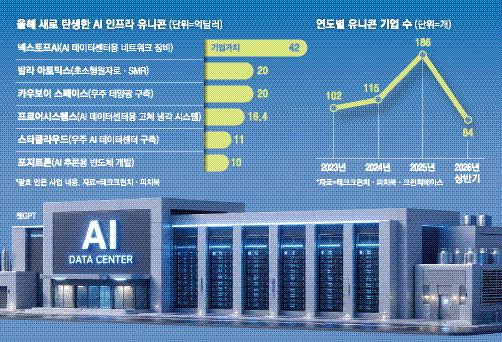
The face of "unicorn" (unlisted startups with an enterprise value of more than $1 billion), which can be called the "romantic" of startups, is changing. Last year, software startups that make Generative AI services such as artificial intelligence (AI) coding, search, and business automation sucked in investment, but this year, AI infrastructure startups such as power, cooling, semiconductors, and data centers are listed as unicorns one after another. Analysts say that competition for AI infrastructure between Google, Meta, and Microsoft (MS) is spreading to the startup ecosystem.
TechCrunch, a U.S. IT media outlet, compiled data based on Crunchbase and Pitchbook on the 5th (local time) and found that 84 new unicorns were born in the U.S. in the first half of this year. Many were directly or indirectly related to AI, but this year, infrastructure companies that support it were more prominent than AI applications.
A case in point is Proer Systems, which received $140 million in investment in March and was recognized for $1.64 billion in corporate value. The company has developed a cooling technology that cools the heat generated by AI chips and servers. The main product 'Airjet' is an ultra-small cooling device that distributes heat by creating air flow with ultrasonic vibration instead of existing fans.
The same is true of the network and semiconductor sectors. Nextop AI, which became a unicorn with an enterprise value of $4.2 billion in March this year, will develop Ethernet networking equipment that reduces data bottlenecks in large-scale GPU clusters. Positron, an AI semiconductor company specializing in reasoning, also raised its corporate value to $1.06 billion by attracting large-scale investments in February and May this year. As demand for power from AI data centers surged, the next-generation nuclear power company Bala Atomics was also recognized for its corporate value of $2 billion and became a unicorn. It also drew attention that people from Palantir and Lockheed Martin participated as individual investors.
Behind this change is a bottleneck change in the AI industry. In the early days of Generative AI, excellent giant language models (LLMs) and services using them were competitive. However, power, cooling, and network have emerged as new competitiveness as model performance has been leveled up and super-large data centers that connect hundreds of thousands of GPUs have emerged. As much as making good AI, how stable and efficiently it operates has become important.
Competition for AI infrastructure is also expanding into space. Cowboy Space and StarCloud, which recorded $2 billion and $1.1 billion in corporate value in May, respectively, are representative. Cowboy Space is developing technology to power AI data centers on Earth with a space solar power network, and StarCloud is creating a data center for AI inference in low orbit.
The startup that has recorded the highest corporate value so far this year is Prometheus, which has become a hot topic as Amazon founder Jeff Bezos served as CEO. Unlike chatbots and text-generating AI, Prometheus, which has an enterprise value of $41 billion, is building an ultra-advanced next-generation computer-aided design (CAD) AI tool that can design complex physical products such as jet engines, aerospace systems, and medical devices and simulate manufacturing processes.
The same trend shows that Andreesson Horowitz (a16z), the world's largest venture capital (VC), created a $1.7 billion fund dedicated to AI infrastructure this year.
Related Stories
 AI News
French far-right leader Marine Le Pen to run for president after appeals court shortens public
16 minutes ago
 AI News
Egypt files complaint over referee decisions in World Cup loss to Argentina
17 minutes ago
 AI News
World leaders work to keep the peace with Trump amid NATO Summit in Turkey
17 minutes ago
 AI News
WORLD CUP DAILY, July 8: Argentina & Switzerland advance
17 minutes ago
 AI News
Nato leaders will not mention World Cup to Donald Trump to avoid irritating him at summit
17 minutes ago
 AI News
Trans Mountain reaches toll settlement with oil shippers after prolonged negotiations
18 minutes ago
 AI News
LETTER: Fireworks lit up the sky over a troubled Canada
18 minutes ago
 AI News
Bell and Université de Sherbrooke to advance quantum, cybersecurity and next
18 minutes ago