
Thailand's WWII 'Death Railway' resurfaces after decades | NHK WORLD
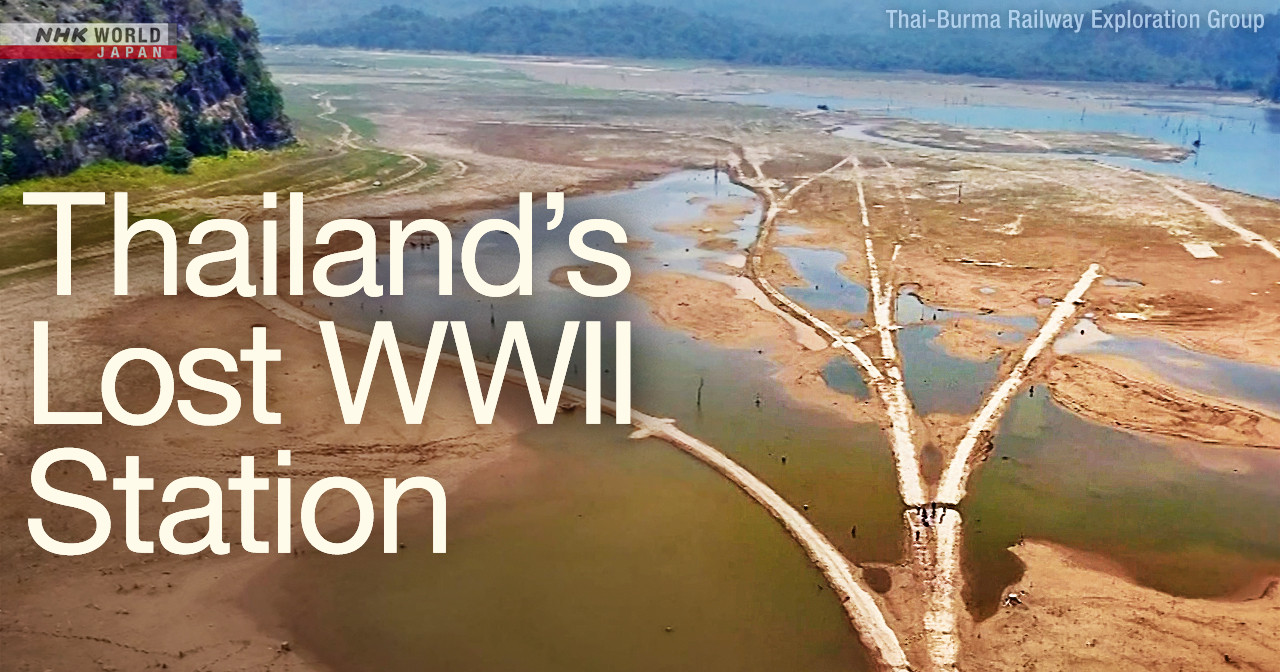
Thailand's 'Death Railway' emerges after years underwater
Traces of the infamous "Death Railway" have resurfaced in Thailand after more than four decades underwater, revealing relics of the Japanese structures built by forced labor during World War Two — and offering a rare and fleeting glimpse into one of the conflict’s darkest chapters. In May, NHK World visited the site with a villager who grew up along the tracks... just before rising water submerged them once again.
For 52-year-old Pichai Sairantee, the railway bed's reappearance was deeply personal. He was raised in the village of Nithe, listening to wartime stories passed down by his grandparents and village elders.
"Our house stood right by the river," he recalls. "Back when we were kids, people could still walk along the tracks."
The site lies beneath the reservoir of the Vajiralongkorn Dam in Kanchanaburi Province, near Thailand's border with Myanmar. The reservoir was drawn down in early April as the dam underwent maintenance. Water levels fell to a record low, exposing the remains for the first time since the valley was flooded in 1984.
"This is just like what I saw when I was a kid," Pichai says, returning to the place he once called home.
Known locally as Nithe, the station was named "Neekey" by the now-defunct Imperial Japanese army. It was part of the Thai-Burma railway, built during World War Two, as a supply route for the Japanese Army.
The station became a key operational hub, where steam locomotives hauling troops and supplies were serviced before continuing toward the front.
The station's distinctive Y-shaped track layout allowed locomotives to reverse direction. It also included maintenance facilities for repairing rolling stock.
When the reservoir receded this year, the outline of the Y-shaped junction became clearly visible from the air. Researchers also identified what are believed to be the remains of an inspection pit, where mechanics worked beneath locomotives, and a water tank that once supplied steam engines.
The Thai-Burma railway stretched about 415 kilometers through mountains and dense jungle. It was completed in just 15 months — but at an enormous human cost.
The Japanese army forced Allied prisoners of war and Asian laborers to build it. Disease, starvation and brutal conditions claimed tens of thousands of lives, giving rise to its enduring nickname — the "Death Railway."
Growing up in the shadow of war
Much of the railway was dismantled after the war, including Neekey Station. Yet the community of Nithe lived on until the 1980s, when the dam submerged nearly 400 square kilometers of land. Pichai's family was among the last to leave.
The stories he heard from village elders about their wartime experiences have stayed with him.
"By evening, every fire had to be out. If any light was seen, bombs might be dropped. This area was a major target and was heavily bombed," he says.
Pichai also remembers hearing how his grandfather, like other villagers, quietly passed food to Allied POWs working on the railway.
"They needed bananas and simple things," he says. "The Japanese soldiers disapproved, but many villagers sympathized with the prisoners."
As a boy, Pichai walked the tracks between his home and the fields where his father worked. His parents warned him never to bring anything back.
"If we took something, they made us return it because they feared we would disturb the spirits. They believed the souls of countless people still rested here," he says.
Today, only a 130-kilometer section of the railway remains in operation in Thailand, carrying tourists across the River Kwai Bridge — a structure made famous by the French novel and the Oscar-winning 1957 film based on it.
Much of the rest has vanished — dismantled after the war, abandoned or submerged beneath reservoirs.
Over time, memories of Pichai's hometown have also begun to fade. He fears that the stories passed down through generations are disappearing, along with the physical remains of the railway.
"Deep down, I never thought I'd see this place again," he says. "But standing here now, the elders' stories make much more sense. It's like learning history all over again."
Professor Kakizaki Ichiro of Yokohama City University was astonished by how well the railway remains had been preserved after decades underwater.
"I don't think you'll find any other remains that show so clearly how the tracks were laid out within a station," he says.
Kakizaki's research focuses on military logistics, forced labor and the railway's legacy in Thailand. He says the site is an important piece of historical heritage that helps reconnect people with the past.
"Today, Thailand and Japan enjoy a very friendly relationship. But we must never forget what happened more than 80 years ago. These remains remind us of the darker side of history and offer an opportunity to reflect on what took place here."
The station's reappearance is more than a historical curiosity. It is a brief opportunity to see a place that is normally hidden beneath the reservoir.
Authorities say the site would likely remain accessible for only about three months before the monsoon rains refilled the reservoir. When NHK visited in early May, the water had yet to return, but dense vegetation had already begun to reclaim the ground, obscuring many of the surviving features.
Now, the window is closing. Once again, the remains are disappearing beneath the water.
Pichai says he is grateful he had the chance to walk through his hometown one more time.
"Even underwater, I know exactly where it is."
Related Stories
 World
World
The Kia PV7 Teased Ahead of World Premiere at IAA Transportation
3 minutes ago
 World
World
Iran hostilities flare after US strike in strait of Hormuz; supertanker hits mines and catches fire
3 minutes ago
 World
World
Newborn baby’s body found in Sydney rubbish bin as police hold ‘serious concerns’ for mother
1 hour ago
 World
World
United Arab Emirates says it has intercepted an Iranian drone over its territorial waters
1 hour ago
 World
World
World Rowing Championships: Two silvers for Ireland as Henry claims gold for GB
2 hours ago
 World
World
Nurse who saved sole newborn survivor of hospital nursery fire to be awarded
2 hours ago
 World
World
England dominate at Lord’s to seal WTC series against Pakistan
3 hours ago
 World
World
US and Iran trade strikes for first time in weeks
3 hours ago