
Tennis Canada plans new stadium as part of Montreal modernization
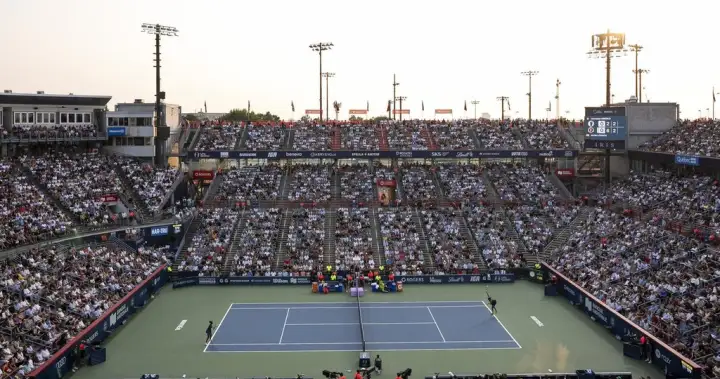
Tennis Canada plans to build a new centre-court stadium with a retractable roof in Montreal as part of a major modernization of its facilities at Jarry Park, saying the project is necessary to keep pace with rising standards on the professional tours.
The organization made the announcement Tuesday after conducting a year-long feasibility study examining options for the long-term future of the National Bank Open in Montreal.
The proposed project would include increasing the venue’s capacity to approximately 15,000 seats — the aging IGA Stadium holds 11,991 — while adding up to four practice courts and a match court, according to National Bank Open tournament director Valérie Tétreault.
“It was a very important step,” Tétreault said in an interview. “We’re feeling like we’re really falling behind and that’s what we’re also told by both the ATP and the WTA. So that puts, of course, extra pressure on us.”
Tétreault said the study considered three scenarios: renovating the existing IGA Stadium, building a new stadium within Jarry Park or relocating the tournament site elsewhere in the city. The last possibility was quickly ruled out due to cost, she said, while the difference between the other two was “negligible.”
The next steps include determining the construction timeline, estimated costs and how the project will be funded, Tennis Canada said. The organization added that it has already begun discussions with all three levels of government about potential funding.
“Conversations are going well, we’re feeling like everybody is recognizing the importance of the event in terms of the economic impact it creates, but also in terms of the sporting, the social impact it creates,” Tétreault said. “We’re feeling like everybody is mobilized and engaged and wants to help us find a solution.
“Tennis Canada is willing, of course, to participate in the financing model that we’ll put in place for the project. But we will need the help also of the three levels of government.”
Tennis Canada is targeting the site of an existing baseball field west of the practice courts for the new venue, allowing the tournament to continue at its current facility during construction. The stadium would be a three-season venue, with winterized facilities surrounding a non-winterized court.
The need for a roof over centre court has been a recurring topic for years, with rainy weather often derailing match schedules at the National Bank Open, held annually in late July and early August.
Tétreault has also stated that Montreal’s facilities sit “pretty much at the bottom of the list” among 1000-level tournaments, one tier below the four Grand Slams.
The Cincinnati Open — which takes place immediately after the National Bank Open — is one of several top-tier events that have made significant investments in recent years, undergoing a US$260-million redevelopment before the 2025 tournament.
Montreal’s centre court, meanwhile, last underwent major renovations in 1996 and the venue’s south end dates back to 1969, a remnant from the Montreal Expos’ Jarry Park baseball stadium.
Tétreault said Toronto, which alternates the men’s and women’s tournaments with Montreal each year, faces less pressure to modernize because Sobeys Stadium was built in 2004 and rain has historically been less disruptive there.
The ATP and WTA haven’t issued an ultimatum to keep the tournament in Montreal, Tétreault said, but both tours have requested an action plan outlining how the facilities will be modernized.
“They want to be reassured in a way that this is something that is a priority for us, that we’re looking at it and that we’re looking for solutions,” she said. “Even this year in the planning of the 2026 tournament, it’s the first time that I am asked to do monthly check-ins with the ATP.
“This was never necessarily the case before, but they want to know how we’re progressing with the work that we’re doing to modernize our facility.”
Tétreault also noted that the National Bank Open does not meet the standard number of practice courts and requires ATP approval to use extra courts at nearby Complexe sportif Claude-Robillard.
Tennis Canada signed a 30-year agreement with the ATP and WTA in 2022 as part of negotiations surrounding the tournament’s expansion into a 12-day event, but Tétreault said organizers still need to meet evolving standards set by the professional tours.
“Right now they are seeing a gap, of course, because we know that we’re not necessarily meeting certain standards,” she said.
Related Stories
 Canada
Trump takes aim at Bombardier sales in the U.S. as Canada's tariff deadline looms
28 minutes ago
 Canada
Canada braces for prolonged trade war as counter
28 minutes ago
 Canada
More heavy rain forecast for Cape Breton as it recovers from weekend storm
1 hour ago
 Canada
Canada's new tariffs: Businesses are bracing for higher costs
1 hour ago
 Canada
Canada’s retaliatory tariffs on $20bn of US goods take effect
1 hour ago
 Canada
Trump targets Canada on social media a day before counter
1 hour ago
 Canada
Trump targets Canada on social media a day before counter
1 hour ago
 Canada
Iran foreign ministry takes aim at Canada for support of U.S. actions in Strait of Hormuz
2 hours ago