
'Switch sides, there's a washing machine': Bombay HC judge's 'horse
The court set aside the externment order against 49-year-old Saeed Ahmad Abdul Wahid Chaudhary, who claims to be the general secretary of the Socialist Democratic Party of India (SDPI), holding that the police action was "vitiated" and "mala fide".
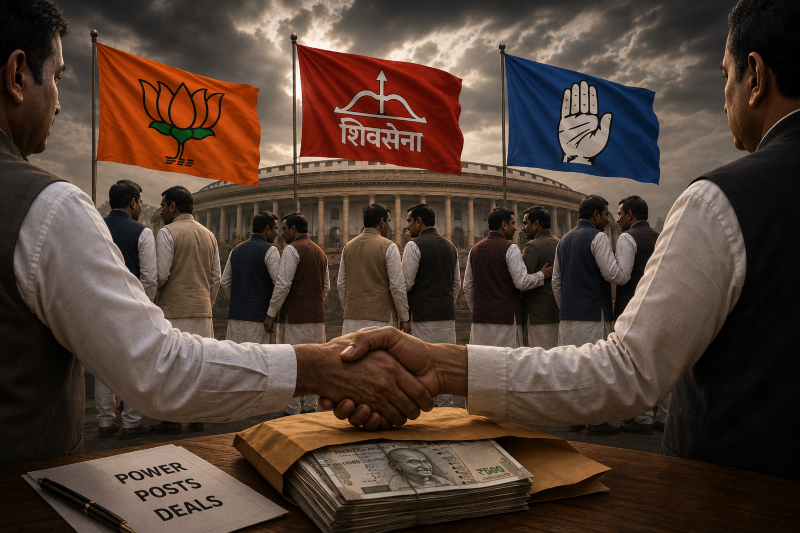
During the hearing, Justice Madhav J. Jamdar made a light-hearted remark about the political defections witnessed in Maharashtra, where several MLAs and MPs have switched parties in recent years.
Referring to the trend, the judge said, "Day before yesterday, one 10-year-old child was killed in an accident and what the State Assembly was discussing was how a Presiding Officer is elected and how he has shifted from one party to another... What is this?"
The judge then joked with the petitioner, saying, "Even you (Saeed) should switch sides... Anyways, horse-trading is going on in entire Maharashtra. You have some FIRs... consider switching sides, there is a washing machine," as quoted by Live Law.
The remark referenced the Opposition's frequent use of the term "washing machine" to allege that politicians facing criminal cases receive relief after joining the ruling Bharatiya Janata Party (BJP).
Earlier in the hearing, Justice Jamdar had strongly defended citizens' right to protest and criticised the externment order, reiterating that dissent and peaceful protests are protected under the Constitution.
Chaudhary challenged the externment order, claiming he had been barred from the area for one year.
According to the petition, the externment proceedings stemmed from a show-cause notice issued in October 2025, based on multiple First Information Reports (FIRs) registered against him between 2019 and 2024 for participating in or organising protests.
Advocates Payoshi Roy and Ibraheem Harbat, appearing for Chaudhary, argued that all the FIRs against their client were registered under Section 188 of the Indian Penal Code (IPC), which deals with disobedience of an order duly promulgated by a public servant.
They submitted that the cases related to protests over issues such as the Citizenship (Amendment) Act (CAA), the National Register of Citizens (NRC), the Babri Masjid dispute and the sealing of the Gyanvapi Mosque, The Indian Express reported.
They contended that none of these activities justified an externment order and sought its cancellation.
Hearing the matter, Justice Madhav J. Jamdar questioned the rationale behind penalising citizens for participating in protests and expressing dissent.
Referring to recent paper leak controversies, the judge remarked that people cannot be prevented from protesting government actions.
"What is this? All citizens are being made slaves of the Indian Government... They cannot stage protests, they cannot agitate—what is all this? Now so many papers have been leaked. If people protest, you will slap cases... What is this?" Justice Jamdar observed, as quoted by Live Law.
The judge also questioned why slogans critical of the government should invite punitive action.
"It is the right of the citizens to protest.... The petitioner has just raised slogans like 'BJP Government Murdabad', 'Amit Shah Murdabad'... Why can't citizens raise such slogans? Why externment orders for such slogans?" the judge said.
The High Court reminded the police that they are accountable to the people and must act within the framework of the Constitution rather than serve those in power.
Setting aside the externment order, the court held that the police action was legally unsustainable and violated the petitioner's fundamental rights.
The bench reiterated that every citizen has the freedom to express opinions under Article 19 and the right to live with dignity under Article 21 of the Constitution.
Related Stories
 AI News
Venice mayor proposes dynamic pricing for day-trippers with 50
39 minutes ago
 AI News
Friday briefing: The US at 250: who gets to tell the story?
39 minutes ago
 AI News
Portugal survive late drama to beat Croatia and reach World Cup last 16
39 minutes ago
 AI News
'Cristiano Ronaldo is the reason we watch soccer': A legend descends on Toronto for the World Cup
39 minutes ago
 AI News
Venezuelan earthquake survivors search for missing pets at 'Hospital McDonald's'
39 minutes ago
 AI News
Canadians have 'sense of superiority' over Americans, poll finds
40 minutes ago
 AI News
Joint statement by the Prime Minister of Canada and the President of the Republic of the Philippines
40 minutes ago
 AI News
Rollout of Canada’s boosted grocery benefit starts today
40 minutes ago