
'Super Intelligence': the president’s new term for AI, explained
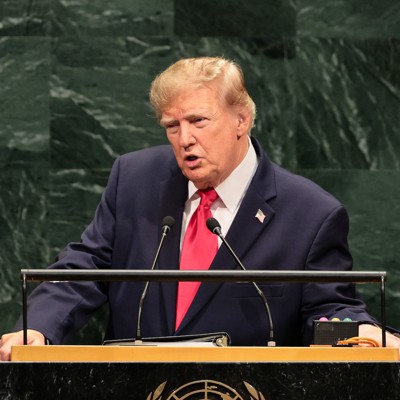
President Donald Trump on Tuesday announced a rebranding of the term “artificial intelligence,” saying during the United Nations General Assembly that from now on, it will be called “super intelligence.”
“From this point forward, all of United States’ documents, and hopefully the world’s, will be changed to use the much more accurate term, ‘super,’ as opposed to ‘artificial’,” he said.
Though the rebrand may have been a surprise to many, superintelligence is already an established term in AI literature. It was popularized in philosopher Nick Bostrom’s 2014 bestseller Superintelligence, which defines the term as “any intellect that greatly exceeds the cognitive performance of humans in virtually all domains of interest.” Artificial superintelligence, or ASI, thus refers to future AI systems that could be much smarter than humans, and contrasts with the weaker forms of AI that exist today.
ASI is a step beyond AGI, or artificial general intelligence, which OpenAI defines as “highly autonomous systems that outperform humans at most economically valuable work.” By this definition, today’s AI isn’t AGI yet, much less ASI, since we can’t yet hire AI as a reliable virtual employee.
Some experts dislike the term superintelligence, or question whether it’s a coherent concept. In the influential 2025 paper “AI as Normal Technology,” authors Sayash Kapoor and Arvind Narayanan write, “We do not think there is a useful sense of the term ‘intelligence’ in which AI is more intelligent than people acting with the help of AI.”
But others say the possible renaming contributes to an ongoing conversation about AI’s growing abilities.
“‘Super’ does align well with the fact that AI is exceeding human capabilities in a growing range of tasks and by increasing margins, which can have distinct national security implications beyond simply matching human performance,” said Caleb Withers, a research associate for the Technology and Security Program at the Center for a New American Security.
For example, in early September, OpenAI announced a solution to the Navier-Stokes Millennium Prize problem, one of the most important open problems in math.
As AI becomes more capable, it has grown increasingly central to the U.S.-China relationship. Trump and Chinese president Xi Jinping are slated to meet this week to discuss trade and AI issues. Bostrom, who has warned of the dangers of fully superintelligent AI systems, said an all-out AI race increases the risk that the technology gets out of control. “If competitors are convinced that coming second [in the AI race] means the total loss of everything they care about, they will take whatever risk necessary to bypass their rivals,” he said.
Trump reportedly worries that an AI slowdown could cause a market crash, and sees “super intelligence” as a critical sector for America to stay ahead of China. “Whoever wins AI, you have to remember this, and now I say, whoever wins SI, whoever wins super intelligence, wins. That’s the group that wins.”
Related Stories
 AI News
Modern Industrials Announces $6M in Funding to Deploy Custom AI Solutions to Manufacturers and Distributors
56 minutes ago
 AI News
Nvidia scandal: What’s next for the US tech company?
56 minutes ago
 AI News
New York bans AI chatbot toys for five years; companies that break the law face fines of up to $15,000 a
56 minutes ago
 AI News
Google, the 'big brother' of artificial intelligence (AI), which surprised the world with 'AlphaGo'
57 minutes ago
 AI News
Constitution Day 2026: From student protests to 'Vote Chori', how the Constitution stayed at the centre of
1 hour ago
Virtus Artificial Intelligence & Technology Opportunities Fund Discloses Sources of Distribution
1 hour ago
 AI News
Mohamed bin Zayed University of Artificial Intelligence awards Tahnoon bin Zayed Scholarship in AI Excellence to 42 undergraduates for 2026/27 class
2 hours ago
 AI News
AI’s Ability to Refuse Commands May Become a Legal Requirement for Autonomous Weapons
2 hours ago