
SUNY funding to advance tech that could improve patient care
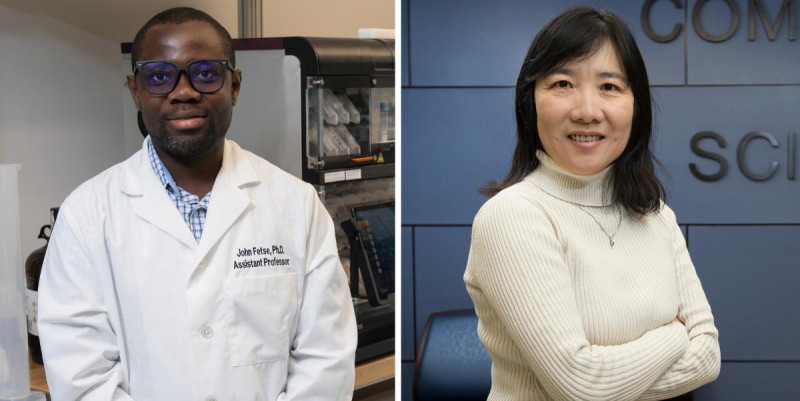
Binghamton researchers receive SUNY funding to advance technologies that could improve patient care
Technology Accelerator Fund provides seed funding to move cancer diagnostic and drug delivery toward commercialization
Two Binghamton University faculty members will receive seed funding through the SUNY Technology Accelerator Fund (TAF), which provides grants to faculty inventors and scientists.
The projects both address healthcare innovations: using artificial intelligence to accelerate cancer diagnostics and enhancing RNA therapeutic drug delivery.
“SUNY is a national leader in interdisciplinary research that develops state-of-the-art technologies, saves lives, transforms industries, and serves the public good,” said State University of New York Chancellor John B. King Jr. “Through the SUNY Technology Accelerator Fund, we are proud to continue investing in cutting-edge research and celebrate the vision, passion, and purpose that our researchers embody.”
Professor of Empire Innovation Nancy Guo, a faculty member at the Thomas J. Watson College of Engineering and Applied Science’s School of Computing, received TAF funding for ClinSegAI. The predictive model uses artificial intelligence to detect biomarkers within standard pathology imaging to rapidly reduce treatment decision time, marking a major improvement in the standard of care.
“Our medical imaging analysis model will incorporate molecular biology insights to identify early indicators of tumor progression, potentially detecting changes before they are visible through conventional radiological assessment,” Guo said.
Also receiving TAF funding is Assistant Professor of Pharmaceutical Sciences John Fetse, a faculty member at the School of Pharmacy and Pharmaceutical Sciences, who is researching RNA therapeutics.
Current methods using lipid nanoparticles (in a person's fat cells) have poor delivery and efficiency, and they raise toxicity concerns that limit proper dosing. Fetse has overcome these challenges by incorporating amino acids directly into the lipids, reducing toxicity risk and improving delivery rates.
"RNA medicines hold enormous promise for diseases that have long had no effective treatment, but delivering them safely to the right place in the body remains one of medicine's biggest unsolved challenges,” Fetse said. “This funding allows us to test a fundamentally new type of delivery vehicle — one that is safer, more effective, and more versatile than existing options. Our technology, PeptoLNP, is built from amino acids, making it naturally biodegradable and adaptable for targeting different tissues. This work will generate the evidence needed to move the technology out of the lab and toward patients."
Binghamton University President Anne D’Alleva praised the researchers for their cutting-edge ideas that could save lives.
“Binghamton faculty are developing new technologies that could have a real impact on delivering timely, safer, and more effective treatments for people suffering from a variety of diseases,” she said. “Professors Guo and Fetse are tackling important health challenges through their research, and I am grateful to SUNY for supporting this work and helping move these discoveries beyond the lab and closer to people who could actively benefit from them.”
Research projects from five SUNY universities — Albany, Binghamton, Buffalo, Stony Brook, and Upstate Medical University — split $400,000 in TAF grant money. The program helps support critical research — such as feasibility studies, prototyping, and testing — that demonstrates an idea or innovation has commercial potential. The goal is to accelerate time-to-market for these innovations and increase their market readiness for potential investors, strategic partners, and customers.
Related Stories
 Technology
Munich-based Arcos raises €5.5 million to build and operate civil safety infrastructure across Europe
48 minutes ago
 Technology
Uzbekistan, S.Korean KISED explore soft
48 minutes ago
 Technology
Revealed: how Russia uses mobile ‘super
1 hour ago
 Technology
Legacy technology exposure gives brokers a new placement question
1 hour ago
 Technology
Finvolve marks Rs 90 crore first close of Rs 250 crore fund to back defence, aerospace and deeptech startups
2 hours ago
 Technology
UPI MDR puts payment fintech startups back on investors’ radar, VCs brace for higher valuations
2 hours ago
 Technology
Guernsey, Jersey and Isle of Man issue smart glasses warning
3 hours ago
 Technology
Why planners need to be proactive about drones
3 hours ago