
Student Protests in India: The Politics of Outrage and Hope
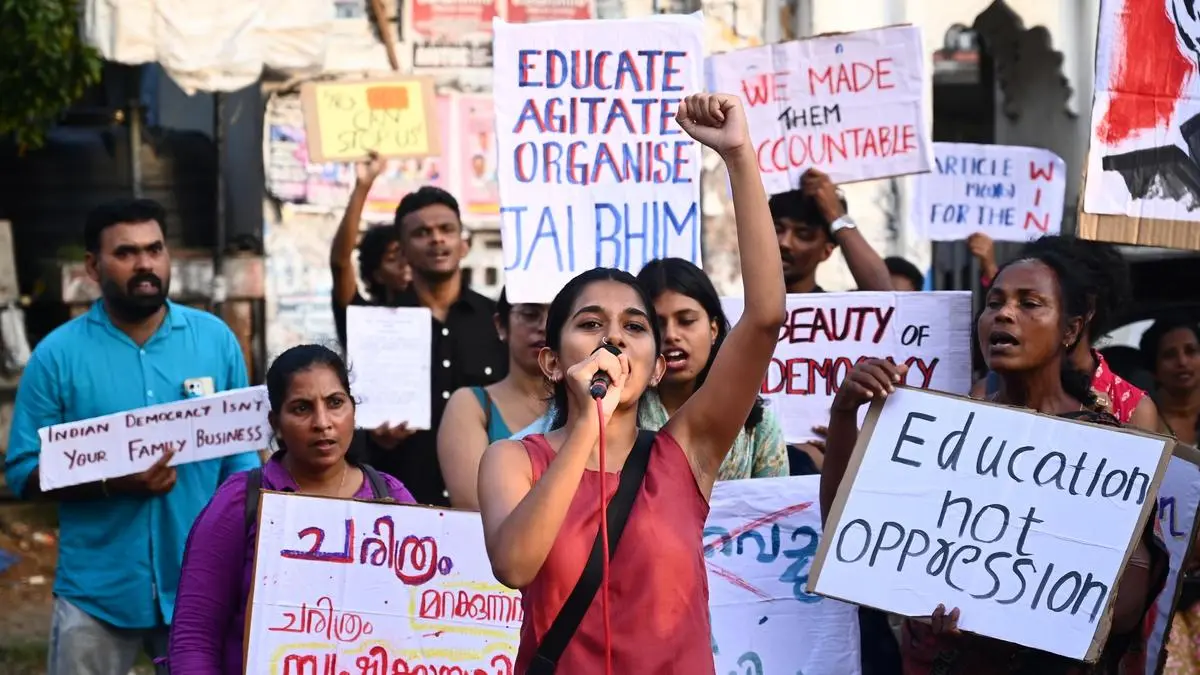
A student protest is political, even when its demand seems administrative. A delayed examination, a paper leak, an arbitrary cancellation, an uncertain recruitment process, a shortage of teachers, poor hostel facilities, or an opaque admission procedure can each seem like a separate grievance. But when thousands of young people gather over such problems, the issue is no longer just an examination or a university. It is also a question of trust. When people lose trust in institutions, protest becomes a way for a generation to say that it no longer believes ordinary channels will hear its complaints.
This is why Networks of Outrage and Hope, by Spanish sociologist Manuel Castells, is relevant to India today. Castells argues that protest movements do more than bring people together around a single issue. They turn private anxieties into collective action. People who separately experience humiliation, insecurity, or injustice find one another through networks. Communication helps them overcome fear. Anger becomes collective outrage, and the possibility of change can turn that outrage into hope.
We can see this process in India’s current student protests. A student who spends two or three years preparing for a competitive examination is doing more than studying for a test. For many, the examination is a bet on the future: a job, financial independence, or a chance to improve their circumstances. When an examination is compromised, cancelled, or delayed, it disrupts more than a timetable. It can disrupt a person’s plans for their life.
Also Read | India is a coalition, and its democracy needs coalitions
Administrative language often fails to convey this experience. A notification may refer to “irregularities” while a student faces uncertainty about the future. An official statement may cite “procedural issues” while a family faces another year of financial and emotional strain. A government may describe a protest as a law-and-order problem. Protesters may be asking a more basic question: who is accountable for the future young people were asked to invest their time and effort in?
Student protests should not be dismissed as isolated outbursts. They point to a crisis of trust in institutions. Castells argues that poverty or unhappiness alone does not create a movement. A movement can take shape when people communicate and recognise that others share their experience. One person sees another person’s fear and recognises their own. A private concern becomes a public issue, and digital networks have sped up that process.
A student in Patna does not need an organisation based in Delhi to learn that students there are angry. A student in a small town does not need access to a newspaper or television office to tell others what happened at an examination centre. A photograph, video, account, or short message can spread across the country before an official press release is ready.
This is part of what Castells calls the “network society”: a society in which communication networks shape how people organise and share information. But social media alone does not make a movement. Castells distinguishes between digital networks, where people communicate across distance, and physical places, where they gather in person. The two can come together to create a public space for discussion and action. That is why Jantar Mantar, university campuses, and other public spaces matter.
A hashtag can make an injustice visible to millions within minutes. The state knows this, which helps explain why protests in public spaces can draw strong responses. A grievance that remains on a screen can be ignored, disputed, or buried. A hundred young people gathered in a public place are harder to overlook. Protest is also a way to be seen. This raises difficult questions for those in power.
If young people repeatedly have to leave their classrooms to demand fair examinations, leave their campuses to demand basic facilities, or leave their homes to demand jobs, perhaps they are not unusually impatient. Perhaps the institutions meant to respond have become unresponsive.
Protest is often treated as an interruption to governance. But in a democracy, protest can be a response to representative institutions failing to represent people adequately. Parliament, state legislatures, universities, examination bodies, and government agencies are meant to provide ways for people to raise grievances and seek solutions. When those channels lose credibility, people look for other ways to be heard.
This matters especially for students. They have little formal power within institutions, but they can communicate widely. Castells calls this “mass self-communication”: people sharing their own accounts and ideas with large audiences, rather than relying entirely on established media and institutions to tell their stories.
Manuel Castells’s Networks of Outrage and Hope examines how digital networks can turn private grievances into collective political action. | Photo Credit: By Special Arrangement
This also helps explain why student movements can make political parties uncomfortable. Students may welcome political support but resist being treated as a party’s youth wing. They may not want any party to claim ownership of their movement. Castells observed a similar preference for horizontal organisation—where participants communicate and make decisions among themselves—and a distrust of delegated authority in several networked movements. These views grew partly from scepticism about traditional political representation.
Political parties can learn from this. A party that arrives at a student protest simply to put its flag on the stage may misunderstand the moment. The task is to understand what caused the anger, not to claim it. The state should also avoid treating every protest as a partisan conspiracy. Parties will take part in movements, as they always have; student politics has never been separate from politics. But blaming a party for a protest does not answer the concerns that brought people out.
Calling a protest “political” is not a rebuttal. In a democracy, demanding accountability from those in power is political.
There is another dimension to consider. The state has considerable power to communicate. It has official agencies, public broadcasters, media allies, and the authority to describe events in institutional language. Students have phones, networks, and a growing ability to tell their own stories.
This contest over meaning is central to Castells’s account of power. He argues that power works partly through control of communication networks and the ability to shape how people understand events. Counterpower emerges when citizens build networks of their own and share different interests and values. A student protest is therefore not only a demand for policy change. It is also a struggle over who gets to describe what is happening.
Is a paper leak an isolated incident or evidence of institutional failure? Is unemployment just a statistic, or does it describe a generation waiting for work? Is a university hostel simply an administrative facility, or is it necessary for equal access to education? Is protest an inconvenience, or a democratic right? These are political questions. They have always been.
Perhaps the most significant political fact about India’s students today is that they refuse to treat their anxieties as private failures. For years, young people have been told that if they work hard, study long enough, and compete fairly, the system will eventually reward them. What happens when the system cannot ensure that the competition is fair?
Meritocracy—the idea that people advance through ability and effort—can then sound less like a promise and more like an excuse. A young person who fails an examination can be told to try again. But what do we tell a student whose examination was compromised? What do we tell a student who has lost another year because an institution failed to do what it was set up to do? What do we tell a generation asked to wait indefinitely?
The title of Castells’s book captures part of this experience. Outrage and hope can be successive stages of democratic action. Outrage says that things cannot continue this way. Hope says change is possible. A healthy democracy should make room for both. A greater danger is that young people may lose both the anger to demand change and the hope that change can happen. Outrage shows that people still believe something is worth fighting for; hope shows that they believe things can improve. Political apathy has neither.
Also Read | The history of protest is a history of emotions becoming political
This is why India’s current student protests deserve serious attention—not because every demand is necessarily right or every protest beyond criticism, but because they reveal something about the state of Indian democracy. The question for the government is not only how quickly it can disperse a gathering, but why so many young people feel they have to gather in the first place.
Castells reminds us that movements can influence political institutions even when their immediate demands are not met. They can also change public awareness and what people expect from politics. That may be one lasting effect of India’s student protests: they are teaching a generation that citizenship involves more than filling out an examination form, paying a fee, standing in a queue, or casting a vote.
A democracy must listen before it mistakes an act of citizenship for an act of rebellion. When institutions stop listening, people turn to the street to make themselves heard. Once a generation has found a collective voice, it is difficult to ask it to return to silence.
Manoj Kumar Jha is a Member of Parliament in the Rajya Sabha and a member of the Rashtriya Janata Dal.
Related Stories
 India
India
BJP accuses Rahul Gandhi of making ‘false claims’, lacking understanding of Indian politics; calls his press conference ‘damp squib’
3 hours ago
 India
India
Milan’s wife thanks Rahul, Mamata; bypolls to shape oppn politics: Cong
4 hours ago
 India
India
PM Modi tells Seva Yatris: Service must remain the primary duty, politics no exception
5 hours ago
 India
India
Jamiat Ulama-i
7 hours ago
 India
India
India news: Cockroach party demands Election Commissioner Gyanesh Kumar's resignation
7 hours ago
 India
India
CEC Gyanesh Kumar: Why India's Election Commission is in the eye of a storm
8 hours ago
 India
India
#WATCH | “Gyanesh Kumar should not merely be removed from office; he should also be prosecuted” - senior advocate Prashant Bhushan on the EC
11 hours ago
 India
India
"Nation
12 hours ago