
‘Spit on our sacrifice’: Canadian veterans fume after Trump and allies take jibes at military
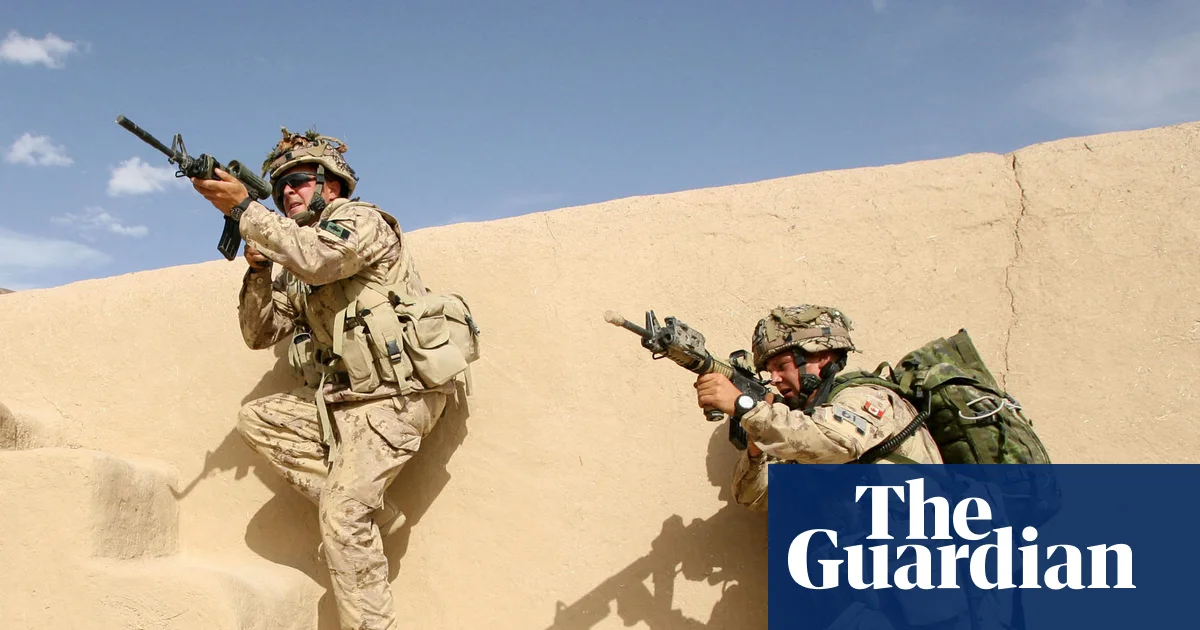
On the morning of 11 September 2001, Perry Chalmers was running drills for the Royal Canadian Regiment’s specialised mortar platoon in New Brunswick when he heard the news: America was under attack. Word quickly spread across the base. “I went inside to watch the news,” the former corporal recalls. “And there was a huge feeling of – and you’re going to have to excuse me – holy shit. What the fuck just happened?” Chalmers called his wife, who informed him that, just before 10:30am, the second of the World Trade Center towers had fallen. With that, his battalion was put on notice: dispatched to nearby airports to assist in the forced landings of commercial aircraft after the shutdown of North American airspace.
The Canadian troops went to retrieve their rucksacks and any other necessities, should they need to spring into action at a moment’s notice. As Chalmers recalls: “Things started to happen really quickly.”
Chalmers would deploy to Afghanistan, on a nine-month tour of combat duty, where he saw combat alongside US troops. He put his mortar platoon training to good use, as a counter-IED engineer, dealing with the threat of improvised explosives in conjunction with the US army’s 10th Mountain Division.
He was one of more than 40,000 members of the Canadian armed forces who served in Afghanistan, supporting US and Nato operations. The Canadians lost 158 lives. In 2007, a stretch of Ontario’s highway 401 was rechristened the “Highway of Heroes” to commemorate the convoys of fallen soldiers ferried between the military base in Trenton, Ontario, and the coroner’s office in Toronto.
This response to 9/11 was consistent with the longer history of Canadian-US military cooperation. About 14,000 Canadians landed on Juno Beach in Normandy on D-day during the second world war. More than 26,000 Canadians served in the Korean war. While Canada did not officially participate in the Vietnam war, an estimated 30,000 Canadians headed across the border to volunteer for the US military.
Over the course of the war in Afghanistan, Chalmers can count 35 fellow Canadian troops who lost their lives. But he never really brooked any regrets, or bad feelings, about his role in the US-led war. “My experience was that we were participating in an operation to help our brothers and sisters in the United States,” he says. “None of them ever snubbed their noses at us. We were treated as equals, and respected, for what we brought to the table.”
But no longer. While calling Canada “a state”, US vice-president JD Vance recently commented that it “had underinvested in its military that quite literally would get invaded by a foreign country were it not for the umbrella of protection provided by the United States of America”.
Going one step further, Donald Trump’s transportation secretary, Sean Duffy, told Fox News that Canada “doesn’t have a military”.
Self-styled “secretary of war” Pete Hegseth has spent time on X, mocking Canadian cadets and criticising a Canadian coast guard detachment for taking part in a Pride celebration. Trump himself was criticised earlier this year for claiming that Canadian and other Nato forces in Afghanistan were “never needed”, claiming these allies “stayed a little back, a little off the frontlines”.
The remarks have been condemned at the highest level of the Canadian government. The defence minister, David McGuinty, described Hegseth’s social media posts as “below the dignity of the office he holds”. Amid a serious diplomatic dispute between the two nations, the prime minister, Mark Carney, accused Trump and Hegseth of “doing memes”.
“It’s disrespect and betrayal,” Chalmers says. “It makes me very angry.” “It’s really hard to hear how ungrateful they are, especially Vance, who served,” said Chris Banks, a retired Canadian army sergeant with nearly two decades of experience. “To hear him spit on our sacrifice is insulting, it’s hurtful, and it’s disrespectful to the dead. On the other hand, these men have proven themselves nothing more than children. So when I heard JD Vance say it, it’s like, ‘Oh, good. Dumbass said something else’”.
Banks deployed to Afghanistan in 2008, where he was part of a Canadian platoon that laid down cover fire for Americans under attack from the Taliban. To this day, he still has vivid memories of taking cover in a ditch near Pashmul, alongside an American platoon, looking up as the trees overhead were shredded by shrapnel.
He says he was proud to serve. But when he came home to Ontario in 2009, he felt something had changed. He began drinking heavily – sometimes as much as a litre of vodka a day – and struggling with suicidal thoughts. All hallmarks of PTSD. He received treatment, and now advocates for the mental health and wellbeing of other Canadian veterans. Still, a tinge of bitterness remains, when he thinks back on fighting on behalf of the US.
“I lost a part of myself,” he says. “In that war we fought, for them.”
Nancy Payne still remembers exactly where she was when she found out her son had died. Cpl Randy Payne served with a military police unit, stationed in Wainwright, Alberta. He was part of a specialised close protection team, charged with safeguarding high-ranking officers, government officials and other VIPs, in war zones.
On 22 April 2006, an armoured vehicle triggered a roadside bomb outside Kandahar airbase, killing Payne and three other Canadian soldiers. It was the deadliest attack on Canadian forces since 2002 – when four Canadian soldiers were killed by a US bomb after a disastrous friendly fire incident at the Tarnak Farms training facility in Afghanistan.
Nancy was at home, alone, when the phone rang in the dead of the night. It was her son’s commanding officer. “When you get a call at three in the morning from Randy’s boss, you know it’s not good news,” she recalls, speaking over the phone from her home in Lansdowne, Ontario. “I just kept saying ‘Not my Randy … not my Randy’.”
In 2025, the Royal Canadian Legion awarded Nancy a Silver Cross, a commendation for Canadian military mothers. She laid a wreath at the national war memorial during the Remembrance Day ceremony in Ottawa.
More locally, she has commemorated her son with a prize – “the Captain’s Award” – bestowed to students who distinguish themselves in athletics and leadership at his former high school. She, too, is unnerved by the US attacks on the Canadian military and veterans like her son. “What they’re saying is not right,” she says. “We were neighbours for so long. That’s all changed, now.”
Nancy is not the only military mother who feels this way. Earlier this year, Jane McKay, mother of deceased Master Cpl Tim Wilson, penned an op-ed for the Toronto Sun newspaper taking aim at the Trump administration. “Trump has no respect for any soldier – American, or Canadian, or those from the Nato alliance,” she wrote. “He owes them all an apology.” Some US politicians have tried to make amends. On 1 September, Arizona Democrat senator Ruben Gallego travelled to Ottawa on an official congressional trip. The goal was to strengthen the weakening trade relations between the two nations. But Gallego made a point of singling out Hegseth’s anti-Canadian military tweets as “deeply disrespectful to the men and women of Canada that have died fighting with us”. For veterans like Chalmers, such lip service may be too little, too late. He used to play tabletop strategy games with a group of civilian friends in the US, via the online social platform Discord. That all ended when they laughed off his concerns about Trump’s talk of Canada becoming the “51st state”. Banks used to routinely take his family across the border for vacations and stateside shopping trips. No more. “I loved working with Americans, I loved training with them,” he says. “But now it’s hard to have that same level of empathy.” Would he eagerly enlist to help the US again?
“What would happen if there was another hypothetical 9/11?” he says. “I hate to say it, but why would any nation, ever again, partner with the United States, if this is how they treat their closest neighbour and ally?”
Related Stories
 Canada
Emera to acquire Canadian Utilities in $14.3B all
6 minutes ago
 Canada
Canada’s trade surplus widens to more than 4-year high in August, as front-loading ramps up
6 minutes ago
 Canada
Oakville pilot among 4 Canadian crew members on missing air ambulance flight
6 minutes ago
 Canada
4 Canadians on lost medical air transport jet out of Hamilton identified by U.S. Coast Guard
6 minutes ago
 Canada
Former head of German foreign intelligence suspected of 'treasonous espionage'
1 hour ago
 Canada
US
1 hour ago
 Canada
Emera to acquire Canadian Utilities in $14.3B all
2 hours ago
 Canada
Giant underwater Kelvin wave could 'pack a punch' for B.C. in mid
2 hours ago