
South India's Ageing Population: Beyond Baby Bonus Politics
On July 11, 2026, at a World Population Day programme in Vijayawada, Andhra Pradesh Chief Minister N. Chandrababu Naidu launched Pillale Sampada, or “Children are Wealth”. The name announced a reversal: a State that once preached population control now preaches population conservation. The government had earlier promised one-time payments of Rs.30,000 for a third child and Rs.40,000 for a fourth, and says the wider policy will follow public consultations.
The anxiety rests on a real demographic shift. The Sample Registration System Statistical Report 2024, the Registrar General’s continuous large-scale demographic survey, confirms that fertility across the South sits well below replacement. But low fertility does not translate at once into a smaller workforce, still less into absolute decline. Age structures turn over decades, and mortality and migration can bend the curve substantially.
India’s total fertility rate, the average number of children a woman would bear over her lifetime at current age-specific rates, stood at 1.9 in 2024, against a replacement level of roughly 2.1. Every southern State was below both marks: Kerala and Tamil Nadu at 1.3, Andhra Pradesh at 1.4, Karnataka and Telangana at 1.5. Replacement level is not an arbitrary threshold. Two children replace two parents; the additional 0.1 compensates for the slight excess of boys among newborns and for children who do not survive to adulthood. Below that mark, each generation is smaller than the one before, once the age structure works itself through.
Chart 1: Total fertility rate in the five southern States and India, 2024. Source: SRS Statistical Report 2024. The dashed line marks replacement-level fertility of approximately 2.1.
India completed this transition faster than any major country except China. The demographers Srinivas Goli and Shubhra Kriti have documented how completely it has spread: fertility has converged below replacement across religious and caste groups alike. Their caution cuts both ways. Goli and colleagues estimate that fertility below 1.8 begins to carry net economic costs, so the South’s anxiety is not imaginary. The question is whether paying for births is the remedy.
The SRS Bulletin 2024 records the same pattern in the crude birth rate, the count of annual live births per 1,000 people of all ages. Kerala registered 11.1 births per 1,000 population and Tamil Nadu 11.6, against 18.3 nationally. Andhra Pradesh stood at 14.3, Karnataka at 14.9 and Telangana at 15.7. The rate is called crude because its denominator counts everyone, men, children and the elderly included. Two States with identical fertility can therefore post different birth rates if one has proportionally more women of childbearing age.
Chart 2: Crude birth rate in the five southern States and India, 2024. Source: SRS Bulletin 2024 and SRS Statistical Report 2024.
These figures justify planning for slower growth and an older society. They do not signal an imminent shortage of workers. A State can stay below replacement fertility for years while its population keeps growing, because a large cohort, meaning a generation born in the same span of years, remains in the reproductive and working ages. Demographers call this population momentum. Decades of higher fertility left behind large birth cohorts that are still moving through their childbearing years, so births remain plentiful even as family size shrinks. Kerala fell below replacement fertility in the late 1980s; its population has grown in every Census since. The mathematical demographer Nathan Keyfitz formalised the idea in a celebrated 1971 paper in the journal Demography.
The Union government’s projections show that Andhra Pradesh and Telangana entered this decade with unusually large workforces. In 2021, people aged 15 to 59 made up 67.1 per cent of Andhra Pradesh’s population and 67.5 per cent of Telangana’s, against 64.2 per cent nationally. Karnataka and Tamil Nadu stood at 66.4 per cent. Kerala, furthest along the transition, was at 63.1 per cent.
Chart 3: Share of the population aged 15 to 59, 2021 and projected 2036. Source: Calculated from Population Projections for India and States, 2011-2036. The 2036 figures are projections based on Census 2011.
By 2036, Andhra Pradesh, Karnataka and Telangana are still projected to hold working-age shares near or above the national average. Kerala is the outlier, its share projected to fall to 59.5 per cent. Tamil Nadu’s is projected at 63.6 per cent.
This leaves Andhra Pradesh and Telangana a demographic-dividend window: the phase in which workers outnumber dependants, freeing incomes to be saved and invested. But age structure alone confers no dividend. Employment, skills, productivity, women’s ability to enter and stay in paid work, and the absorption of migrant workers will decide whether the workforce becomes an advantage. These levers act on labour supply now. A child born in 2026 turns 15 only in 2041, and 18 in 2044. The East Asian economies converted similar windows into sustained growth because education, jobs and women’s employment expanded together; societies that fail to absorb their young simply grow older without growing richer. In a landmark 1998 study, the economists David E. Bloom and Jeffrey G. Williamson estimated that this age-structure shift accounted for as much as a third of East Asia’s growth miracle.
The near-term transition shows most clearly at the other end of the age pyramid, the chart that stacks a population by age from newborns to the very old. In 2021, people aged 60 and above made up 16.5 per cent of Kerala’s population, 13.7 per cent of Tamil Nadu’s and 12.3 per cent of Andhra Pradesh’s. By 2036, those shares are projected to reach 22.8, 20.8 and 19 per cent. Karnataka and Telangana follow at 17.2 and 17.1 per cent.
Chart 4: Share of the population aged 60 and above, 2021 and projected 2036. Source: Population Projections for India and States, 2011-2036; also reproduced in the India Ageing Report 2023.
That shift will multiply demand for geriatric and chronic-disease care, home-based and community care, accessible transport, social pensions and support for older people living alone. Smaller families and the migration of adult children deepen the need for formal care even where the elderly stay healthier for longer. These pressures intensify within the decade, long before any additional births can reach the labour market. The scale of the vulnerability is already documented.
The India Ageing Report 2023 finds that more than 40 per cent of India’s elderly fall in the poorest wealth quintile, that 18.7 per cent live with no income at all, and that the population above 80, dominated by widowed women, will grow by around 279 per cent between 2022 and 2050. “Poverty is inherently gendered in old age,” the report observes. Surveying this regional divergence, the demographers K.S. James and Shubhra Kriti note that nearly a quarter of India’s older persons live with functional disability, which raises the cost of maintaining a household’s standard of living by 30 to 50 per cent; the southern States, carrying the oldest age structures, will bear the largest share of that burden.
Setting the old against the young makes the transition vivid. In 2021, Kerala had about 81 people aged 60 or above for every 100 children below 15. Tamil Nadu had about 69 and Andhra Pradesh 60. The national ratio was about 39.
By 2036, the official projections imply that the elderly may match or outnumber children in every southern State: about 134 for every 100 children in Tamil Nadu, 129 in Kerala, 121 in Andhra Pradesh and 106 in Telangana, with Karnataka near parity at about 100. India as a whole stays younger, at about 74.
Chart 5: People aged 60 and above for every 100 children below 15, 2021 and projected 2036. Source: Calculation from the State-wise age-group shares in Population Projections for India and States, 2011-2036, Technical Group on Population Projections, National Commission on Population, Ministry of Health and Family Welfare. Values above 100 mean people aged 60 and above outnumber children below 15; 100 indicates parity.
What follows from that crossover? Classrooms empty while geriatric wards fill, and the burden of dependency shifts from child-rearing, which families absorb, to eldercare, which falls increasingly on the State as migration disperses adult children. Studies led by the demographer S. Irudaya Rajan at the Centre for Development Studies have long documented how out-migration leaves elderly parents alone in Kerala’s villages even when remittances keep arriving. Rajan urges governments to see the old through the lens of a second demographic dividend, on the Japanese pattern, arguing that a large section of people above 60 remain productive and that new industries and skills should be built around them. The concept comes from the economists Ronald Lee and Andrew Mason, who showed that longer working lives and the accumulated savings of older adults can finance a further round of growth.
Cash assistance can soften the immediate cost of childbirth, and that is no small thing. Its demographic effect is another matter. A 2019 UNFPA review of policies in low-fertility countries, by the demographers Tomáš Sobotka, Anna Matysiak and Zuzanna Brzozowska, found that one-time payments yield a modest rise in births that is usually short-lived. Such schemes shift the timing and spacing of children; they rarely alter completed family size. The stronger evidence favours comprehensive packages: accessible childcare, well-paid parental leave, flexible employment and financial assistance together.
The distinction bites in Andhra Pradesh. A payment of Rs.30,000 or Rs.40,000 arrives once, while the costs of housing, food, healthcare, childcare and schooling run for years. Families also weigh job security, the career price of motherhood and the division of care within the household. The State’s wider proposals, workplace childcare and educational support among them, may matter more than the headline sum if they become accessible and predictable.
The policy must also preserve reproductive choice. The legitimate public object is to help people have the number of children they want, not to treat women or families as instruments of a population target. The region’s own statute books show how quickly the instrument can be reversed. Andhra Pradesh repealed in November 2024 the rule that barred parents of more than two children from contesting local body elections; Telangana followed in January 2026. Provisions written to punish the third child now make way for schemes that reward it; in both directions, the State sets a number for the family. Genuine choice requires maternal healthcare, contraception, infertility services and family support across the full range of decisions.
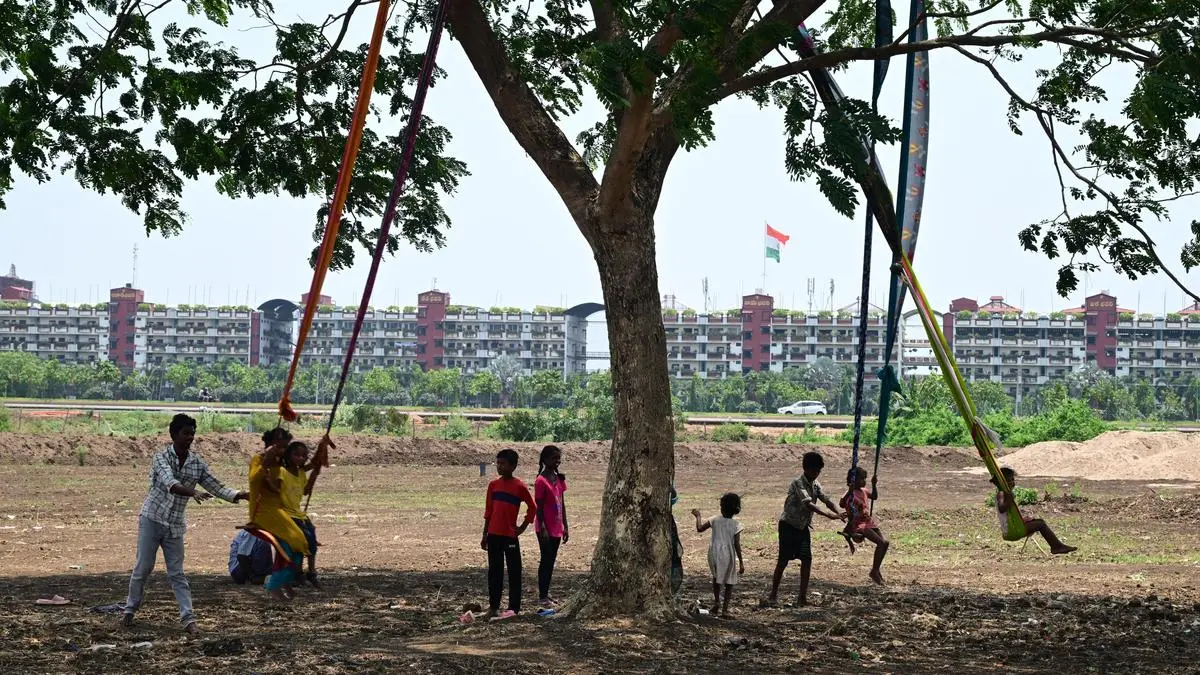
The legitimate public object is to help people have the number of children they want, not to treat women or families as instruments of a population target. A representational image of street vendors selling deepavali crackers at Parrys Corner in Chennai on November 11, 2023. | Photo Credit: Akhila Easwaran
UNFPA’s State of World Population 2025, pointedly titled The Real Fertility Crisis, reframes the global debate in exactly these terms: the crisis lies in unmet reproductive aspirations, not in raw numbers. Its 14-country survey with YouGov found that 36 per cent of Indian respondents had experienced an unintended pregnancy, 30 per cent reported an unfulfilled desire for more, or fewer, children than they have, and 23 per cent had faced both. Pooja Sikund, Vinoj Manning and Anisha Aggarwal, of the Ipas Development Foundation, have drawn the right conclusion from such figures: the task is reproductive preparedness, not population control, with contraception and fertility care treated as ordinary healthcare. The same logic extends to the age structure. Preparedness applies to the old as much as to the unborn.
The five States are travelling the same road at different speeds.
Kerala and Tamil Nadu must expand eldercare and retool health systems quickly. Both need investment in geriatric healthcare, long-term care and support for older people who continue to work. Kerala has moved first. It presented India’s first Elderly Budget with its 2026–27 State Budget, and in May 2026 issued orders constituting the country’s first Department of Senior Citizens Welfare.
Andhra Pradesh and Telangana combine very low fertility with a still-large workforce, a window that will not stay open. The priority is productive employment for the workers already present. Without jobs, even high fertility deepens poverty: a child in a workless household adds a dependant, not an earner, for at least 15 years, drawing down family savings and stretching public services across more claimants. The dividend arithmetic works only when the extra hands find work. Upskilling, labour-market integration and women’s workforce participation come first.
Karnataka occupies the middle ground. The projections hold its working-age share near the national average through 2036 while its elderly share climbs to 17.2 per cent. The State can still capture returns from its present workforce, and centres such as Bengaluru keep drawing young migrant workers.
Migration will be central. Construction, manufacturing, hospitality, transport and care work across the South already run on labour from younger States. Housing, portable welfare, schooling for migrant children and protection from wage exploitation can sustain labour supply far sooner than any pronatalist incentive, meaning any scheme designed to raise the number of births. Kerala shows the pattern in mature form: as its own workers emigrated to the Gulf, workers from the north and the east arrived to fill the vacancy, a substitution demographers describe as replacement migration. Competition for these workers will sharpen as the northern States age in their turn; the South’s advantage lies in treating them well early. The term comes from an influential 2000 study by the United Nations Population Division, which asked whether migration could offset decline and ageing in low-fertility societies.
Higher female employment and the continued participation of healthy older workers act just as quickly. These are levers Andhra Pradesh and Telangana can pull before ageing accelerates. The room here is real. The Periodic Labour Force Survey puts the share of women aged 15 and above who are working or seeking work, the female labour force participation rate, at 41.7 per cent nationally in 2023–24.
A 2024 working paper by the economists Shamika Ravi and Mudit Kapoor for the Economic Advisory Council to the Prime Minister finds that the southern States have consistently reported relatively high female participation, but attaches two warnings for this region: the presence of young children sharply depresses women’s participation in Kerala, and urban Andhra Pradesh stands out for a decline in the participation of women with children. Care responsibilities, the authors conclude, significantly shape whether women enter the labour force at all, which is precisely where public investment in childcare would tell. Each percentage point of female participation adds workers to the economy now, without waiting a generation.
The projections used here were published in 2020 and rest on Census 2011. They remain the most systematic official State-level estimates, but they predate the pandemic and cannot fully register subsequent shifts in migration, mortality and fertility. The SRS supplies recent annual rates, not a fresh count or an updated district-level age structure.
That limitation strengthens the case for a new Census. Governments need current age and migration data to decide where schools can be consolidated, where hospitals need geriatric capacity, and which regions face labour shortages. The evidence in hand nonetheless settles the direction: the South has entered a phase of low fertility and rapid ageing while still holding a large workforce.
Pillale Sampada has fixed public attention on the demographic transition, the long shift every society makes from high births and deaths to low ones. The numbers point elsewhere: employ today’s workers better, and ready the care systems for tomorrow’s elderly. Additional births may reach the labour force after two decades. Ageing will not wait that long. The projections hand governments a decade of lead time and precise numbers to plan with. The choice before the southern States is between preparing for the population they will actually have, and paying, in cash and in lost time, for the population they wish they had.
The deeper question beneath Pillale Sampada is what a population policy is for. For half a century the Indian state treated family size as a target: first a ceiling, enforced through disqualifications and sterilisation drives, and now, in the same region, a floor, to be purchased in cash. Both make the household an instrument of state arithmetic. The evidence assembled here points to a different object. Fertility in the South will not return to replacement on any policy horizon that matters, and the age structure through 2040 is already written. What remains open is threefold: whether people can have the children they actually want, whether the present workforce finds productive employment, and whether the care systems needed by 2036 are built in time. A population policy worth the name would measure itself against those three tests, not against a birth rate. The South completed India’s demographic transition first. It can now show the country how to govern what comes after.
Charts 1 and 2 use the 2024 Sample Registration System estimates. Charts 3 and 4 use the 2021 and 2036 age-group shares in the Union government’s population projections. Chart 5 source: Government of India Population Projections 2011–2036. Values above 100 indicate the elderly population exceeds the child population; 100 indicates parity. Working-age share is the sum of the 15–29 and 30–59 categories. Because published figures are rounded to one decimal place, calculated ratios may vary slightly from ratios derived from unrounded population counts.
Primary sources: SRS Statistical Report 2024; SRS Bulletin 2024; Population Projections for India and States, 2011–2036; India Ageing Report 2023; UNFPA review of policies in low-fertility countries; Andhra Pradesh government announcements.
N.V. Geetha is a former Senior Technical Director at the National Informatics Centre. She writes data-based stories.
Also Read | India’s demographic dividend is turning into a divide
Also Read | Census 2027 must capture the lived realities of vulnerable groups, minorities: Poonam Muttreja
Related Stories
 India
India
New York to ban Central Park’s horse
21 minutes ago
 India
India
One
25 minutes ago
 India
India
Rahul Gandhi, his 'ecosystem' trying to create anarchy in India for 'regime change', says BJP
1 hour ago
 India
India
‘Mary Millben can back BJP, Imran Khan can’t criticise it’: CJP's Abhijit Dipke flags contrast
1 hour ago
 India
India
CJP's Saurav Das, Ashutosh Ranka: India's 'cockroach' leaders jailed after holding protest
2 hours ago
 India
India
India’s IDBI Bank falls 7% as government announces $5.5 billion stake sale to Canada's Fairfax
2 hours ago
 India
India
Backlash in Kashmir over proposal for uniform Friday sermons across mosques
2 hours ago
 India
India
Will wipe out the broom: Jhotas father rules out entering politics, but warns AAP of electoral rout
4 hours ago