
Soldiers and students study drone technology in Hereford together
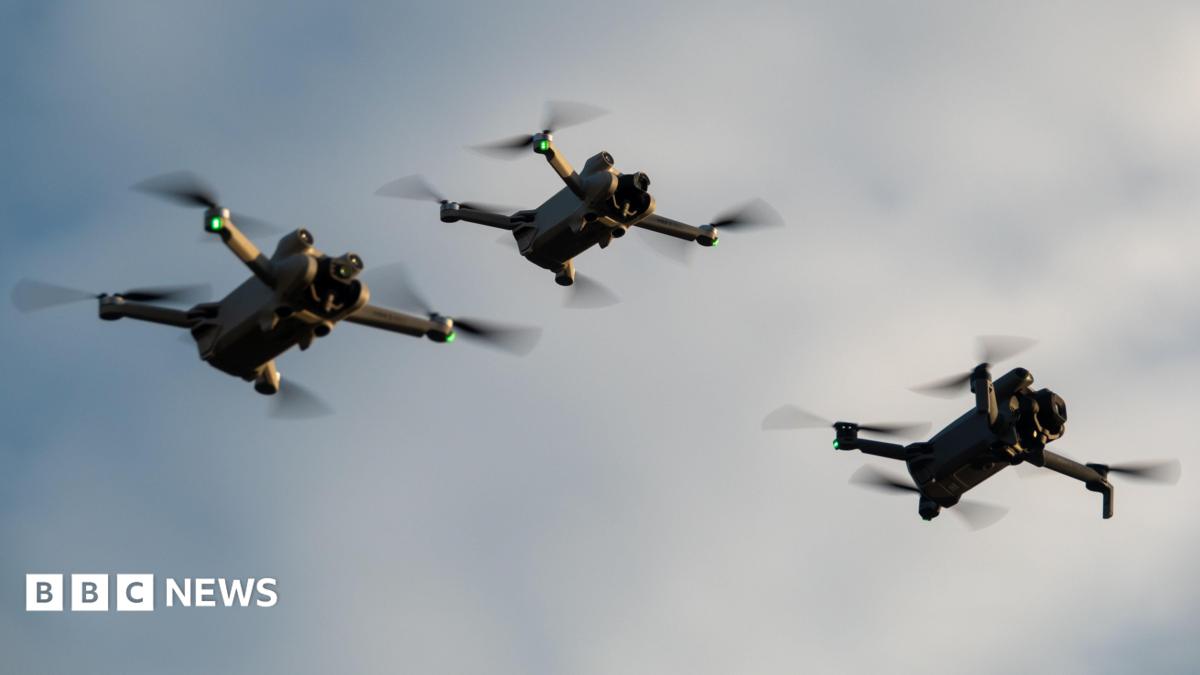
Students on the new autonomous robotics degree will study alongside Army personnel
Soldiers are swapping military life for university study as part of a new degree designed to prepare the next generation of drone and robotics engineers.
The Autonomous Robotics programme has been developed in partnership with the Army, with military personnel studying alongside civilian students on two and three-year engineering degrees.
The course is being delivered by the New Model Institute for Technology and Engineering (NMITE), a specialist engineering higher education institution in Hereford.
For some of the soldiers taking part, the move from active service to academic life represents a dramatic change of pace.
Thirty-one-year-old Sgt Callum Dervey joined the Army at 18 after leaving school with what he describes as "a few GCSEs".
Now, after 13 years of military service, he has returned to education.
"I'm now back in a cohort of people who are much younger than myself," he said.
"Coming back into an academic setting is certainly already starting to feel challenging, but I'm sure it's going to get easier."
Sgt Callum Dervey has returned to education after 13 years in the Army
Focusing on autonomous systems, robotics and drone technology, organisers say the course aims to meet growing demand for expertise in emerging technologies.
Military personnel on the programme are taking three-year secondments from active service and are expected to take the skills they develop back into the Army.
Dervey said the Army was looking to increase its engineering expertise and adapt to emerging threats.
"It's so we can adapt rapidly in line with what the current threats are," he said.
"The skills and experience we get from working with academia, industry partners and end users can be taken back and taught to the field Army, which will be crucial in the future."
This is one of the drones the students will be learning to build, programme and operate during the degree
NMITE president and chief executive James Newby said the degree had been conceived with defence and security in mind, but its applications extended well beyond the military.
"They'll be learning about autonomous systems and robotics and control and mechatronics and systems thinking," he said.
"Those are hugely important skills in manufacturing, agriculture and humanitarian work."
Matthew Ryall said the course had opened his eyes to a wide range of career options
Student Matthew Ryall, who has enrolled on the three-year MEng course, said discussions with lecturers had opened his eyes to the range of careers available.
"It's expanded so much that it could be anything, whether it's manufacturing, defence, whether it's in the air, on the ground or underwater as well," he said.
Tell us which stories we should cover in Hereford & Worcester
Follow BBC Hereford & Worcester on BBC Sounds, Facebook, external, X, external and Instagram, external.
Robot sessions aim to inspire future engineers
New PM must make defence a priority, say students
Plan for drone-busting missile motor factory lodged
Related Stories
 Technology
SpaceX Weighs Buying Customer Data From Failed Startups to Feed Grok's Training Pipeline
20 minutes ago
 Technology
Does technology hold the answer to getting people off welfare?
20 minutes ago
 Technology
More Kiwis taking 'hands off' approach with self
1 hour ago
 Technology
$49M Boost for Aussie Clean Tech Manufacturing
1 hour ago
 Technology
Why US plan to sell F
2 hours ago
 Technology
Fueling a return journey from Mars
2 hours ago
 Technology
From tractors to AI, tech is changing agriculture
3 hours ago
 Technology
Hong Kong to target breakthroughs in core tech
4 hours ago