
Sofa culture: Horse
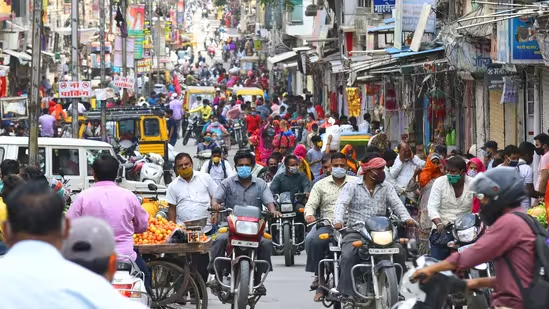
Sofa culture: Horse-trading in Tamil Nadu politics
The gift of “Sofa” with a stack of money to a politician in Tamil Nadu is a satirical parody of the horse-trading underway ever since actor-politician C Joseph Vijay-led Tamilaga Vettri Kazhagam (TVK) has assumed power with 108 seats (in reality with 106 voting members after one member was barred and Vijay vacated one seat) and still short of simple majority in the state legislature with 234 members
The assembly speaker had, however, declined to initiate disqualification proceedings against them indicating the resurfacing of the old game of “horse-trading” in Tamil Nadu amid the allegations of transfer of money, positions and inducements in order to encourage and ascertain the momentum of defections from opposition parties to the ruling TVK coalition. AIADMK chief Edappadi K Palaniswami had sought action against the rebel MLAs and had not filed a separate plea before the high court or the Supreme Court because the Speaker is ordinarily the first authority to decide such disputes. The fundamental question is whether it is reasonable to expect court intervention and judicial review in the case of Tamil Nadu with the ‘Operation Tiger’ in Maharashtra and the emergence of factionalism within the Trinamool Congress in West Bengal revealing the national trend of opposition parties weakened by electoral defeats becoming vulnerable to inducements and internal factionalism.
The game is not over and the resignation of four MLAs belonging to the rebel group within the AIADMK and their subsequent joining of the TVK on May 25, 2026 has not only reduced the AIADMK’s assembly strength but also exposed the ruling TVK’s art of managing the numbers game in the state legislature. This development is noteworthy because these four MLAs were elected on AIADMK tickets only a few ago. The Speaker announcing that no disqualification proceedings would be initiated against the rebel AIADMK MLAs also speaks volumes about the nature of political competition and the desperation of the ruling TVK which came to power on the plank for change and alternate to the politics of money, patronage and privileges. There are more members from the AIADMK including senior leaders who are negotiating their time and fortunes while waiting in the wings.
There is a near breakdown of ties between the Marumalarchi Dravida Munnetra Kazhagam (MDMK) led by V Gopalasamy (Vaiko) and the Dravida Munnetra Kazhagam (DMK) with MDMK leadership articulating its self-respect and dignity while at the same time exploring the future prospects in alliance with the TVK. It may be noted that MDMK contested four seats as part of the DMK-led alliance and succeeded in winning two of them. The present strength of the MDMK in the state assembly is two seats and any attempt to join the TVK coalition would present a fresh political and legal crisis because the MDMK has contested its seats on DMK symbol. This may pose an awkward dilemma for the MDMK and further expose the legal complexities of the electoral democracy in India. All these developments may indicate the survival tactics of the TVK and of its potential to exploit the weaknesses of our political democracy. The nexus between money and political power remains an indisputable reality.
It may seem as simple and ordinary transition but the coalition government led by the TVK in Tamil Nadu is surviving with the support from the erstwhile allies of DMK including the Congress, Communist Party of India (CPI), Communist Party of India-Marxist (CPI-M), Viduthalai Chiruthaigal Katchi (VCK), and the Indian Union of Muslim League (IUML) besides drawing support from the rebel members of the AIADMK. This is the paradox of the electoral politics and political democracy in India caught in the trappings of power and authority. It is natural for the voters to ask whether their mandate has been respected or appropriated.
The Greek philosopher Socrates feared that democracy rewards rhetoric and popularity rather than facts and competence. Skilled orators and demagogues can manipulate public opinion, leading voters to elect and support a government contrary to their own interests.
The control of social media and artificial intelligence (AI) tools has further exposed that one need not be competent as a leader with qualities attributed to good leadership including the ability or conviction to communicate with the masses. Social media does the work instead with the new and rapid developments in technology. The role of money and the underlying financial clout of a political party remain a critical determinant in obtaining the votes of the people and elected members of the assembly. The price is the only difference with money launderers and lottery kings replacing the liquor barons and sand mafia of the earlier regimes.
(Prof.Ramu Manivannan is a Political Scientist – Scholar-Activist in areas of education, human rights and sustainable development. He is currently the Director, Multiversity – Centre for Indigenous Knowledge Systems, Kurumbapalayam Village, Vellore District, Tamil Nadu.)
Related Stories
 Finance
Lib Dems: Closer EU ties will grow economy
7 hours ago
 Finance
AFRICA FINANCE IN BRIEF:Private capital surges as African markets deepen cross border investment
12 hours ago
 Finance
Emerging Trends in Real Estate® 2026
1 day ago
 Finance
Cher’s son, Elijah Blue Allman, indicted on felony charge: report
1 day ago
 Finance
A planned $5 million raise may fund crypto assets or director insurance at Digital Currency X
1 day ago
 Finance
Third Marineland beluga dies after being moved, this time in Spain
1 day ago
 Finance
Day centre for disabled adults in Brighton to close
2 days ago
 Finance
US lawmakers pass bill giving Trump more power to sanction Russia and its enablers
2 days ago