
Shane Perley-Dutcher gets his ‘full
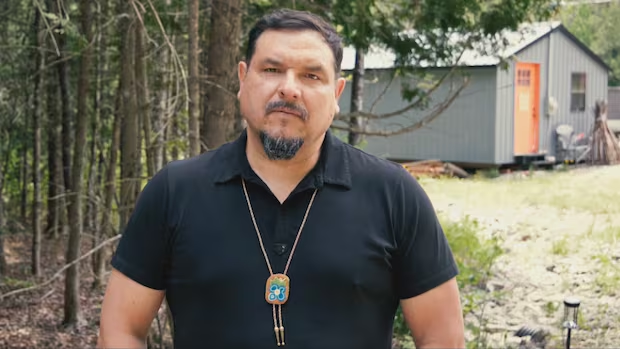
Shane Perley-Dutcher gets his ‘full-circle moment’ at the National Art Gallery
Exhibition features work of 6 artists shortlisted for Canada’s top art prize
When Shane Perley-Dutcher first visited the National Gallery of Canada in Ottawa back in 2006, it was for a chance to meet the renowned Ojibwe artist Norval Morrisseau.
Little did he know, he would be back at the gallery 20 years later, this time installing his own work, as one of six shortlisted artists for the country’s top art prize, the Sobey Art Award.
Speaking from Ottawa on opening day of the 2026 Sobey exhibition, Perley-Dutcher recalled how he came to meet the celebrated artist 20 years before.
Perley-Dutcher was living in Ottawa, co-ordinating youth programming at an Indigenous health centre.
Morrisseau was at the National Gallery to launch a retrospective exhibition of his work, the first ever put on by the gallery for an Indigenous artist.
Shane Perley-Dutcher brings Wabanaki-inspired art to national stage
Perley-Dutcher was invited to bring a group of young people to meet Copper Thunderbird, as Morrisseau was also known.
“Of course, they had no idea who he was,” said Perley-Dutcher.
“I knew full well who he was, and I was like, 'Wow, yes, we're going.'”
The group showed up “without hesitation," said Perley-Dutcher, and “had the honour” of spending some time with the celebrated painter and printmaker.
“That, to me, changed my whole world,” recalled Perley-Dutcher.
Seeing an Indigenous artist celebrated by the country’s largest art gallery opened a new world of possibilities for Perley-Dutcher, who himself was a practising artist hailing from Neqotkuk, or Tobique First Nation, in New Brunswick.
The experience allowed Perley-Dutcher to imagine himself and his work on the national stage.
And 20 years later, the experience makes his participation in the 2026 Sobey Art Award exhibition a “full-circle moment.”
Merging traditional and contemporary techniques
Perley-Dutcher’s art practice is inspired by traditional Wolastoqey and Wabanaki culture.
As a young boy, he learned to make black ash baskets and found himself “in trouble in math class for carving totem poles out of my pencils, because one of the native art instructors taught me how to use a knife to carve.”
Perley-Dutcher later attended the New Brunswick College of Craft and Design where he learned metal and silversmithing, which he now incorporates with traditional forms like black ash basketry.
His Sobey award exhibit is “centred around the metal basket and applying the metal as a new way of preserving traditional knowledge,” said Perley-Dutcher.
“Basketry was so important to the Indigenous peoples of the Wabanaki territory,” he said.
“It really is a symbol of their resiliency, their survival, their ingenuity … and how they survived.”
It’s been a long road for Perley-Dutcher to see the success he is now experiencing.
At one low point, the artist found himself “almost homeless” in New Brunswick, unable to make ends meet with his art practice and odd jobs.
“I was like, ‘Do I still do art? Do I not? What do I do?’” he recalled.
He packed up and headed west, landing in Ottawa, where there was a larger market for his jewelry work.
In 2008, he produced a silver pin to commemorate the residential school apology delivered by then prime minister Stephen Harper.
“I was proud to have my pin on the survivors that were actually there to witness it,” said Perley-Dutcher, “and for those who saw that as a healing moment.”
Around the time his daughter started learning Ojibwe in school, Perley-Dutcher and his wife realized, “If our daughter's going to speak an Indigenous language, it should be our own.”
So the family returned home to Neqotkuk.
“I can't go anywhere else in the world and get my culture,” said Perley-Dutcher.
At Gallery on Queen in Fredericton, director Nadia Khoury carries some of Perley-Dutcher’s work, and in recent years has placed four pieces “into major collections nationally and internationally.”
The Sobey Art Award can be career-changing, she said, not only for the winner but also for the six shortlisted artists and the 30 longlisted artists before them.
The winner of the Sobey Art Award will receive $100,000, while shortlisted and longlisted artists receive awards of $25,000 and $10,000, respectively.
This year marked a milestone for New Brunswick artists, said Khoury, as three of the five Atlantic region longlist nominees hailed from the province.
Even her gallery’s association with Perley-Dutcher has brought opportunities her way, she said.
After outreach from Art Toronto, the Fredericton gallery will attend the country’s largest art fair this year.
“For many years, the Atlantic provinces were a little bit forgotten in a way, ” said Khoury, but lately things have changed with “a lot of amazing things happening.”
There’s also been an “awakening” when it comes to Indigenous art across the country, said Khoury.
“Indigenous art has a strong place in the Canadian scene,” said Khoury.
“It’s now being recognized and honoured to where it should have been for years.”
“The art world is such a roller-coaster of a ride,” said Perley-Dutcher.
“You have to really appreciate the moments where you're celebrated, and you have to learn from the moments when you may not get the attention that you feel like you deserve.”
After three decades of making art, Perley-Dutcher is appreciating the moment.
“To actually be here now in the National Art Gallery, you know, it feels really good … I'm glowing inside and out.”
The 2026 Sobey Art Award exhibition continues until Jan. 3, 2027, and the winner will be announced at a celebration on Nov. 14, 2026.
Erica Butler is a reporter with CBC New Brunswick. She lives in Sackville and works out of the Moncton newsroom. You can send story tips to erica.butler@cbc.ca.
Related Stories
 Canada
WSJ: Carney considers making Canada EU 'Associate Member'
6 hours ago
 Canada
Carney teases economic activity already spurring from investment summit
6 hours ago
 Canada
Carney pitches Canada to global investors as Trump tries to pull investment south
7 hours ago
 Canada
Carney pitches Canada to global investors as Trump tries to pull investment south
8 hours ago
 Canada
Carney eyes 'unique alliance' with EU as trade war with US intensifies
8 hours ago
 Canada
‘Can’t afford to put that pressure on our residents’: Canadian cities seek investment
8 hours ago
 Canada
Carney touts 'new, powerful, confident' Canada to business leaders ahead of summit
10 hours ago
 Canada
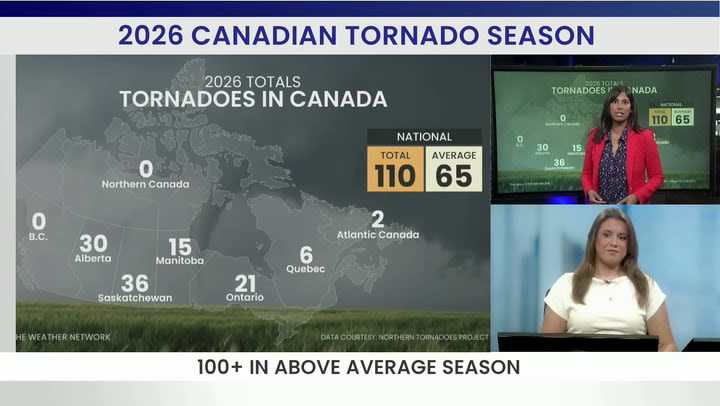
Breaking down canada's unusually busy 2026 tornado season
10 hours ago