
Saskatchewan experiencing less
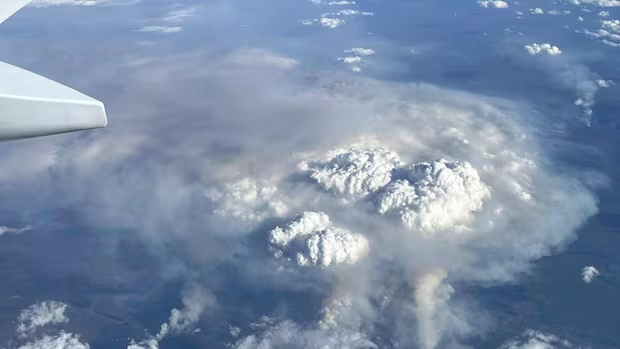
Saskatchewan experiencing less-severe wildfire season compared with 2025
Experts say high precipitation the reason for the difference
While Ontario is experiencing its worst wildfire season, Saskatchewan is breathing a sigh of relief.
This is a stark contrast compared with last summer, when the province was ravaged by major blazes.
Saskatchewan residents were on high alert as spring approached, an understandable reaction after fires in that province and Manitoba fires made up more than half of Canada's burned land last year.
This year is shaping up to be different.
The Canadian Interagency Forest Fire Centre says Saskatchewan has recorded 315 wildfires as of Thursday. The province had counted 447 wildfires as of Aug. 6, 2025.
This might not seem like a large decrease, but the major difference lies in the accounted area of forest consumed by the flames.
Experts say quieter wildfire season doesn’t mean Sask. is out of the woods
The interagency forest fire centre counted 2,554,382.7 hectares burned in Saskatchewan as of Aug. 6, 2025, compared with 291,654.8 hectares — nearly nine times less — by Thursday.
This difference is significant and is most likely due to the late precipitation the province saw last winter, according to Colin Laroque, a professor of environmental science at the University of Saskatchewan.
"It was hot and dry with no moisture last year. So, everything was ready to burn. This year, we had a relatively dry time, with no real snow and lots of melt in January and February. And then in April and May, that's when more of our snow came in…. And so, because we had the late snows, it made it difficult for fires to get started."
Saskatchewan experienced freezing rain and snow in May. This weather was frustrating for some, but it has proven to be beneficial for forest fire prevention.
While many parts of the province have benefited from the distribution of precipitation, the north remained dry, leading to the worst of the fires spreading across that area.
Bryan Chartrand, the Saskatchewan Public Safety Agency's general manager of field operations, says this year's fires are much more centralized than last year's.
These smaller concentrations have made the blazes easier to control, for the most part.
"We weren't overwhelmed with so many fires. The [precipitation] has improved the conditions in the forest. So, when a fire does start, it doesn't burn quite so aggressively and as quickly as we experienced last year," he told CBC reporters.
The rain has also helped with the number of fires started by humans. Chartrand says 129 fires that started due to human activities have been recorded this year, a notable drop from last year's 297.
Chartrand says firefighters haven't made major changes to their responses and strategies compared with last season but are trying line camping this year. That is when firefighters remain on the fire line overnight instead of travelling back and forth to base.
"Obviously, there are delays and logistical challenges when you're moving the staff back and forth. So, to improve efficiency and time on the line for suppression activities, we are camping staff out near the fires."
Laroque suggests Saskatchewan now experiences two forest fire seasons, with one beginning in March and extending until May, followed by a second season from July to August.
"Our climate was warming, especially in the winters, and we're getting a lot of warm periods…. And in the last five years or so, we started getting late falls. It was dry, and then the snow wouldn't come like we were used to it. And we were getting earlier and earlier hot, dry periods without any kind of snowpack."
The snow melts more quickly, and the soil dries out earlier in the year.
"We're set up perfect for a forest fire season," the professor said.
While Saskatchewan has been given a bit of a relief season this year, other provinces have not been as fortunate.
Ontario is currently experiencing its worst-ever wildfire season. British Columbia, Quebec and the Northwest Territories are also facing extreme wildfire damage and out-of-control flames.
Even with fewer fires in Saskatchewan this year, the season is not over, and firefighters are still hard at work battling the flames.
Hannah Scott is a journalist with CBC Saskatchewan. She has a bachelor's degree in Indigenous journalism from the First Nations University of Canada. Hannah can be reached at hannah.scott@cbc.ca
with files from Emmanuel Do Prado
Related Stories
 Canada
Trump selects Katie Zacharia as next White House press secretary
47 minutes ago
 Canada
How good is this year's flu shot? Here's what to know about flu season
47 minutes ago
 Canada
Workers rescued from Montreal highrise after platform malfunction
1 hour ago
 Canada
Poilievre shrugs off Musk's pro
1 hour ago
 Canada
Canadian woman who married ISIS fighter pleads guilty to terrorism charge
1 hour ago
 Canada
Thieves make off with tens of thousands of wine bottles worth millions
2 hours ago
 Canada
Farmers grapple with equipment damage and theft as ‘chaotic’ harvesting stretch hits
2 hours ago
 Canada
North Saanich athlete selected for Team Canada U18 softball team
2 hours ago