
Rubber mask helps to track cattle methane emissions in real time
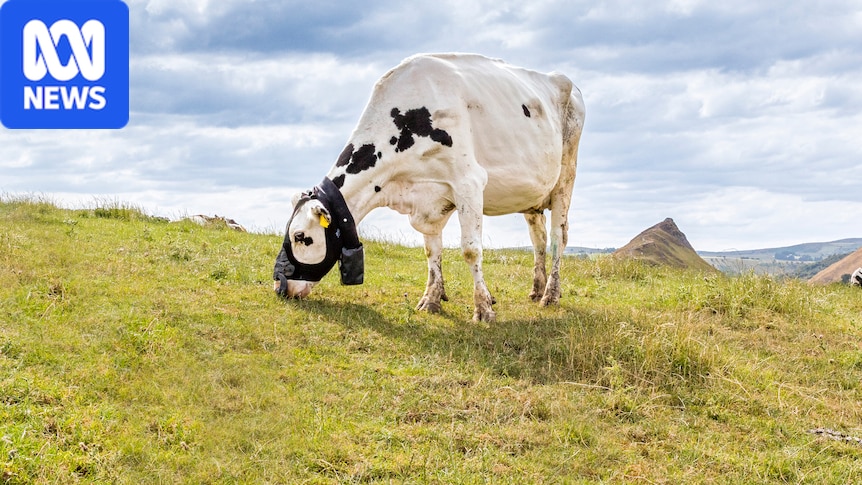
Wearable tech measures cattle methane emissions in real time
The "rubber sock" tracks the methane emissions of individual cattle. (Supplied: Zelp)
New wearable technology for cattle will allow farmers to track the animals' methane emissions in real time.
The CSIRO estimates that methane-producing animals contribute more than 10 per cent of Australia's total greenhouse gas emissions.
The new device may help the livestock industry to lower its emissions.
Australia's cattle industry is banking on new wearable technology to measure animals' methane emissions in real-time.
The wearable device for cattle continuously measures methane gas near an animal's nostrils and delivers data to users via a smartphone app in real time.
The ZELP Sense was developed with funding from the Global Methane Hub (GMH), an international philanthropic network focused on reducing methane emissions worldwide.
The device is effectively a rubber, waterproof sock that fits snugly to the animal's head while allowing cattle to continue eating and drinking normally.
Its backers hope it will assist farmers with monitoring and potentially working to reduce emissions from their herds.
The device is the latest new technology that aims to measure the emissions more accurately. (Supplied: Zelp)
"That sock holds a pick-up device, a nozzle basically, that is positioned above the nostril of the animal that samples the air that is coming out," GMH agriculture program director Hayden Montgomery said.
"It's the combination of the measurement of the concentration of the methane in the airflow as well as the rate of the airflow that gives us the ability to estimate the emissions on a daily or even hourly basis."
Mr Montgomery said it was an important tool in helping the livestock industry to demonstrate the steps it was taking towards reducing its greenhouse gas footprint.
"It gives us for the first time the ability to accurately measure emissions from grazing livestock at a cost that is not prohibitive, and without a lot of requirements for quite expensive laboratory equipment to analyse gas samples," he said.
Mr Montgomery said the system had been developed and tested through more than 20,000 hours of real-world use, backed by a growing trend towards climate-friendly meat.
"We see in the marketplace food companies increasingly interested in sustainable sourcing," Mr Montgomery said.
"Methane is growing in importance as part of that conversation."
The device has been funded by an international philanthropic network and delivers data to an app in real time. (Supplied: Zelp)
It is hoped this and other technologies on the market will help farmers validate mitigation techniques at scale, such as low methane genetics and feed supplements, to ultimately produce less methane.
The CSIRO estimates that ruminant animals, including cows, sheep and goats producing methane through digestion, are responsible for more than 10 per cent of Australia's total greenhouse gas emissions.
But methane emissions from livestock are challenging to quantify.
Asparagopsis is a genus of edible red seaweed that contains bromoform, which has been studied for its capacity to reduce methane emissions in livestock. (Supplied: Sea Forest)
Some other methane-detecting devices act as paddock "breathalysers", measuring gas in the animal's breath when cattle voluntarily walk into fixed feed stations.
In recent years, the cattle sector has also made efforts to reduce animals' methane emissions through diet, such as adding methane-reducing asparagopsis, a native Australian seaweed, to feed rations.
Industry wants clearer picture on methane
The Australian Climate Council points to agriculture and livestock farming as the largest single emitter of methane, with a 2023 report suggesting the sector is responsible for "nearly 65 per cent of the climate pollution from Australian agriculture".
But the livestock industry has long questioned the methodology of how cattle methane emissions are calculated, and believes the new technology will help paint a clearer picture.
Cattle Australia deputy chair Adam Coffey, who farms cattle in Central Queensland, said livestock emissions have historically been "lumped" in with energy and resources in the broader conversation around global warming.
"We know that livestock emissions are categorically different from your car's exhaust, and I think it's well and truly time that recognition was given," he said.
Mr Coffey said further investigation was needed to differentiate emissions from biogenic sources, like livestock, from thermogenic sources like coal seam gas.
Adam Coffey says discussion around cattle industry emissions needs to be reshaped. (Supplied: Adam Coffey)
"These devices will play their part in ascertaining exactly what our emissions are or aren't; hopefully this is where we get a bit smarter around how we do measure our livestock emissions," he said.
"We will continue to work and invest in how we reduce them, but we do need to understand that they are categorically different to how they've been historically framed.
"If you're looking at low methane genetics, then I guess a device like this would potentially play a part in trying to prove whether the change in management is actually having an effect or not."
Cattle industry figures hope the technology will help paint a clearer picture of the sector's overall contribution to emissions. (Twitter: @david_vacy David Williams )
Mr Coffey said this wearable device was just one example of the sort of "powerful tech" that was emerging to help producers make more sustainable management decisions.
Related Stories
 Technology
India Has 70 Lab
10 minutes ago
 Technology
Somalia and UNDP Strengthen Cooperation on Digital Government and Transformation
40 minutes ago
 Technology
Lee So
1 hour ago
 Technology
Beyond North Korea, Seoul’s spy law targets tech theft
1 hour ago
 Technology
How a startup is building drones, satellites in Noida
2 hours ago
 Technology
75 mini Indias' to be established in US within 5yrs: Indian populas in US rises 175% in 20 years; 'American...
5 hours ago
 Technology
Deep Tech and AI: 10 Startups Tackling Global Challenges With Market Execution
5 hours ago
 Technology
Heidi and SiteHive among 15 winners at the Startup Daily Best in Tech Awards 2026
7 hours ago